)
)
How Kepler made every AI answer traceable to a primary source, powered by Quartr
Kepler is the verifiable AI platform for financial research, used by analysts at hedge funds, PE shops, and investment banks to run research and build models on companies they cover. The team, built by ex-Palantir engineers, set out to solve the central problem financial services firms face with their current set of AI tools: they can’t trust or audit the numbers.
Kepler solves this with unique architecture that separates what AI does from what code does. Claude interprets the analyst's question while deterministic code retrieves the underlying data and runs the calculations. A proprietary financial ontology mediates between the two, so the language model and the retrieval layer speak the same vocabulary of companies, filings, line items, and events. The model never touches the numbers, and Kepler returns a cited, traceable answer in seconds, every time.
To power that, Kepler required a trustworthy source for everything public companies say and publish: earnings calls and IR materials. That verification bar every data source has to clear before it gets wired into the platform was cleared by Quartr.
"We needed transcripts and IR materials we could trust without re-validating every line. Quartr was the only option that let us hold our verifiability standard across earnings content without building a scraping or transcription operation ourselves."
– Vinoo Ganesh, founder & CEO at Kepler AI
One primary-source layer
Financial research almost always means manually reading across document types, because each one carries a different part of the story. The reported numbers live in the filing, the reasoning behind those numbers shows up in the earnings call, and the framing management chose to lead with appears on the slides.
Pulling only one leaves the answer incomplete, and stitching multiple vendors together introduces seams in latency, formatting, and coverage that show up the moment an analyst clicks through to verify a citation.
By consolidating transcripts and IR materials through the Quartr API, Kepler gained a single integration and a consistent quality standard across more than 15,000 companies. Transcripts, slide presentations, and related events were all linked through the same event identifiers, eliminating the fragmentation that comes from stitching together multiple vendors. The result was faster, more reliable retrieval – powered by the industry's fastest transcript delivery times.
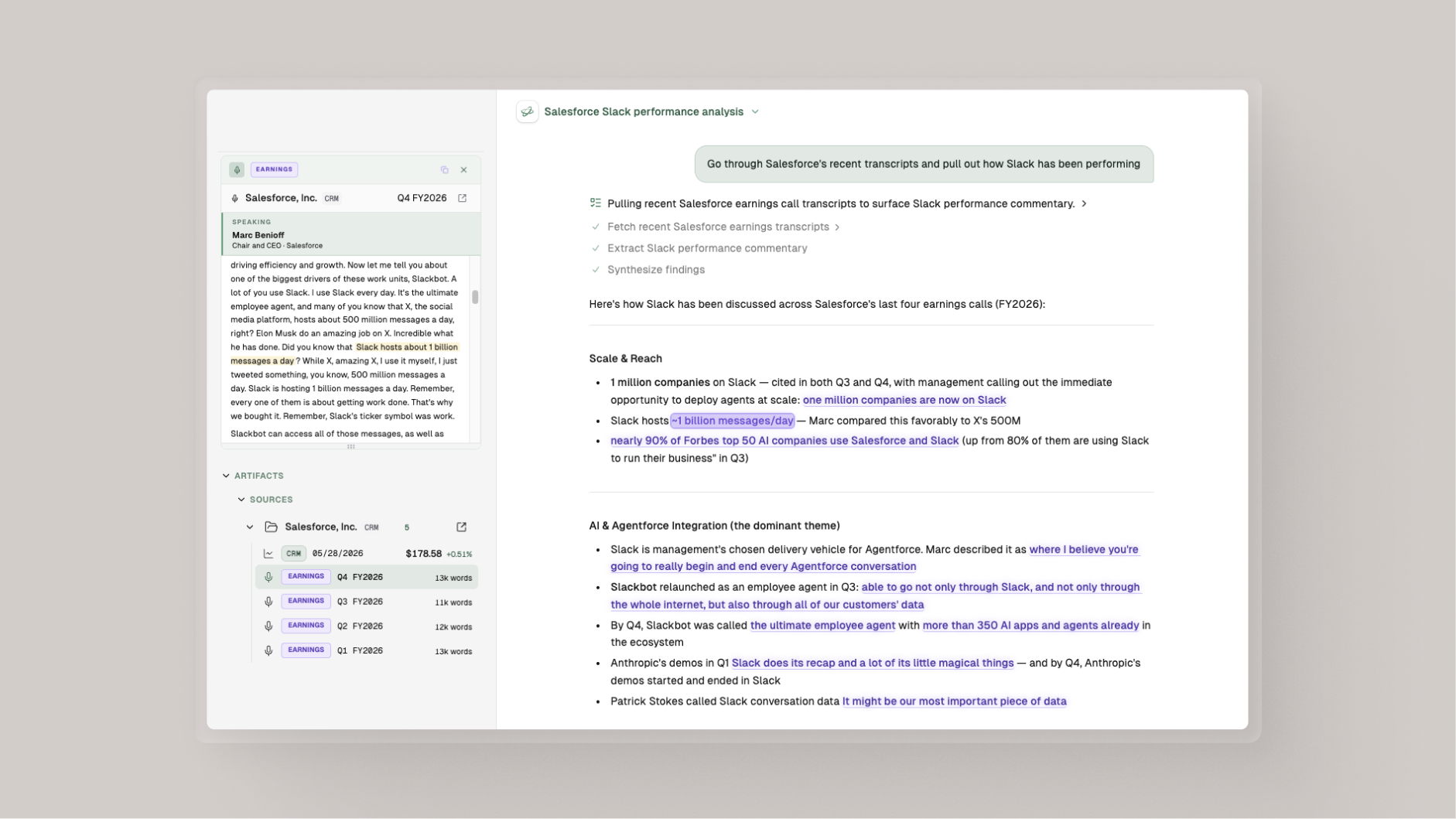
How Kepler uses Quartr
Kepler pulls transcripts and slide decks from Quartr continuously across all covered companies. Quartr delivers 90% of post-event transcripts within 40 minutes of public availability, and 90% of slide presentations within 30 minutes. Structured data is extracted once and reused across every user query, so analysts never wait on a fresh fetch when they ask a question.
When a user asks a question tied to an earnings event, Kepler's agents fan out and pull from the relevant SEC filing, the Quartr transcript, and the Quartr slide deck for the same reporting period in parallel. The agents then read across all three sources to produce a single cited answer.
Every claim is fully traceable: numbers link directly to the relevant line in the filing, management quotes jump to the exact passage in the transcript with speaker identification, and slide references point to the precise phrase on the page where it appeared. That last point matters. Phrase-level citation inside a slide deck, not just page or document-level citation, is what transforms "trust me" into "verify it yourself," without forcing the analyst to do the digging.
The 10-K tells you what happened. The earnings call tells you why and what's next. We can't credibly help our analyst customers without both, and Quartr is how we get the second half at the quality bar our users expect.— John McRaven, CTO at Kepler AI
What Kepler needed from Quartr
To meet the bar of getting included in Kepler’s platform, Quartr had to deliver on several high bar requirements.
The first was coverage that matched Kepler's universe. Hedge fund and PE analysts don't cover only one market, so Kepler needed transcripts and IR materials across the full set of companies its users follow, with the same quality bar everywhere. Quartr meets that with 15,000+ covered companies across 65 markets and an average of 6.5 years of historical event coverage (7.8 years in the U.S.).
The second was structured data rather than raw documents. Kepler's deterministic retrieval layer needs JSON transcripts and parsed slide content with consistent identifiers (CIQ tickers, ISIN, QuartrID) across every dataset, which means reliable joins between a transcript and the corresponding slide deck happen out of the box. No intermediate parsing, transcription, or OCR layer to build and maintain.
Delivery had to hold through earnings season. During peak weeks, hundreds of companies report in a span of days, and a source that lags or drops events forces Kepler to either delay answers or surface incomplete ones, both of which fail the verification bar. Quartr backs uptime and delivery with contractual SLAs rather than the "best effort" most data vendors offer, which is the predictability Kepler needs to keep the platform answering through the busiest reporting weeks.
Verifiability as a product principle
Kepler's thesis, which partners like Anthropic and Parallel share, is that AI in finance only becomes useful when it becomes verifiable. Confidence without citation isn't enough. Analysts need to be able to click through every claim and see the source themselves, and that principle is only as strong as the primary-source layer underneath it.
With Quartr providing all IR material from public companies through a single API with shared identifiers, contract-backed SLAs, and accuracy benchmarks measured in WER rather than promises, Kepler can apply the same verifiability standard across every document type its users encounter.
From Quartr's side
"Financial AI has had a foundational problem from day one. Earnings calls, transcripts, and filings – the primary inputs in company research – were built for humans to read one at a time, not for AI to query across thousands of companies. Kepler is one of the sharpest teams we've seen building on top of Quartr API, turning clean, first-party IR data into analyst workflows that are trustworthy and fully verifiable. We're proud to be the infrastructure they're building on."
– Oscar Küntzel, Co-founder & CEO, Quartr
Quartr powers four of the five largest hedge funds globally, several leading asset managers with over $1.5T in AUM, and two of the four largest global banks, alongside platforms like Perplexity and two of the Magnificent Seven for mission-critical financial data use cases.
What this changes for the analyst
A buy-side analyst preparing an earnings preview used to spend hours reading the last several quarters of transcripts and decks alongside the filings, building a mental picture of what management has said, what they've changed, and where the numbers line up or don't. On Kepler, the same analyst gets a cited synthesis back in under a minute, with every figure linked to its filing line and every quote linked to the exact passage in the transcript or slide. The hours that used to go into the document scavenger hunt go into judgment instead.
What this means for enterprise buyers
The architecture Kepler has built – language model for reasoning, deterministic code for retrieval and calculation, ontology in between – points to where AI in regulated industries is heading. Any domain where an answer has to trace back to a primary document has the same foundational requirement: a primary-source data layer that holds up under scrutiny. That's the bar Quartr is built to meet, and it's why teams like Kepler build on it when verifiability isn't optional.