Marlboro is one of the most recognizable brands in the world. Despite being a product that cannot be advertised across much of the globe, it has remained the best-selling cigarette brand for decades. But it didn't begin with the Marlboro Man. The brand started as a struggling women's cigarette, complete with a colored filter meant to match the smoker's lipstick. What followed was one of the most impressive rebrandings in business history. Come with us to Marlboro Country.
Philip Morris: the early years
In 1847, a London tobacconist named Philip Morris opened a small shop on Bond Street, selling hand-rolled cigarettes sourced from Russia, Turkey, and Egypt. At the time, tobacco smoking was already well established across Europe, primarily through pipes and cigars. Cigarettes, however, were only beginning to spread, influenced in part by practices from the Ottoman Empire.
After Morris died in 1873, the business passed to his widow and brother, who continued operating under the family name. Over time, the business expanded beyond the shop into a portfolio of branded cigarettes, including Cambridge, Oxford Blues, and Derby, distributed through a growing network of retailers. Like much of the industry at the time, Philip Morris primarily targeted male smokers. But within its portfolio sat one exception: Marlborough – a brand positioned toward women.
Mild as May
After decades of building its tobacco business in the domestic British market, Philip Morris expanded abroad, establishing a New York subsidiary in 1902 to bring its brands to the U.S. Over the years that followed, the American business developed into a more independent operation, increasingly shaped by local consumer preferences.
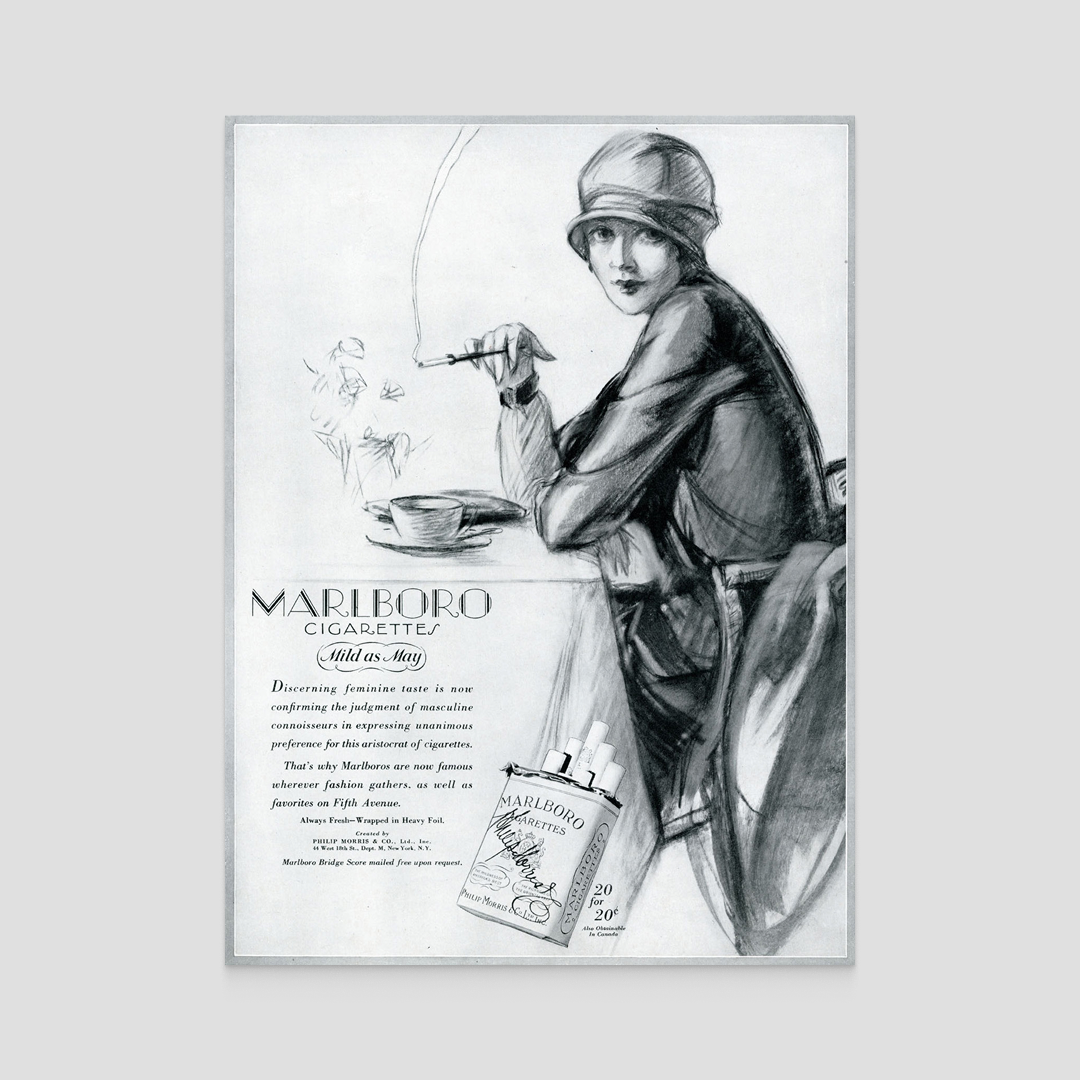
In 1924, Philip Morris Americanized the brand and launched Marlboro in the U.S., marketing it to women through magazines and newspapers. Smoking cigarettes had long been popular among men, but the roaring twenties brought with it many changes. Most interestingly for Philip Morris, it was becoming socially acceptable for American women to smoke. The relaunched brand, now with American spelling, moved early to capture the opportunity.
The campaigns featured fashionable women smoking elegantly, positioning the cigarette as “Mild as May” with the slogan “Always Fresh – Wrapped in Heavy Foil,” alongside copy that framed Marlboro as a symbol of social status.
One of the first Marlboro ads after its U.S. launch in the 1920s.
While the marketing material soon extended beyond Fifth Avenue to “on the beach and at casinos,” it was far removed from the masculine imagery of the Great Plains that would come to define the brand a few decades later.
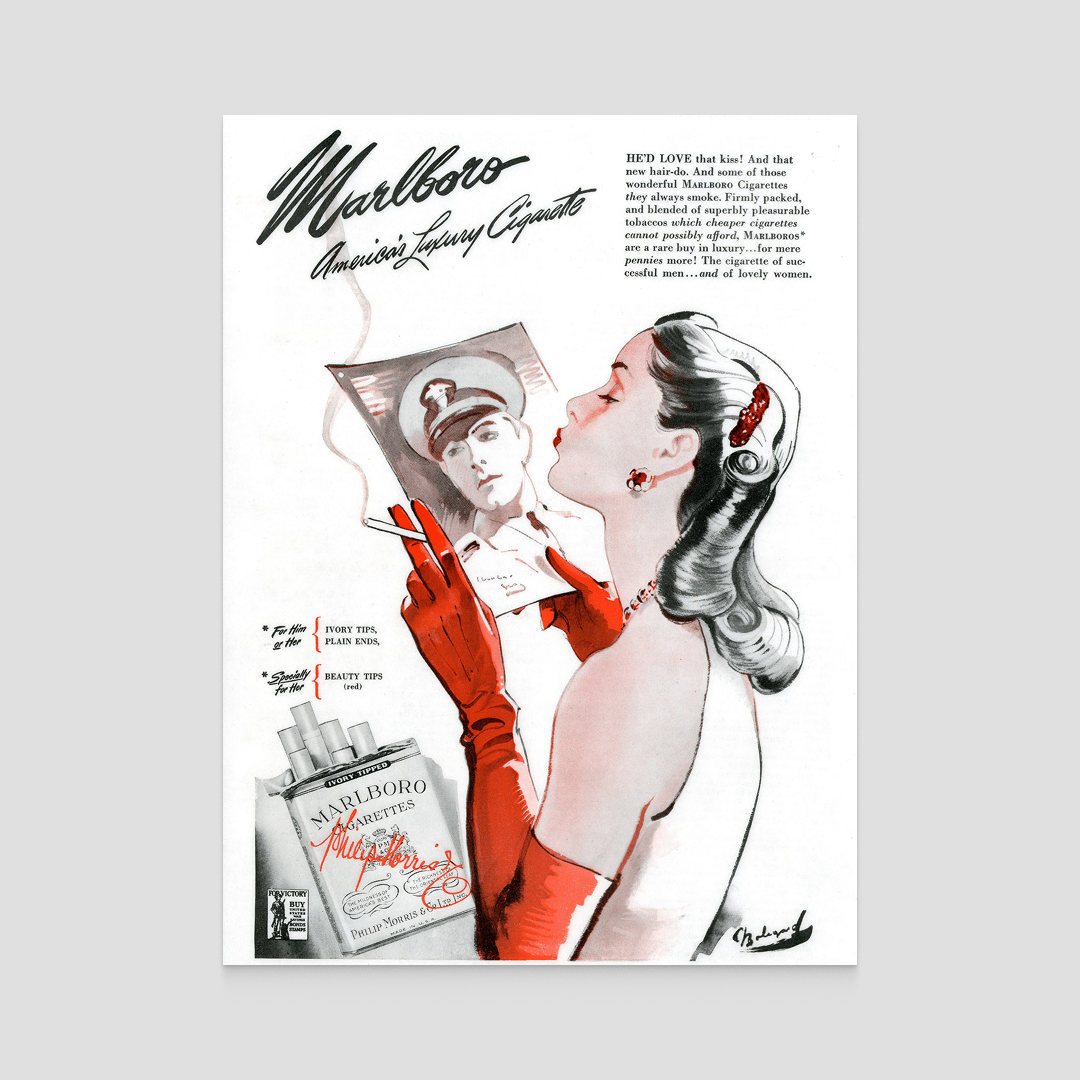
It wasn't just the setting that made the positioning distinctly feminine. Marlboro also marketed its filtered cigarettes with “Ivory Tips” that “protect the lips.” In the years that followed, this evolved into “Beauty Tips,” featuring red ends designed to prevent lipstick marks while matching a woman's lips and nail polish.
Marlboro's, available with ivory tips or beauty tips.
While dominant brands such as Camel, Lucky Strike, and Chesterfield focused almost exclusively on male smokers, Marlboro set out to capture a segment they largely overlooked. The strategy might have made sense, but its narrow focus proved limiting, with sales falling short of expectations through the late 1920s and into the 1930s.
World War II proved to be the final blow. Cigarettes had long been embedded in military life, and the war only strengthened their association with masculine identity. As millions of soldiers returned to civilian life, they carried that habit with them. Marlboro had no credible claim on that territory, leading sales to collapse and the brand to be pulled from shelves entirely.
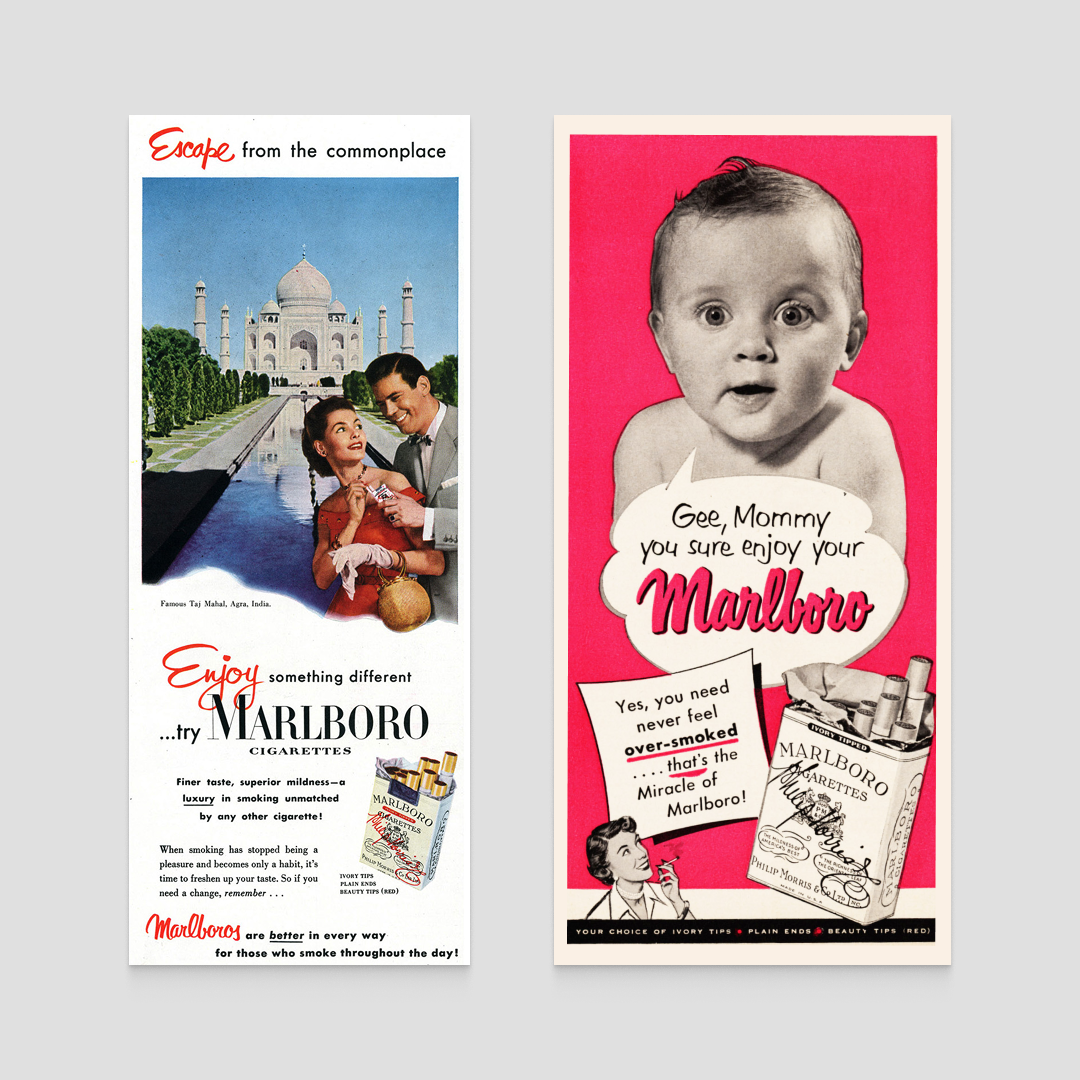
By the early 1950s, Marlboro reappeared with attempts to broaden its appeal. In the “Escape from the commonplace” campaign, the brand highlighted its taste and (alleged) mildness through imagery of global landmarks and the line “Enjoy something different.”
Two (failed) Marlboro campaigns of the early 1950s.
Coinciding with this, the brand also used its “healthier” positioning in a campaign with the slogan: “Yes, you need never feel over-smoked … that's the miracle of Marlboro!”, targeting parents through children. One of these ads read: “I should say not! My Dad would never smoke anything but a Marlboro”, insinuating its own image as something that men would only smoke in secret. The image that Marlboro wasn't for men would soon change.
Despite these efforts, by 1954, Marlboro held just 0.25% of the U.S. cigarette market. Yet its product, particularly its filter, would soon give it an unexpected opportunity.
Sign up for Edge
Get curated quality company deep dives every other week.
Enter Leo Burnett
The filtered cigarette had been on the U.S. market for years, but by the early 1950s it was gaining popularity after long being stigmatized and associated with women. Among many male smokers, it was seen as an adulteration that diluted the experience. A man who smoked a filter was either concerned about his health, which was viewed as a sign of weakness, or unable to handle a “real” cigarette.
But as studies increasingly linked smoking to lung cancer, some of that resistance began to shift. While most smokers weren't ready to quit, many were seemingly ready to reconsider what they smoked. In 1954 alone, filter cigarette sales tripled across the U.S., driven by growing publicity around the health risks of smoking. Philip Morris, through Marlboro's existing filter, saw an opportunity.
Marlboro's aforementioned attempts to broaden its appeal in the preceding years had failed, and it was still widely perceived as a women's brand among those who even recognized it. With virtually no presence among male smokers and a firmly feminine image, reinforced by details like its ivory tips, Marlboro wasn't an obvious candidate to capture the emerging market for filter cigarettes.
Yet that lack of recognition also presented an advantage. Without a meaningful market share to defend, the brand had little to lose and nothing to dismantle. Rather than build something new, Philip Morris could reshape what already existed.
After consulting outside specialists, including research experts Elmo Roper and Louis Cheskin of the Color Research Institute, the company arrived at a conclusion Marlboro's own history had already demonstrated: the emotional response triggered by a package transfers directly to the product inside. For decades, Marlboro's brand, image, and packaging had done exactly that.
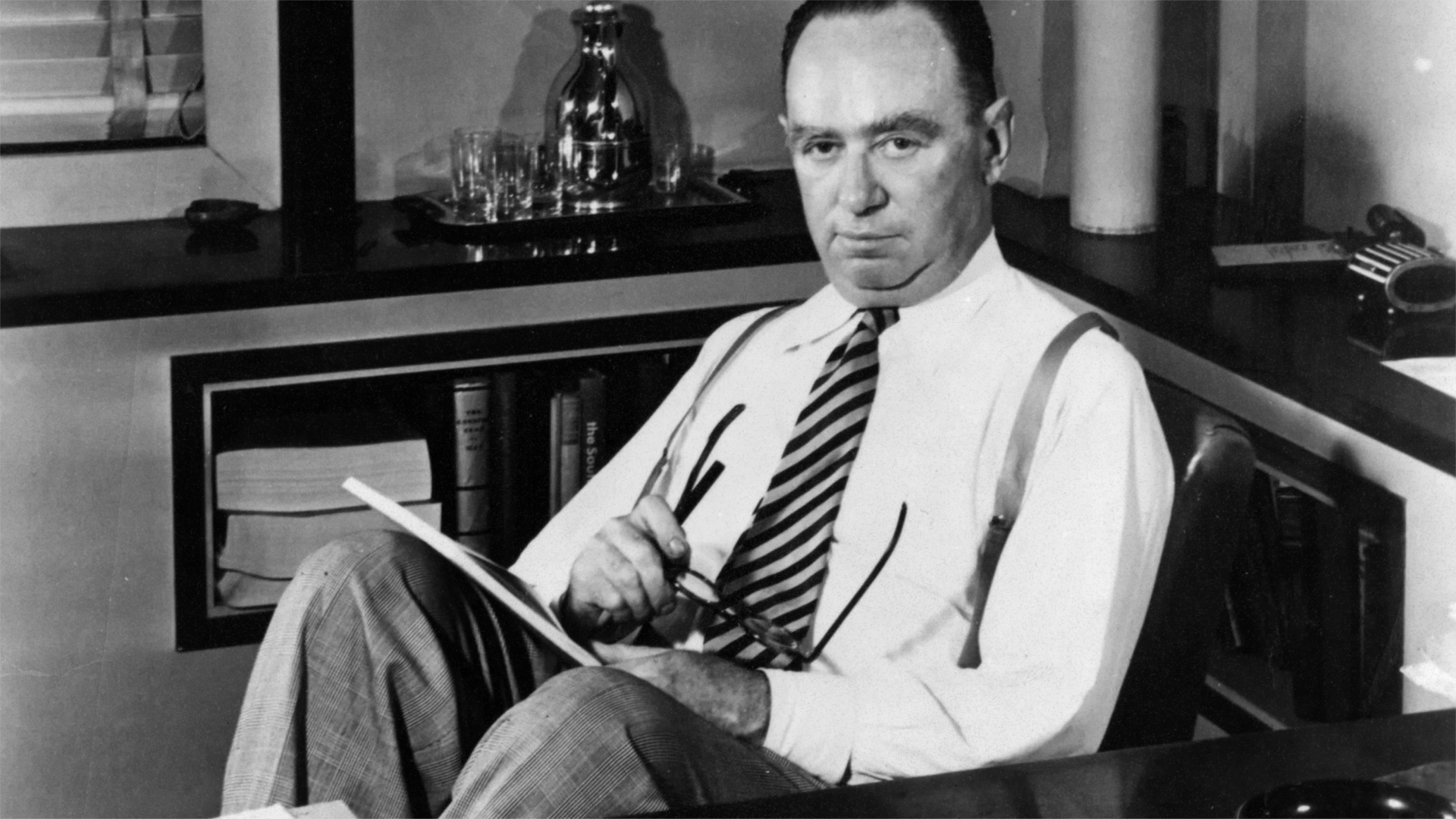
Sensing it would need an entirely new positioning, Philip Morris moved the advertising account to Leo Burnett. His Chicago-based agency had built a reputation for developing enduring consumer brands, with campaigns such as the Jolly Green Giant and Tony the Tiger. Unlike the product-claim advertising that dominated the cigarette industry, Burnett's approach stood apart, centering on emotional branding.
Leo Burnett, the architect of Marlboro's rebranding.
Product, packaging, and positioning
What Leo Burnett and his team had to position was a new tobacco blend – a “recipe,” as the company called it – that Philip Morris believed could reach well beyond Marlboro's former audience. Where the old Marlboro had been mild by design and feminine by association, the new one offered a more distinct flavor.
Its “Selectrate” filter, made of cellulose acetate, was considered highly effective while preserving the flavor. Crucially, it didn't get between the smoker and the tobacco. The cork-patterned tip replaced Marlboro's earlier ivory design, giving the cigarette a less refined appearance. As Burnett put it: “There was nothing sissy about it.”
But it wasn't just the cigarette itself that was redefined. Philip Morris introduced the flip-top box, a firm cardboard construction that kept cigarettes from crushing, and maintained the same “freshness” in the first as the final cigarette of the box. It was the first real change in cigarette packaging in decades, and it immediately gave Marlboro something visible and tangible that no competitor had.
With the package structure in place, the team tested different visual designs to strengthen the image. Eventually, they settled on a look that conveyed masculinity and translated well to black-and-white television, while retaining continuity through the red color previously used on Marlboro's cigarette tips. Throughout, Burnett understood that the package carried as much meaning as the cigarette itself. As he explained in The New Yorker in 1958:
“Outside the clothes and jewelry you wear, a cigarette package is your most frequently exposed possession. Every time you expose it, it says something about you. Marlboro says, we believe, that while you want a highly effective filter and a mild combination of the world's finest tobaccos, you don't smoke just because of habit but you know and appreciate good tobacco flavor.”
Together, the new blend, the filter, and the flip-top box amounted to a fundamentally different product from the one that had spent decades failing to find an audience. The product problem had been solved. What remained was the image. On January 7, 1955, in a letter to Philip Morris advertising director Roger Greene, Burnett outlined the task ahead:
"The job of Marlboro advertising is to take a new popular-priced filter cigarette with an old luxury cigarette name and give it a personality and a reason for being that will make it stand out among all the brands in a chaotic and fast-growing field.
Since Marlboro is going to be Philip Morris & Company's major entry in the popular-priced filter field, the advertising must stand out and be remembered in a field distinguished by conflicting and very similar claims."
Burnett's conclusion from Roper's research was direct: emphasizing filter technology would only reinforce the anxiety it was meant to ease. Smokers didn't want to be reminded of health risks each time they lit a cigarette. The answer was not to argue that filters were safer, but to make them irrelevant, to present Marlboro as a cigarette defined by its flavor. As he recalled later in 1958:
“It didn't take any motivational research or psychological seance to decide that the best way to sell the new Marlboro was to present it for what it really was – a filter cigarette with a full, honest flavor that could satisfy a man who was a regular smoker. In other words, a man's filter."
He continued:
“We asked ourselves what was the most generally accepted symbol of masculinity in America, and this led quite naturally to a cowboy.”
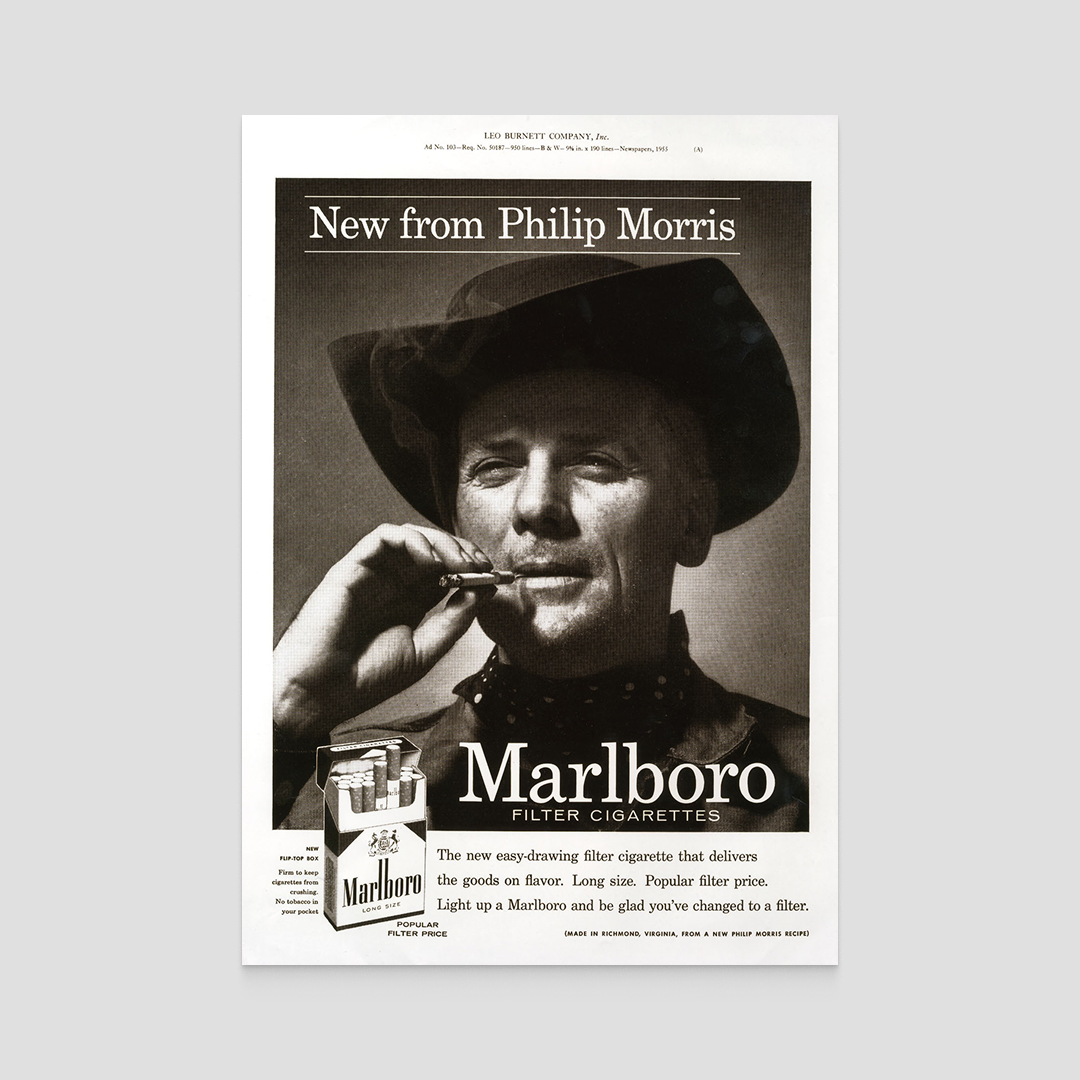
The campaign that redefined Marlboro.
The most masculine symbol
When the first Marlboro ads – featuring figures that would later evolve into the Marlboro Man – launched nationally in early 1955, the cowboy was already a dominant figure in American popular culture. The Life and Legend of Wyatt Earp and Gunsmoke both launched that same year, joining The Lone Ranger and a broader wave of westerns that had been building on American television since the early 1950s. The rough, self-reliant cowboy had long stood as a symbol of rugged masculinity, and Philip Morris and Leo Burnett had just placed a Marlboro between his fingers.
When Clint Eastwood rode across the screen to the music of Ennio Morricone in Sergio Leone's films of the mid-1960s, the cowboy archetype would reach its most iconic expression. But by then, Marlboro had already spent years building its identity around that image.
In complete contrast to its past as “Mild as May”, the rebranded Marlboro ads rolled out across television, print, and billboards. They showed a man no one would question, smoking a cigarette that, by association, became unquestionable itself. The introduction was clean and confident, as Burnett described:
"We are out to capture a major share of the filter cigarette business and first impressions are as important to advertisements as they are to people. … We want to look and sound like a confident leader."
At Burnett's recommendation, the ads carried the line “New from Philip Morris,” signaling a break from what came before while borrowing credibility from the company behind it. The inclusion would add what Burnett described as a sense of authenticity: “That it's made by a reputable manufacturer” (Kufrin, 1995).
The campaign saw immediate success, with Marlboro becoming the number one brand in the New York market just 30 days after its introduction. Following the initial cowboy ad, known as “The Sheriff,” Burnett and Marlboro expanded to other masculine figures later that same year.
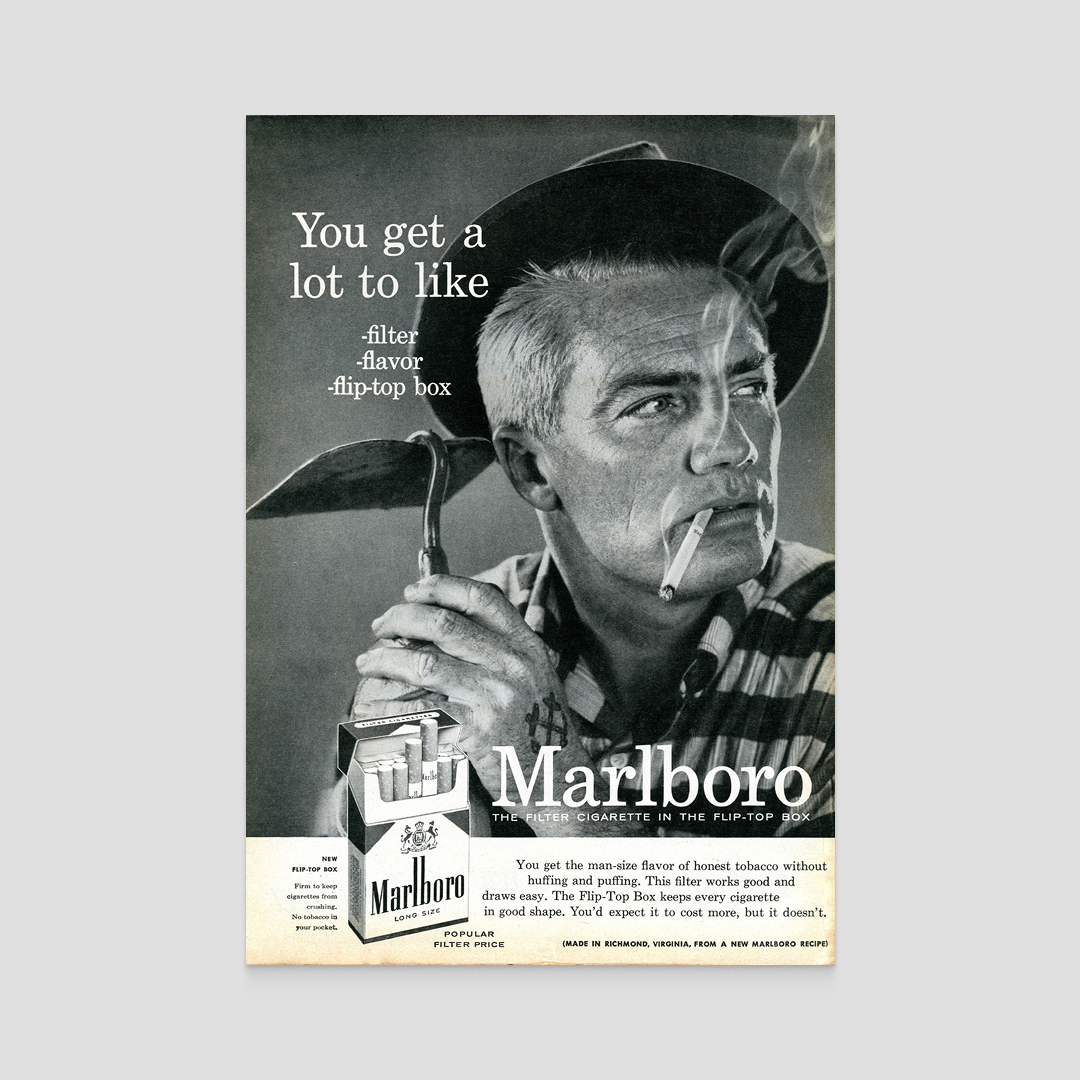
The campaign featured sailors, sea captains, pilots, weightlifters, war correspondents, scientists, and farmers, alongside the slogan-turned-jingle: “You get a lot to like with a Marlboro – filter, flavor, flip-top box.” Rather than using professional models, the agency took a more straightforward approach and cast men who embodied what Burnett described as “masculine confidence”:
“We shunned slick professional models, so familiar in cigarette advertising, as well as testimonials. Among our own friends and acquaintances, however, we found men who typified what has been referred to as 'masculine confidence.'”
A common feature among these figures was the presence of a small, weathered tattoo on their hand, used to reinforce their masculinity. Combined with their rugged appearance, the tattoo helped create the image of a man who had lived an eventful life and could be trusted to know what cigarette to choose.
“To many women, we believe it will suggest a romantic past. This almost sounds as though Dr. Freud were on our Plans Board. He isn't. We've been guided by research and old-fashioned horse sense.”
– Leo Burnett, the philosophy of the new Marlboro advertising (1955).
Alongside the cowboy came a cast of masculine archetypes across professions.
Demand quickly outpaced production, and remained strong because, just as Marlboro knew, the smoke matched the commercial promise of the slogan: “Delivers the goods on flavor.” While the campaign was aimed at men, its appeal extended beyond them. The Burnett agency sensed that women often gravitated toward what they perceived as a man's cigarette, and early results reflected that.
Another layer soon followed through television advertising. Singer Julie London, described at the time as “one of the most beautiful women in America”, appeared in a nightclub setting, singing the slogan “You get a lot to like with a Marlboro”, while sliding a cigarette from the box toward the man sitting across from her. The message required no explanation: smoke Marlboro, and a woman like Julie London might find you worth her attention.
Where there's a Man … there's a Marlboro.
Breakout and resistance
The numbers tell the story of the years that followed. From 18 million cigarettes in 1954 and a market share of 0.25%, Marlboro sold 6.4 billion in 1955, 14.3 billion in 1956, and 19.5 billion in 1957. By then, it was selling three times as many cigarettes in a single day as it had in the entire year before the rebrand. By 1958, with the addition of a soft pack alongside its flip-top box, the brand was selling 20.7 billion, reaching a 4.5% share of the U.S. market.
A year earlier, Marlboro, along with the rest of the industry, had faced increasing scrutiny that pushed many brands to pivot. U.S. public health authorities, including the Surgeon General, began linking excessive cigarette smoking to lung cancer, followed by a Reader's Digest article showing that most filters delivered little or no meaningful protection.
With scientific consensus still forming and regulation limited, the industry had considerable freedom in how it presented its products. Brands had long used this lack of knowledge to position certain cigarettes as “healthier,” but as evidence began mounting, many of these shifted toward competing aggressively on filtration. So-called “Hi-Fi” cigarettes became the focus of advertising, with health claims at the center. Kent promoted “real health protection,” Viceroy claimed “double-barreled protection,” and L&M described its filter as “just what the doctor ordered.”
During these years, cigarettes were repositioned as technical solutions to a health problem, reducing the product to its filter and the smoker to a patient. Hi-Fi brands were engineering their cigarettes to deliver less tar, less nicotine, and inevitably less flavor. A high-filtration cigarette was, by design, a diminished one.
Marlboro had been built on a different premise. Its filter was designed not to get between the smoker and the flavor. While competitors leaned into health claims, Marlboro held its position: a smoker shouldn't have to sacrifice flavor to smoke a filtered cigarette. Improvements to the filter and the blend were made quietly, marked only by a change in the pack's crest from gray to gold. The brand itself did not shift, but stayed focused on flavor and masculinity.
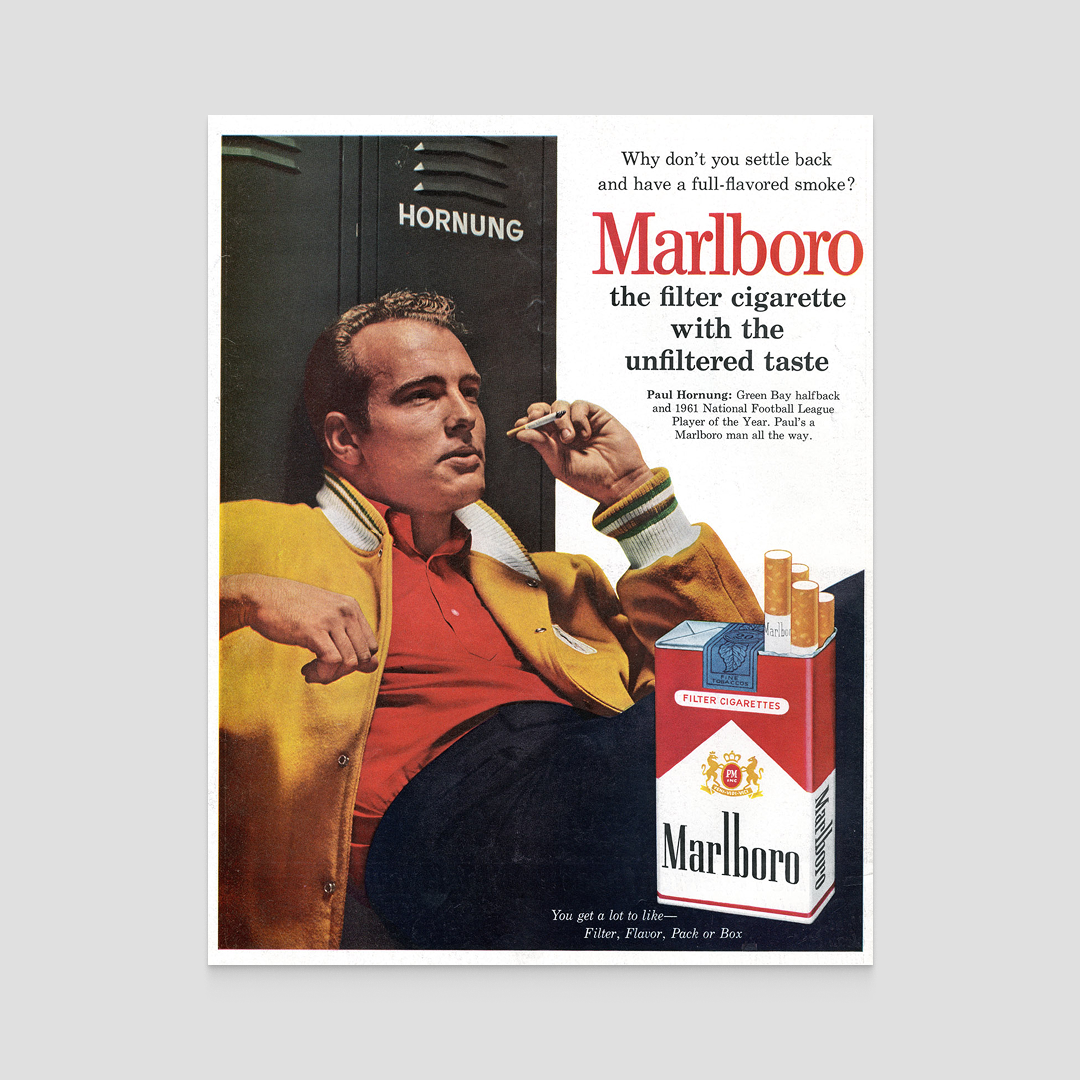
Through the late 1950s and into the early 1960s, the campaign continued along two tracks. The cowboy remained central, but Marlboro expanded its cast of masculine figures to include athletes alongside its tattooed working men. National commercials featured the top football and baseball stars, carrying the same confident and steady tone: “Why don't you settle back and have a full-flavored smoke?”
Green Bay Packers halfback, Paul Hornung, in an early 1960s campaign.
Growth continued, but at a more measured pace. A more informed consumer and intensified competition following the 1957 reports reshaped the market. From 1957 to 1961, Marlboro's cigarette sales climbed from 19.5 billion to 24 billion. The brand continued to gain share, but the explosive growth of the rebrand had passed.
What didn't change was the core symbol. The cowboy remained at the center of the brand, consistent through shifting market conditions. For its next phase, Marlboro would double down on him, the figure that had driven its initial success.
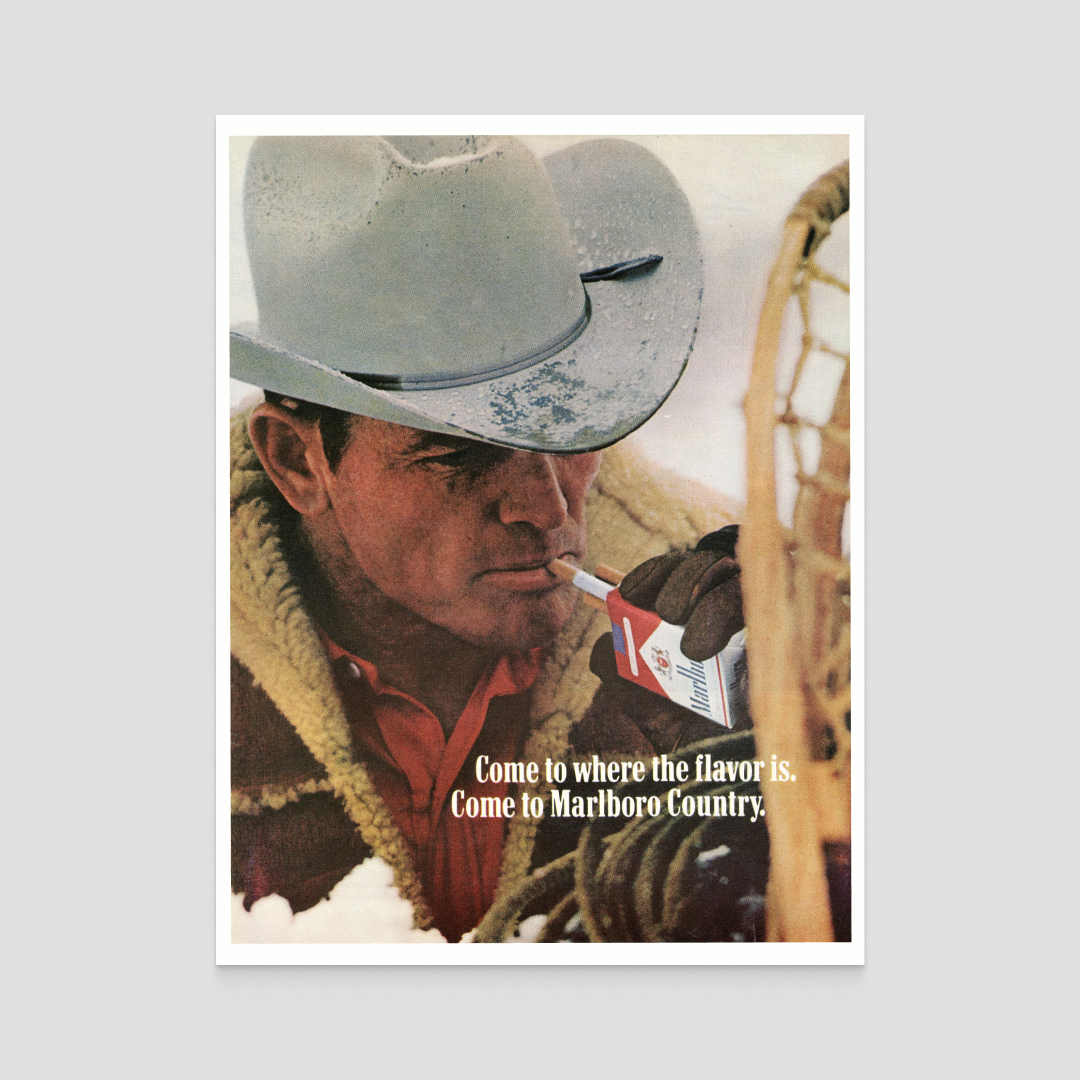
Come to where the flavor is. Come to Marlboro Country.
The Marlboro Man
In 1963, Marlboro, together with the Burnett agency, launched a campaign that would define the brand for decades. Built around the American cowboy in the vast landscapes of the West, it introduced a line that would become one of the most recognized slogans in advertising: “Come to where the flavor is. Come to Marlboro Country.” The cowboy had a world of his own; he was its embodiment, and that world was Marlboro's.
One of the most successful campaigns of all time.
America in the early 1960s was a country undergoing change. A series of political assassinations, the Vietnam War, and increasing social tension all contributed to a complex period of growing division and uncertainty. Marlboro Country offered something simpler, a place of nostalgia, independence, and clarity. The campaign felt distinctly American and built on the themes of the 1950s.
Similar to the casting in previous years, the Burnett agency took a distinct approach. In the first commercials featuring the man who would become the Marlboro Man, it initially used models, but quickly sensed that they lacked the authenticity and ruggedness that had defined the rebrand. Instead, Marlboro began recruiting real ranchers to play the role of cowboys riding across the American West, brewing their morning coffee, and lighting a cigarette with a focused expression on their faces.
But Marlboro Country wasn't limited to the open plains. Cowboys appeared against the backdrop of the Golden Gate Bridge, at Yankee Stadium, and various other recognizable American settings. Wherever men smoked for flavor, the brand suggested, that was Marlboro Country. Still, its natural setting remained the open landscape of the American West, a focus that became more pronounced over time.
The now-legendary campaign lasted for years and extended across television, magazines, billboards, and radio. Building on earlier audio elements such as the Julie London jingles, Marlboro expanded its themes with a significant addition that further developed the Marlboro Man and Marlboro Country. In 1960, the Western classic The Magnificent Seven premiered in the U.S., with its signature theme by Elmer Bernstein leaving a lasting impression in American theaters. By 1963, Marlboro had acquired the rights and began using it across its advertising, reinforcing the tone and identity of the campaign.
Go beyond numbers
Quartr Pro is the leading platform for qualitative public market research. Research faster, understand deeper, and trust every finding.
After the slower years around 1960, Marlboro's growth accelerated throughout the remainder of the decade with the introduction of the Marlboro Man and Marlboro Country. From 24.8 billion cigarettes sold in 1962, the brand closed the decade at 44 billion in 1969. By 1970, its share of the U.S. market had reached 10%. While Marlboro continued to feature other masculine figures in its advertising, they gradually receded as the Marlboro Man became the defining symbol of the brand.
Marlboro cigarette sales from the 1954 rebranding to 1969.
One assumption might have been that Marlboro's focus on masculinity limited its appeal to men. In practice, the opposite proved true. The brand's associations of self-reliance, openness, and pride in something distinctively American resonated across genders. By 1980, more than a third of Marlboros were smoked by women, a result of the broad success of the campaign and brand.
Marlboro says, we believe, that while you want a highly effective filter and a mild combination of the world's finest tobaccos, you don't smoke just because of habit but you know and appreciate good tobacco flavor.— Leo Burnett
As Marlboro's success expanded through the 1960s, opportunities emerged to extend or adapt the brand in line with broader consumer trends. But Philip Morris' response remained consistent and disciplined, just as during the height of the Hi-Fi promotions. Rather than reshape Marlboro to reach new audiences, it launched new brands and introduced line extensions while preserving Marlboro's core identity: its positioning, its imagery, and the cowboy.
Virginia Slims, introduced in 1968, reflected the former approach. Marlboro Menthol (1966), Marlboro 100s (1967), and Marlboro Lights (1971) reflected the latter. The brand grew without altering the elements that had defined its success.
“Marlboro was our first. A full-flavor cigarette whose personality has grown richer through the years and has grown consistently from the full-flavor base from which it was established.”
– Ross Millhiser, 1969, then-President of Philip Morris USA.
That discipline, which had deepened trust in the Marlboro brand, would prove especially valuable from 1971 onward. In January of that year, Congress banned cigarette advertising on American television and radio. For brands still early in their development or lacking a coherent strategy, the impact was severe.
Marlboro's position was different: a decade of consistent imagery had produced a visual identity so complete that it no longer depended on any single medium to continue along the same trajectory. The open landscape, the cowboy, and the red-and-white pack no longer needed video, narration, or a jingle to reinforce the brand.
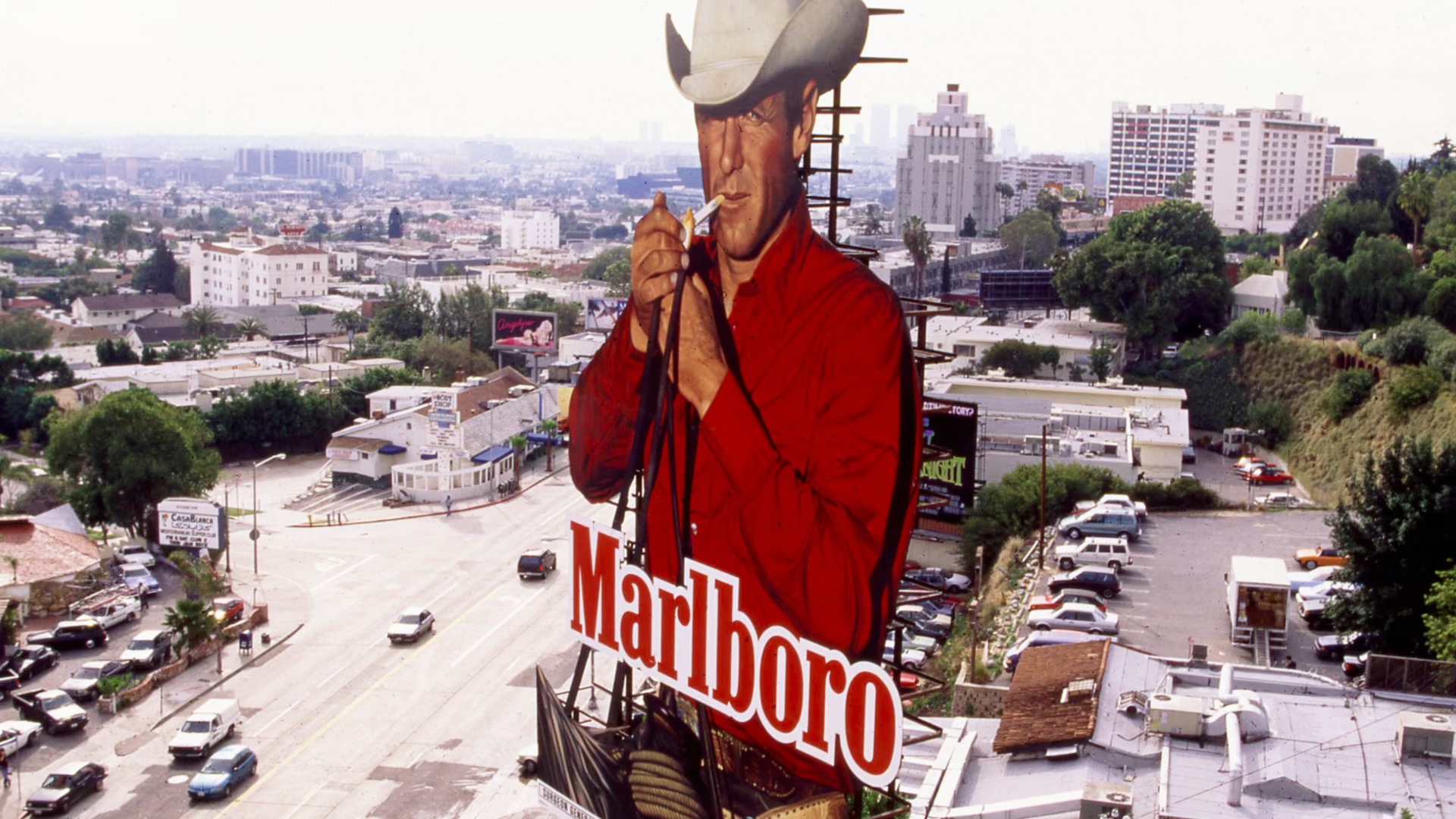
A Marlboro Man billboard, unmistakable in its simplicity.
The highway billboard evolved into one of Marlboro's primary channels, and its mature brand translated naturally to that simpler canvas: a single image, often paired with only a few words, visible to drivers across the country. The ban, which constrained the industry and raised the barrier for new entrants, strengthened Marlboro's position.
An American icon
By 1980, one in five smokers in the U.S. smoked Marlboro. A few years earlier, it had already become the world's best-selling cigarette brand. Formally, that position came from a rebrand. In practice, it was closer to a creation. What replaced the original Marlboro was built almost entirely from scratch, and the momentum leading into the 1980s only continued in the decades that followed.
The making of Marlboro's dominance in the U.S. cigarette market.
Its success rested on a combination of factors explored throughout this story. Product, packaging, timing, but above all, on a campaign that was carefully constructed around a deep understanding of the consumer. Working with Leo Burnett, Marlboro committed fully to a single image and repeated it until it became inseparable from the product itself. Over time, the Marlboro Man became synonymous with smoking. The longevity of that image helps explain the paradox of a product that can no longer be advertised across much of the world, yet remains one of the most recognized brands.
While much of Marlboro's early growth was domestic, its international expansion followed at a similar, if not faster, pace from the 1960s onward. Timing played a key role. During these years, the United States emerged as a global superpower, shaping a culture that people around the world aspired to be part of. Smoking Marlboro offered a connection to that culture, much like drinking Coca-Cola, eating McDonald's, or watching Westerns from Hollywood. American culture, packed in a flip-top box.
Closing thoughts
Marlboro has remained the world's best-selling cigarette brand ever since it reached the top spot in the 1970s. Today, Marlboro sits within a broader portfolio under Philip Morris International and Altria Group, alongside brands and products introduced over time to reach different preferences. But still, the brand's core identity has remained largely unchanged. Even as global smoking rates have declined and as regulations have increasingly limited how it can be marketed, its associations have endured. True to the same recipe that defined its rise, Marlboro lives on.
)
)
)
)
)
)
)
)