)
)
)
)
)
Edge3 May 2024
Microsoft's Journey to Becoming the World's Most Valuable Company
Explore Microsoft's rise from a garage startup to the world's most valuable company, highlighting Bill Gates' role in shaping the digital revolution.
If you grew up in the 21st century, there's a good chance you've committed crimes across Los Santos and Vice City, pulled off heists with Michael or Tommy, and spent countless hours cruising streets listening to Chatterbox FM. The company behind all of that acquired its way into relevance, nearly collapsed, was remade after a boardroom coup, and grew into one of the most disciplined hit-makers in entertainment. Today, it houses Grand Theft Auto, Red Dead Redemption, 2K's sports titles, and Zynga's mobile empire. That company is Take-Two Interactive.
November 19, 2026.
Everyone with the slightest interest in gaming knows precisely what will happen on that date, and what they'll spend the following days doing. That has little to do with what they've actually seen of the coming release, and everything to do with what's come before it.
Over more than two decades, the world's most recognized gaming studio has produced a body of work that built a model and then kept reinventing it. Through immersive worlds and narratives approached with the authorial voice of a film studio, Rockstar turned its releases into cultural events. That's why expectations for what comes next are sky-high.
Beneath the title and the studio sits one of the world's largest gaming companies, housing the studios that build its games and the labels that publish them. Take-Two Interactive's portfolio spans blockbuster console franchises, annual sports titles, and one of mobile gaming's largest publishers. Soon, that portfolio will also include Grand Theft Auto VI.
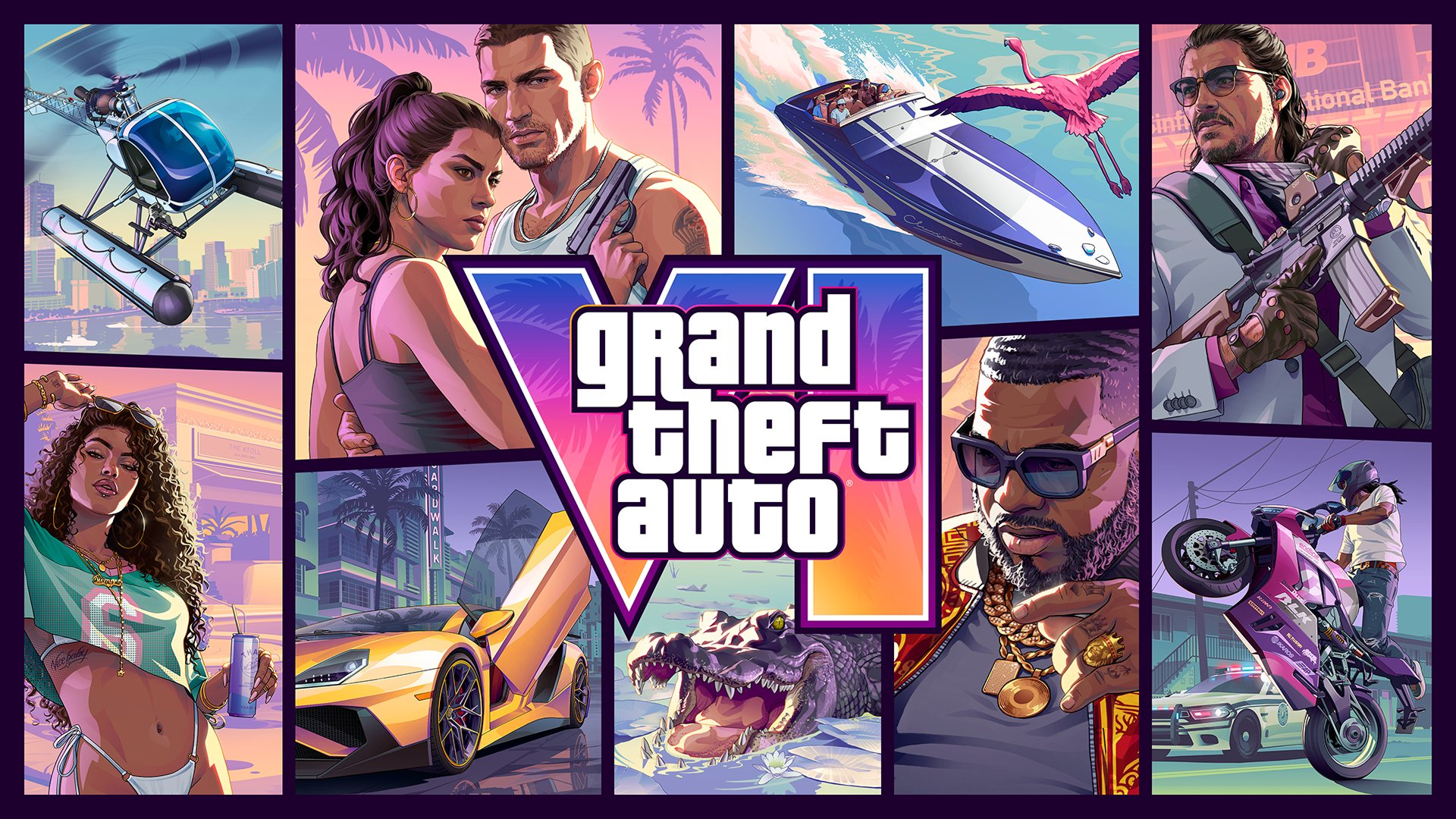
To understand why a release matters this much, and how the studios, labels, and a boardroom takeover assembled the group that exists today, we need to go back to where it all started.
We begin this story with Ryan Brant, the son of publisher, industrialist, and art collector Peter Brant. After graduating with an economics degree from the University of Pennsylvania's Wharton School in 1992, Brant joined his father's illustrated-book publishing company as chief operating officer. But within his first year, he had already decided to pursue a different path: "I wanted to get into a business where I could raise capital as a younger guy. In technology people expect you to be a younger person." (Forbes, 1996).
Backed by family and a group of private investors, Brant incorporated Take-Two Interactive in September 1993. The company's early years were those of a small publisher and distributor operating at the fringes of the PC and console gaming market, financing and releasing games made by others, signing distribution agreements, and building the infrastructure needed to get those games onto retail shelves.
With a few smaller hits in its first years, the company had grown its annual revenue to around $10 million. Brant knew the next phase of growth would come through acquisitions, and to finance that strategy, he took Take-Two public on the Nasdaq in April 1997.
Most of the acquisitions that followed were distributors, giving Take-Two greater control over how its games reached retailers. At the same time, the company signed publishing agreements with Sony, Nintendo, and Sega, expanding the platforms its titles could reach while searching for its next opportunity.
That opportunity arrived in early 1998. At the time, it didn't look like much, but it would become one of the most consequential acquisitions in the history of the video game industry.
The German media conglomerate Bertelsmann, owner of BMG, one of the world's five major record labels at the time, launched a video game publishing division in the mid-1990s. That division, BMG Interactive, had recently published Grand Theft Auto, developed by the independent Dundee-based studio DMA Design. During its first months on the market, the game had generated strong sales across Europe while using the debate surrounding its violent gameplay to generate publicity.
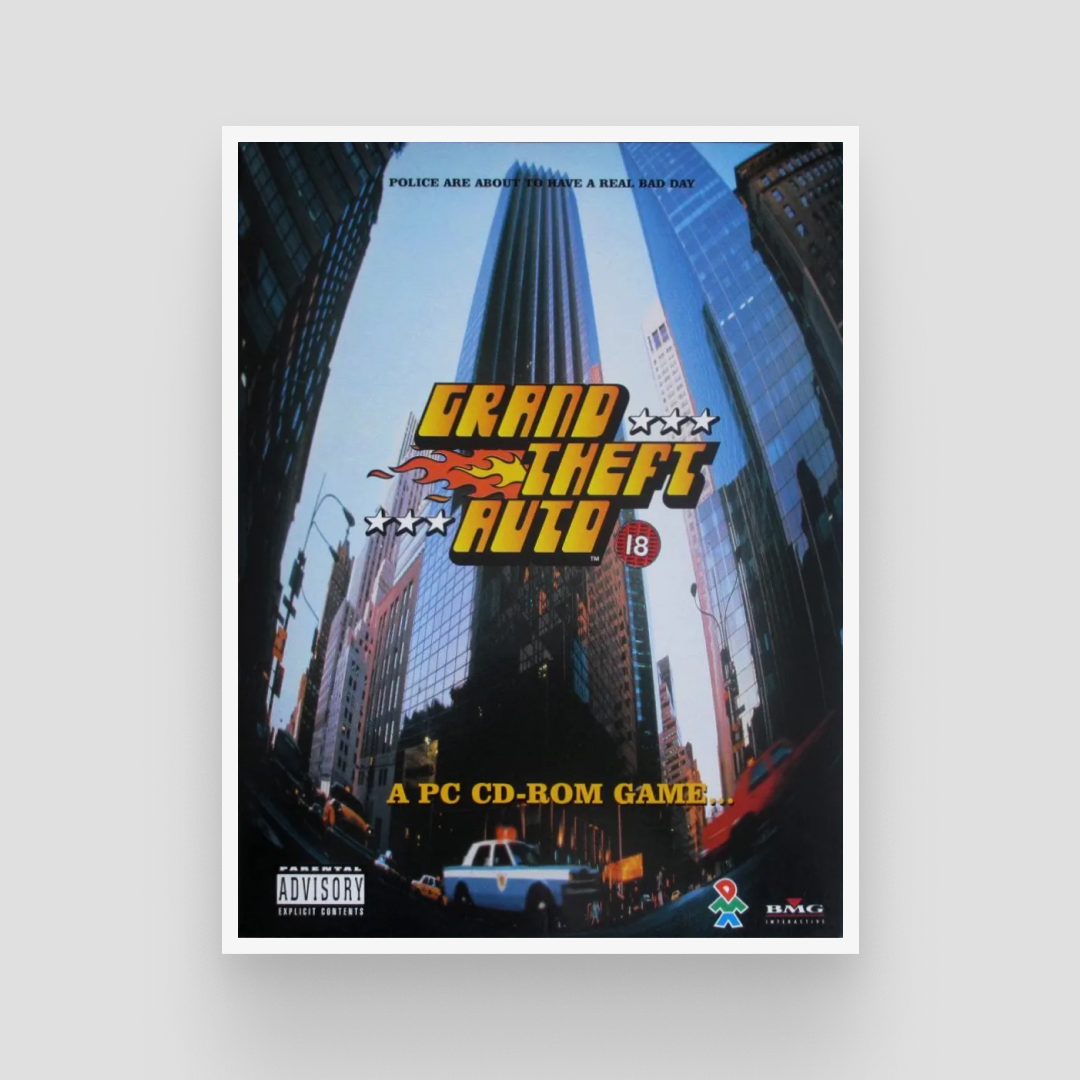
But BMG was a small division within a much larger organization, and the long-term potential of video game publishing wasn't obvious to everyone. Bertelsmann ultimately concluded that BMG Interactive lacked the scale and strategic importance of its core music business and put the division, including its games and distribution operations, up for sale.
Where Bertelsmann saw a non-core asset not worth holding onto, Brant saw it differently. He was convinced that there was great potential beyond (or in part, thanks to) the controversy surrounding GTA. In March 1998, Take-Two acquired BMG Interactive for $14.2 million in stock.
The acquisition gave Take-Two a portfolio of games and distribution rights, but in the bigger picture, the asset that mattered was Grand Theft Auto. The game dropped players into a top-down criminal world of stolen cars, hired hits, and police chases, and was unlike anything else on the market.
The acquisition also brought in the people who would shape Take-Two's future. Among them were brothers Sam and Dan Houser, who over the following decades would form one of the most successful creative partnerships in video game history. Brant recognized both the team's talent and Grand Theft Auto's potential in the U.S., and brought them to New York to establish a new publishing label within Take-Two. In December 1998, they founded Rockstar Games.
By then, Grand Theft Auto had already been on the North American market for a few months and, much like in Europe, attracted both criticism and strong sales. The following year, Take-Two moved to close the gap left by the BMG deal, acquiring DMA Design, the studio that had developed the game.
Take-Two now controlled the entire chain behind the promising asset: the studio that made it, the label that published it, and the distribution that got it onto shelves. In October 1999, it released Grand Theft Auto II, which quickly became the company's best-selling title to date.
But it was the next installment in the series that would be the bigger leap. Grand Theft Auto III broke from its overhead-view predecessors when it was released for Sony's new PlayStation 2 in 2001, dropping players into a fully three-dimensional city. They were now free to follow the story or ignore it entirely, cruising the streets, running from the police, or simply seeing how much chaos they could cause before getting caught or killed.
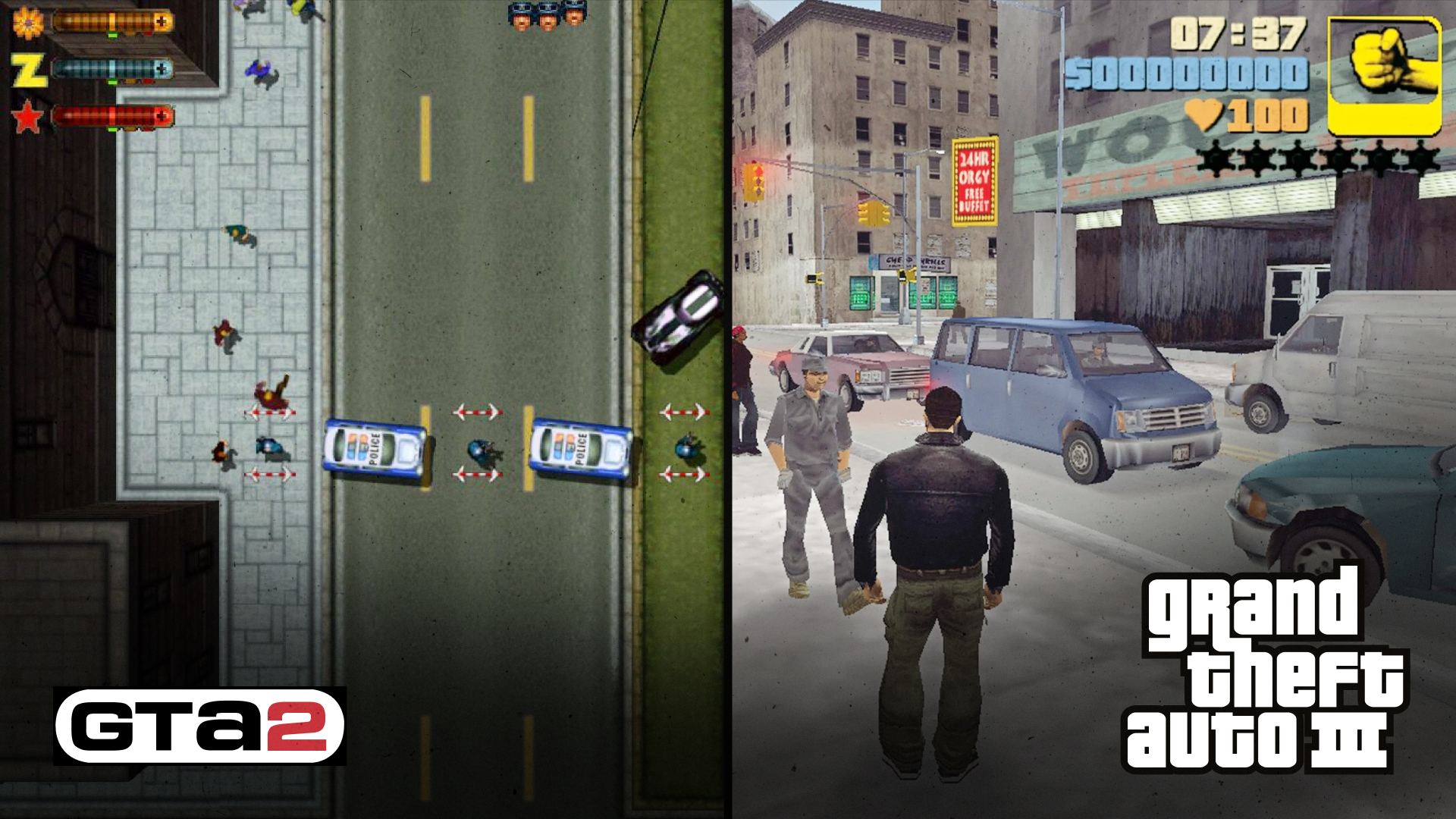
The shift to a fully realized open world was revolutionary. Rather than guiding players through a linear sequence of levels, GTA III gave them the freedom to interact with the city on their own terms. That design would shape the franchise for the decades that followed and become the blueprint for an entirely new genre of games.
Equally important was the game's depth. GTA III had layer upon layer of content, where players could spend days exploring a world rendered in extraordinary detail, constantly discovering something new. Its story mode took it to an additional level, with a plot and mission structure that aimed for cinematic crime drama rather than the disposable stories typical of games at the time. Players followed the silent protagonist Claude through the criminal underworld of Liberty City, a fictional version of New York introduced in the first game.
Though the protagonist never spoke, the game gave players hours of radio to fill the silence while driving the city streets. Multiple stations, each with its own curated mix of music and satirical talk shows, gave Liberty City a sense of a real place with a distinctive vibe. The soundtracks and radio stations remain among the series' most original features to this day.
Rockstar built on that foundation a year later with Grand Theft Auto: Vice City, set in a fictional version of Miami. This time, the protagonist, Tommy Vercetti, was voiced by actor Ray Liotta, bringing a deeper feel to the story. Conversations became richer, characters more memorable, and the narrative moved closer to the authorial voice of a film studio. Through these, the thoughtful conversations gave the characters identities and, by that, created a bond with the players. After spending hours completing mission after mission, you felt a connection to Tommy and were deeply invested in his conflicts.
Inspired by The Godfather, Scarface, Goodfellas, and Miami Vice, these narrative features explain why the franchise succeeded in the first place and why it grew into something closer to cultural legend, rather than just another video game. Creative freedom was central to that. The talent Rockstar assembled in these early years – including writers Dan Houser and James Worrall, producer Leslie Benzies, art director Aaron Garbut, and others – was given the room to express themselves fully.
The games' violence continued to spark controversy, but that was only part of the story. What truly set Grand Theft Auto apart was how immersive it felt. That became the foundation of one of the most influential franchises in video game history.
Get curated quality company deep dives every other week.
By outward appearances, and across parts of its portfolio, these were years of incredible momentum. Following GTA III and Vice City, Rockstar released GTA: San Andreas in 2004, a bigger, deeper, and more ambitious game than its predecessors. San Andreas, set in three fictional versions of Los Angeles, San Francisco, and Las Vegas, and infused with the culture of 1990s West Coast hip-hop, continued pushing the franchise further into the cultural mainstream.
But Take-Two wasn't only building hits in-house. In 2001, Rockstar brought Remedy Entertainment's Max Payne to consoles, then took over as full publisher for its sequel, Max Payne 2: The Fall of Max Payne, in 2003. Beyond Rockstar, Take-Two continued to broaden its portfolio in the years that followed. In 2005, it acquired Visual Concepts and Kush Games from Sega, bringing the studios behind NBA 2K into the company and forming the 2K label around them. Later that year, it acquired Firaxis Games, founded by Civilization creator Sid Meier, adding one of PC gaming's most respected strategy franchises. While Rockstar remained the company's core asset, these acquisitions gradually reduced its dependence on a single series.
Beneath the surface, however, Take-Two was in serious trouble. As early as 2001, complaints emerged that the company's reported earnings did not align with sales figures tracked by industry researchers. The SEC ultimately concluded that Take-Two had inflated revenue by recognizing sales to distributors even when those products could be returned, effectively pulling roughly $60 million of future revenue into the present.
In 2005, Take-Two agreed to pay a $7.5 million penalty, while Brant and other executives paid additional fines. Brant had already stepped down as CEO and was later barred from serving as an officer or director of a public company.
The accounting scandal coincided with another crisis. Also in 2005, hidden sexual content was discovered in San Andreas' code. The material, later known as Hot Coffee, was inaccessible during normal gameplay but could be unlocked through user-created modifications and, after being discovered, was posted online. For a franchise that had long attracted criticism over its violence, the discovery opened the door to an even broader public backlash.
The response was immediate, with legal action, retailers pulling the game off shelves, and the age rating being changed. Take-Two ultimately released a patched version, settled class-action lawsuits, and absorbed both the financial and reputational damage.
The founder was gone, executives and the chairman were under indictment, and government investigations were underway. Take-Two had spent years trying to become more than a one-franchise company, and pieces of that ambition would eventually prove their worth.
But at that moment, it was all about Rockstar. The label had, almost single-handedly, kept the company relevant and solvent through a decade of mismanagement. GTA was the reason anyone cared about Take-Two at all and the reason anyone wanted to fix it.
Before the story continues, it is worth pausing on a name that played a part earlier but has been unmentioned thus far. When Bertelsmann decided to exit the video game business in 1998 and sell BMG Interactive, one executive argued forcefully against the decision. His name was Strauss Zelnick.
Zelnick had joined BMG Entertainment as president and CEO of its North American division in 1995, bringing with him a background of leadership roles across music and gaming. With his experience, he had pushed BMG into interactive entertainment in the first place, and continued to follow that venture closely and with great optimism. When Bertelsmann unexpectedly decided to exit the business, he fought the decision all the way.
“I couldn't have protested more but, at the end of the day, I had a boss,” he told Music Business Worldwide in 2018. Zelnick left BMG in 2000, having watched the company sell Grand Theft Auto and the team behind it for a price that would soon look like one of gaming's great bargains.
Rather than joining another large media company, Zelnick founded Zelnick Media Capital (ZMC), a private equity and management firm focused on media and entertainment turnarounds. Through ZMC, he developed a relationship with Carl Icahn, advising him on a number of investment opportunities over the years.
Then, in early 2007, as Take-Two's troubles became public, Icahn called and asked what he thought of the company. Speaking on the David Senra podcast, Zelnick recalled concluding that Take-Two was a "disaster," likely heading toward bankruptcy within months. His recommendation to Icahn was simple: stay away. Some time later, Icahn called again. Zelnick's team took another look. The conclusion hadn't changed.
Then Icahn called a third time, and this time, he told Zelnick to read the company's bylaws.
What Zelnick found when he read the bylaws was an unusual provision. If holders of a majority of shares signed written consents to replace the board, the board could be removed on the spot. Over the past several years, the Brant family had sold all of its stock, and with the price in freefall, Take-Two's ownership had fallen into the hands of multiple hedge funds. Frustrated with the company's performance, many wanted new leadership.
ZMC had neither the capital nor the ambition to acquire Take-Two outright; its business was turnarounds and managing companies on behalf of investors. Replacing the board, rather than purchasing the company, offered a path that aligned with both ZMC's model and the interests of Take-Two's largest shareholders.
Together with his team, Zelnick approached as many investors as he could without triggering SEC disclosure requirements. In the run-up to the vote, the team had gathered only 48% of the shares. It wasn't enough. Game over.
But just as the takeover appeared to have failed, Zelnick's partner, Ben Feder, found another provision in the same bylaws. At the annual shareholder meeting, any shareholder could raise their hand and call for a vote on a new board slate, even if the matter had not been placed on the agenda in advance. If a majority of the shares physically present voted in favor, the takeover succeeded.
When the annual meeting convened on March 29, 2007, the vast majority of the company's shares were in the room. After the proposal reached 88% in the provisional voting, it passed, and the board was replaced.
That same day, Strauss Zelnick was elected chairman of Take-Two Interactive, with Ben Feder taking the role of CEO. Not a single dollar had changed hands, and neither the board nor management had seen it coming.
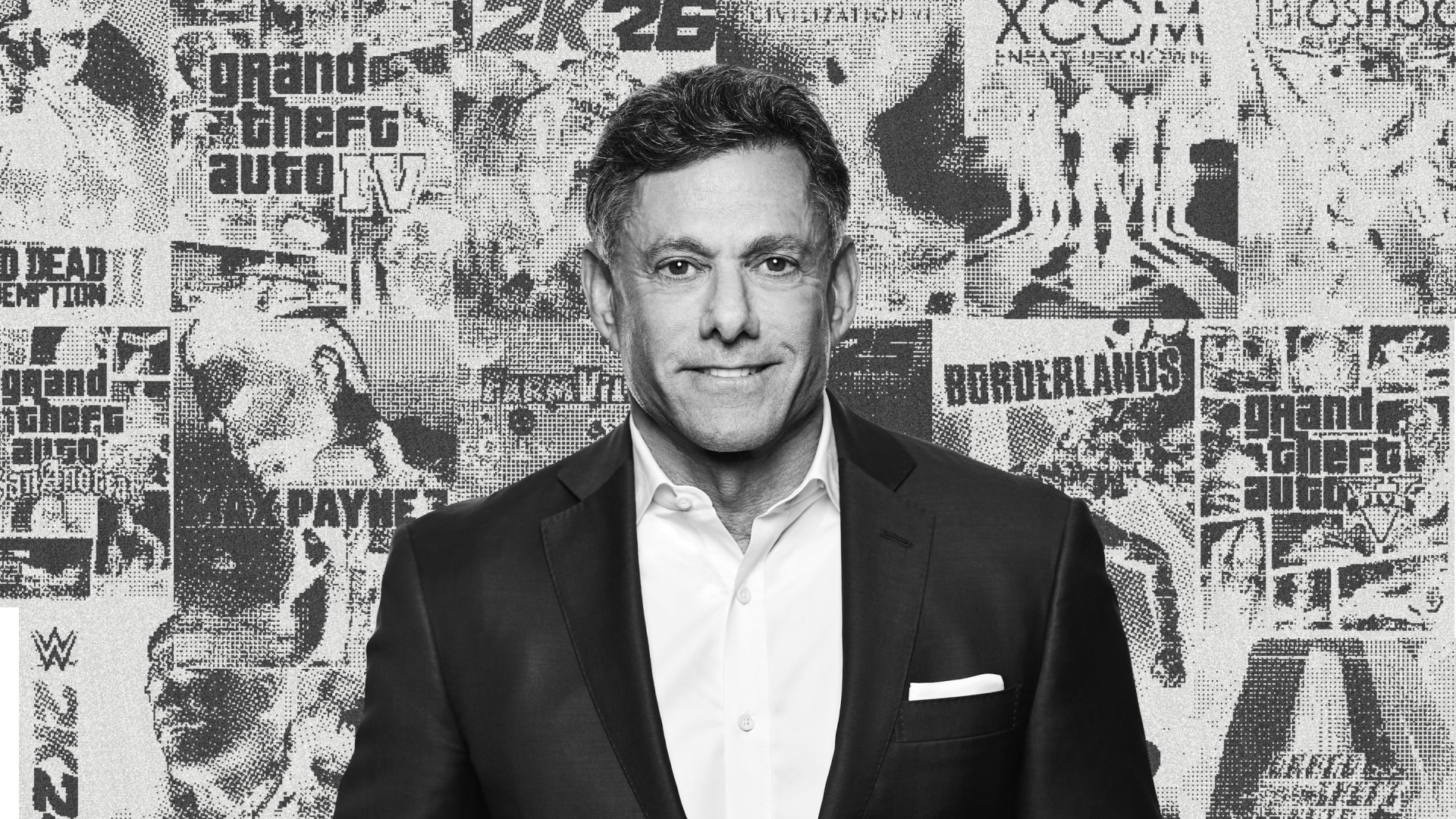
Under Zelnick, Take-Two would eventually look less like a gaming company and more like an entertainment empire. But that was still years away. The company he and Ben Feder took over was still, at this point, a mess. Zelnick recalled the state of the business in 2007 on the David Senra podcast: "Terrible company, terribly run. Every decision they made was horrible."
As mentioned earlier, the only real reason for the takeover was Rockstar and the GTA series. The first priority for the new management, however, was to right the ship. The plan was straightforward: cut costs, protect the studios, support creative teams with the financial resources and patience they needed, and rebuild the balance sheet over time. It would take years, but it would work.
Just as the company was beginning to take its first steps under the new leadership, EA signaled that it saw the value of the assets beneath the struggle. In February 2008, the gaming giant offered to acquire Take-Two for $2 billion, a premium of more than 60% over Take-Two's stock price. With the release of GTA IV approaching a couple of months later, Zelnick and Take-Two declined, declaring “the price is not right and the time is wrong” (Reuters). Over the following months, EA would extend its tender offer five times before withdrawing it entirely in September 2008.
GTA IV launched that April, sold 3.6 million copies on the first day, and generated $310 million in revenue within those 24 hours. Zelnick's read of the asset had clearly been correct. With that validation, the direction sharpened. Over the next few years, with Strauss Zelnick now serving as the company's CEO, Take-Two focused on fewer titles, higher quality, and longer development cycles, all supported by financial discipline. The portfolio that followed reflected that intent.
Make great hits over and over and over again, you're going to have a great enterprise.— Strauss Zelnick, Q4 2026
Rockstar expanded beyond GTA with Red Dead Redemption in 2010, an open world set in a fading American frontier, where horseback riding and bounty hunting replaced car chases and bank robberies. The game gave Rockstar a second successful series to its name and would go on to sell over 25 million units. Red Dead Redemption 2 followed in 2018 and has now sold over 85 million units, making it the third-best-selling game of all time.
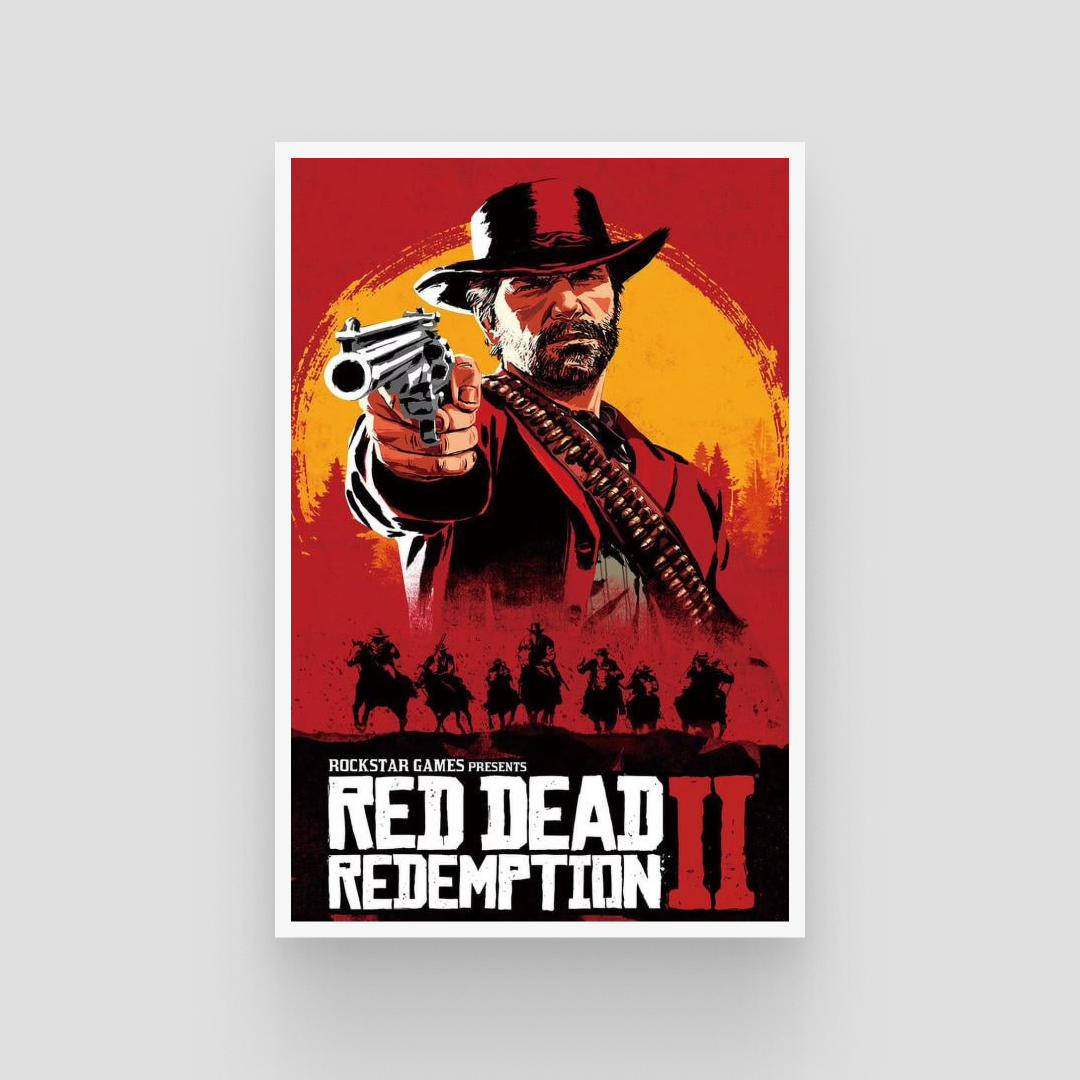
Through the 2010s, the 2K label built a collection of franchises that gave Take-Two a recurring commercial base entirely separate from Rockstar. NBA 2K became the dominant basketball simulation on the market, holding the top-ranked position in its category for over a decade, while WWE 2K added another annually recurring sports title to the mix.
Beyond sports, Borderlands and Civilization grew into strong franchises in their own right, each with devoted audiences and regular sequels. The breadth of titles and the regularity of their releases gave the company a level of diversification it had never had before. The threat of bankruptcy was well and truly over.
That diversification didn't make Rockstar any less important, though. GTA V, released in September 2013, would prove that. The game was set in a fictional version of Southern California, featuring a shrunken version of Los Angeles and its surroundings that dwarfed anything Rockstar had built before. For the first time in the series, players would follow three separate protagonists whose stories unfolded in parallel and intersected as the game progressed.
Expectations were sky-high after more than a decade of exceptional titles, but Rockstar met them without hesitation. Within the first 24 hours, 11.2 million units had been sold, generating $816 million in revenue, making it the largest entertainment launch in history.
But what set GTA V apart from its predecessors was what came after launch. GTA Online, released alongside the main game, started modestly but grew steadily as Rockstar layered in regular free content updates, new missions, properties, vehicles, and events, sustained by players purchasing in-game currency to accelerate their progress.
Remarkably, a game released in 2013 was still growing its active player base well into the 2020s. This clearly changed the economics of the franchise while also raising expectations for what is to come in November 2026. More on both shortly.
Before we get to an acquisition that would become an important piece of Take-Two's portfolio, it's worth pausing on a theme that has been central to this story so far.
The gaming industry has always been fragmented, with acquisitions and consolidation as a natural consequence. A key reason is that development costs for top-tier titles have reached a scale that requires both a large balance sheet and a patient parent. At the core of these acquisitions is intellectual property: the franchises, the brands, and the key personnel behind them.
Alongside that sits a second rationale: portfolio diversification as a way to manage the hit-driven nature of gaming. A game can take years to develop before any revenue materializes, if it succeeds at all. Spreading lengthy and costly projects across a broader portfolio diversifies that risk, with most of the largest companies within the industry being a result of that specific strategy. These forces have shaped the industry for decades and remain just as relevant today.
Recently, consolidation has also taken place at the publisher level. Two of the three largest Western publishers have themselves changed hands in the span of a few years, for reasons that have little to do with the studio-level logic just described. Microsoft acquired Activision Blizzard in 2023 for $69 billion, the largest deal in the industry's history. Two years later, EA agreed to be acquired for $55 billion by a consortium comprising Saudi Arabia's Public Investment Fund, Silver Lake, and Jared Kushner's Affinity Partners, a deal still awaiting regulatory approval.
From Ryan Brant's early acquisitions of small distributors and publishers in the 1990s, Take-Two has grown through acquisitions of promising studios and by giving them the tools to succeed. Over the decades, it has acquired, merged, and closed dozens of studios, keeping what worked and cutting what didn't. Before the takeover of 2007, the model held up but had its limits.
But with the changes set by the new management, that model has been emphasized thoroughly as a key to Take-Two's recent success. Strauss Zelnick discussed its integration strategy at TD Cowen's 52nd Annual Technology, Media & Telecom Conference in 2024 (sourced through Quartr Pro):
“We encourage our labels and within our labels, our studios to be highly independent and to pursue their own destiny. Equally, though, in a best case scenario, all of your colleagues benefit from sharing information and working together in a collegial form. So there's a natural tension in what I just said. There's also, if you do it right, there's a benefit in what I just said.”
He continued on the balancing act of Take-Two as a parent:
“Obviously I'm biased, but I think we strike a very good balance between having independence creatively and co-dependence corporately when it makes sense. And that's what a big diversified entertainment company should do. One of the reasons that some of the big traditional entertainment companies have failed is because they never figured that out. You know, they never found their way to cooperate where they should cooperate and not cooperate where they shouldn't. [...] And the balance for us is like loads of autonomy where it comes to creativity and loads of cooperation when it's like cookie cutter stuff that the corporation should be handling on people's behalf.”
By the early 2020s, that had created a group of two top-tier labels in Rockstar and 2K, each with multiple successful franchises to their names. Blockbuster series like GTA and Red Dead, combined with annually recurring sports franchises such as WWE 2K and PGA TOUR 2K, have given the company a mix that allows it to weather lumpiness around releases better than most companies within the industry.
But one leg was still missing, one that could take that recurring revenue to the next level while opening the door to an entirely new platform and audience.
Throughout the 2010s, mobile had been the fastest-growing segment of interactive entertainment. Take-Two's success elsewhere in gaming had not translated smoothly to the category. Mobile served a different audience, ran on different economics, and required operational expertise that the company had attempted to develop internally but unsuccessfully. So Take-Two took a different approach.
In January 2022, the company announced it would acquire Zynga for $12.7 billion, or $9.86 per share ($3.50 in cash and $6.36 in Take-Two stock), a 64% premium to Zynga's previous closing price. The price tag was contested, but strategically, the deal made sense. Zynga was one of the largest mobile game publishers in the world, with an audience and operational infrastructure that would have taken years to replicate. Its portfolio, including Toon Blast, Words with Friends, Zynga Poker, and Empires & Puzzles, generated consistent daily engagement from hundreds of millions of players across iOS and Android.
Mobile was already the largest segment of the global games market by revenue, and Take-Two's exposure to it had been negligible. The Zynga deal changed that overnight, adding diversification and a base of recurring revenue that would, over time, help smooth out the lumpiness of Take-Two's release cycle.
)
The timing, however, proved difficult. The deal closed in May 2022, just as the mobile advertising market was absorbing Apple's App Tracking Transparency changes, which upended the performance marketing economics mobile games had depended on. User acquisition costs rose, return on ad spend compressed, and legacy titles carrying large development budgets became harder to justify. Across FY2024 and FY2025, Take-Two recorded goodwill impairments totaling roughly $5.9 billion, largely reflecting the acquisition premium against the challenges that followed.
Zynga also came with a set of large, expensive projects predating the deal, which were reconsidered as Take-Two put its stamp on the business. Rather than concentrate resources on a handful of high-budget bets, Zynga shifted to more, smaller launches with lower upfront investment, accepting that mobile hit ratios are too low to justify big bets. Zelnick described the change at TD Cowen's 54th Annual Technology, Media & Telecom Conference 2026:
“When we took over Zynga, they had a couple of projects that had huge numbers attached to, that were legacy projects. We don't do that anymore because the hit ratios are so low in mobile, it just doesn't make sense. Really to focus mightily on fewer than 10 new launches a year in hopes of having one or two hits a year. That strategy has paid off.”
Zynga carries lower gross margins than the rest of Take-Two's portfolio, but the business offers two advantages that the traditional platform-fee economics of console storefronts don't. First, Take-Two has built a direct-to-consumer channel across Zynga's mobile portfolio, which Zelnick called a "significant and indeed material part of our business" at the Q4 2025 earnings call. The company hasn't disclosed its revenue contribution, but management has confirmed the channel now spans nearly the entire mobile portfolio.
Second, regulators are starting to challenge the platform-fee model itself. The EU's Digital Markets Act has already forced Apple and Google to open iOS and Android to alternative app stores and payment systems, with similar legislation working its way through the U.S. as well. For a company generating roughly $6.7 billion in annual revenue, lower platform fees would translate directly into higher gross profit without selling a single additional game.
Take-Two is often described as a video game publisher, a term that undersells what the company actually does. A publisher's traditional role is to finance, market, and distribute games made by independent studios. Take-Two does all of that, but it also owns the studios behind its biggest franchises. Through decades of acquisitions, it has evolved into a company that controls not only distribution but also the talent, technology, and intellectual property that create its games.
That structure operates on two levels. Rockstar, 2K, and Zynga are labels, publishing brands under which Take-Two organizes its portfolio. Beneath each label sit the studios that actually build the games: Rockstar North and Rockstar San Diego under Rockstar, Visual Concepts and Firaxis under 2K, and Zynga's own development teams under Zynga. A handful of external relationships remain where Take-Two retains the publishing role without owning the studio, but these are the exceptions. The studios that define the company operate with considerable creative autonomy, and their output belongs to Take-Two.
While Zynga's games are distributed through mobile app stores such as Apple's App Store and Google Play, Rockstar and 2K distribute through platform owners such as Sony's PlayStation Store, Microsoft's Xbox Marketplace, and, on PC, Valve's Steam. By organizing around labels rather than a single unified structure, Take-Two can run each business according to the economics its platform actually demands: console and PC titles built around large upfront investments and long tails of in-game recurring spending, mobile built around low-cost, high-volume releases and daily engagement.
That same logic extends down to individual franchises. An annual sports title and a decade-in-the-making Rockstar release are, at the studio level, two entirely different businesses, something the labels section below breaks down in more detail.
For fiscal 2026, Take-Two reported revenue of $6.7 billion across a portfolio spanning console, PC, and mobile. Of that total, 97% flowed through digital channels. In Zelnick's early years at Take-Two, that figure would have seemed completely unthinkable when physical retail was the industry's primary distribution mechanism and the idea of a game sustaining meaningful revenue for a decade after launch barely existed.
Weighed down by weaker mobile ad economics, acquisition-related debt, and the cost of righting Zynga's legacy projects, Take-Two's free cash flow fell from $99 million in fiscal 2022 to negative $203, $158, and $215 million, respectively, between FY 2023 and FY 2025, before rebounding to $462 million in fiscal 2026.
Because Take-Two owns most of its studios rather than only publishing their output under licensing deals, the revenue those studios generate flows back to the parent. Net bookings (Take-Two's internal measure of total sales, but recognized when a transaction occurs rather than spread out under GAAP rules) aren't broken out by label after each fiscal year closes, but an approximate split can be estimated from forward guidance at the start of each period.
The past four years of that guidance suggest Rockstar has likely contributed somewhere between 16% and 19% of the share, 2K between 29% and 39%, and Zynga between 35% and 51%, with mobile heaviest in the years immediately following the 2022 acquisition. Fiscal 2027 guidance breaks that pattern entirely, with Rockstar expected to rise to 36% after the GTA VI launch on November 19, 2026.
Rockstar stands apart not only from the rest of the portfolio but also from much of the industry itself. The economics of spending hundreds of millions of dollars and the better part of a decade developing a single game might seem difficult to justify. Then again, few studios have Rockstar's track record.
It releases rarely, sells enormously, and keeps earning for years. GTA V, released in 2013, has sold approximately 230 million units, making it the second-highest-selling game of all time, only behind the considerably cheaper Minecraft. Red Dead Redemption 2, released five years later, sold more units in fiscal 2026 than in any year since its 2018 launch. Beyond the upfront sales, Take-Two and Rockstar have successfully designed these hits to be long-duration assets, generating recurring consumer spending for years after launch, now over a decade in the case of GTA V.
2K works very differently across its sports portfolio, maintaining an annual cadence. A game like NBA 2K26 is best described as refreshed rather than rebuilt from scratch each year: the development cycle is shorter, the investment per release is lower, and the game arrives with a pre-existing audience that knows exactly what it's buying. Committing to a new NBA 2K every year requires a licensing relationship with the NBA, which compresses gross margins relative to wholly owned intellectual property.
The same applies to WWE 2K and PGA TOUR 2K, all built around licensed sports IP, league rights, and real-world rosters, which shape creativity from a different angle than Rockstar's. The challenge isn't inventing a world but deepening one that already exists, finding new ways to extend the game's culture and engagement year after year within a framework that renews on a fixed schedule. Like Rockstar, many of these games have transitioned over the years to generating a large share of revenue from recurring spending.
The 2K label also houses Take-Two's broader entertainment library, including franchises such as BioShock, Borderlands, and Civilization. Like Grand Theft Auto and Red Dead Redemption, these are ambitious console and PC experiences designed to keep players engaged for dozens of hours. But unlike Rockstar's tentpole releases, they typically have shorter development cycles.
Zynga complements Rockstar and 2K by targeting a mobile audience across a broad portfolio of puzzle, casino, and word games, focusing on daily engagement, advertising revenue, and in-app purchases. These games generally don't generate headlines for upcoming releases, but they produce consistent, recurring bookings from a massive audience, built on development cycles far shorter than those of Rockstar and 2K.
For most of the gaming industry's history, the business model was straightforward: develop a game, sell copies, and move on to the next release. Revenue arrived in a burst around launch and then gradually faded. Once the initial sales window closed, there was little left to monetize.
That began to change with the rise of free-to-play mobile games from the earliest days of Apple's App Store in 2008. Rather than relying on upfront purchases, developers discovered that a highly engaged player could generate revenue for years through in-app purchases, virtual currency, and advertising. The industry's economics slowly shifted from maximizing launch-day sales to maximizing lifetime player value.
Over the coming years, console and PC publishers adapted the model for their own audiences. EA was among the earliest, introducing FIFA Ultimate Team in 2009, a mode where players could build squads by purchasing player packs. The mode became one of the most profitable features in the history of interactive entertainment and fundamentally reshaped how EA, and eventually the rest of the industry, thought about monetizing games.
Rockstar gradually arrived at a similar destination with the launch of GTA Online, adding virtual currency, cosmetic items, add-on content, and subscription services like GTA+. But the shift wasn't limited to Rockstar. Across its portfolio, Take-Two of 2026 has, year by year, shifted its revenue mix to the point where it now looks very different from the company that released GTA V back in 2013. The trend is clear in the visualization below when comparing full-game sales and other upfront revenue with recurrent consumer spending (revenue generated within a game).
)
Most recently, in fiscal 2026, recurrent consumer spending accounted for 78% of Take-Two's total net bookings of $6.7 billion. Across NBA 2K, GTA V, Red Dead 2, and primarily Zynga's mobile portfolio, the pattern is consistent: the majority of Take-Two's revenue comes from purchases within its games. Players continue spending money for months, and often for years, after buying or downloading a game, creating a recurring revenue stream more durable than the industry's traditional hit-driven model.
That shift has changed the company's relationship with its own release schedule. A traditional publisher, or Take-Two in the past, lived and died by launch windows: a quarter with no major release was simply a bad quarter. Take-Two still experiences that lumpiness, but now it arrives as an upside spike on top of a floor of steady revenue across a wide range of titles.
The dynamic shows up in Take-Two's fiscal 2027 outlook. Recurrent consumer spending is expected to stay roughly flat in absolute terms but shrink as a share of the total, as GTA VI drives a surge in full-game sales. That mix shift will prove temporary. The real question isn't just whether GTA VI sells tens or hundreds of millions of copies, but how quickly its online ecosystem can begin expanding Take-Two's recurring revenue base over the next decade.
Grand Theft Auto VI, arguably the most anticipated entertainment property of all time.— Strauss Zelnick
Rockstar has never operated like any other label. Its studios take years to develop their games, with an obsessive eye for detail, and only ship when they believe what they've made is truly exceptional. That discipline has produced a body of work unlike anything else in the medium. Games that redefine what the format is capable of, reviewed at the top of critical scales, and capable of exceeding the already extreme expectations set by an equally obsessive predecessor.
Rockstar operates collaboratively across multiple studios, with the creative center of gravity anchored at Rockstar North in Edinburgh (relocated from Dundee), where the Grand Theft Auto series has been developed since its origins at DMA Design. Every Rockstar game feels like it came from the same mind, shaped by the same obsessions: dense, believable worlds, characters with genuine interiority, and a refusal to let technical or commercial constraints define the ceiling of what the game attempts.
That standard costs money and time, but it has produced hit after hit and a fanbase bordering on obsession. GTA V shipped in 2013, Red Dead Redemption 2 in 2018, and in the years since, apart from online content across its titles, Rockstar North's resources have concentrated increasingly on the single project.
While thirteen years between releases span nearly two console generations, Zelnick has been careful never to frame the gap between GTA V and GTA VI as simply a long wait. At TD Cowen's 54th Annual Technology, Media, & Telecom Conference, he pushed back on the premise directly:
"It's not as simple as, 'Wow, what have you been up to for 13 years?' The answer is they've been up to quite a lot. I think one of the reasons that GTA VI is so widely anticipated is that we now have a GTA ecosystem that Rockstar built."
Grand Theft Auto VI is set in Leonida, a fictional version of Florida, with a modern-day Vice City at its center. The series returns to the city last visited in 2006, this time through the eyes of two protagonists: Jason and Lucia (notably the first female lead in the series' history).
Rockstar first confirmed that GTA VI was in active development in February 2022. The world got its first glimpse of it on December 4, 2023, when Rockstar released the game's first official trailer. Set to Tom Petty's "Love Is a Long Road," the trailer received over 93 million views in 24 hours and became the starting point for the road to release.
That road hasn't been smooth. The original release window was fall 2025, but in May 2025, Rockstar pushed the date to May 26, 2026, and six months later moved it again, to the current date, roughly 18 months behind the original target. The release will follow the same strategy as GTA V, launching first on PlayStation 5 and Xbox Series X/S, with a PC version likely to follow later.
As mentioned, GTA V sold 11.2 million units within its first 24 hours in 2013. That is widely expected to be beaten emphatically this time around. In June 2026, the price point of $80 was released, alongside a $100 Ultimate Edition offering exclusive content at launch. Compared to most other console games, the price is a bit higher, signaling Take-Two's confidence in the demand. Strauss Zelnick laid out the financial outlook at the Q4 2026 earnings call, guiding for a significant increase from fiscal 2026 net bookings of $6.7 billion:
“Our initial financial outlook for Fiscal 2027 includes record Net Bookings of $8 billion-$8.2 billion. This reflects meaningful growth over last year, led by the launch of Grand Theft Auto VI, along with the successful execution across our entire portfolio. We expect to sustain this higher level of scale and generate strong cash flows well into the future as we release our robust long-term development pipeline and capitalize on new opportunities across our highly established, multifaceted business.”
)
On cash generation, Take-Two guides free cash flow to increase from $462 million in fiscal 2026 to approximately $800 million in fiscal 2027. Those launch numbers are significant on their own, but what follows through GTA VI's online ecosystem in the years to come may matter even more. Rockstar has spent two decades beating expectations, and nothing suggests that this will be the exception.
Take-Two was founded in 1993, though the company we know today arguably began with the 2007 takeover. The sense right now is that the entire company stands or falls on a single release, but the Take-Two that Strauss Zelnick has built over nearly two decades wasn't designed around a single date, a single studio, or a single franchise. The ambition has been to deliver hits repeatedly across different genres, platforms, and audiences, and to build the organizational conditions that make it possible over and over again.
If history is any guide, GTA VI will likely become the best-selling game of all time and generate substantial recurring revenue for years. But beyond the franchise sits a portfolio of sequels, updated content, and mobile games that show it isn't just about November 19. On the Q2 2025 earnings call, Strauss Zelnick discussed how Take-Two approaches new intellectual property:
“We're different than a lot of other big companies. It's tempting for a big company to rest on its laurels. We have a lot of intellectual property. We know that if we put out a sequel, it's a lower-risk proposition than new intellectual property. [...] Ultimately, everything does decay, including hit titles. So if we're not trying new things and making new intellectual property, to say that we're resting on our laurels really understates it. We're really running the risk of burning the furniture to heat the house. And that doesn't end well. So we do it, even though it doesn't always succeed.”
That philosophy is what has kept Take-Two from becoming a company that lives and dies by one franchise. It's also the mindset Zelnick brings to the topic that is currently reshaping every conversation in the entertainment industry: artificial intelligence.
AI has become a recurring debate across the games industry over the past year. The question is whether it compresses the cost and time required to make complex creative products to the point where scale, talent, and institutional knowledge no longer matter. For a company whose crown jewel has taken the better part of a decade and likely over a billion dollars to build, the stakes of that question are obvious.
Asset creation is not the same as hit creation.— Strauss Zelnick
Take-Two's position is neither defensive nor dismissive. Since generative AI entered the conversation, the company has embedded it across its operations, with hundreds of active pilots and implementations spanning its studios and corporate functions.
The goal, as Zelnick has described it, is the same one that every wave of digital technology has promised: making the routine tasks faster and cheaper, so that the people doing the irreplaceable work have more room. Strauss Zelnick explained his view at TD Cowen's 54th Annual Technology, Media & Telecom Conference:
“I don't believe for a minute that technological advances give someone else an edge or give us an edge. It's just the tool set. It's available to everyone. The key thing is that all this is going to be totally commoditized. Show me one AI company, just one, who's offering their services or products to companies on an exclusive basis. They don't exist. When that executive has that button to push, I'll have the same damn button, the folks at Rockstar seem to be able to make these massive hits, lots of other people have tried. Lots and lots, including former Rockstar employees.
So far, they haven't been able to do it. Doesn't mean they can't in the future, by the way. We're always running scared. It won't be technology that changes the game. That won't be the change. What'll change is that some extraordinarily creative individual or individuals are going to show up and do something astonishing. Our goal is to get those people to work within the Take-Two system. If we fail to do that, we fail.”
The commodity argument is one Zelnick returns to consistently, and it applies as much to the games industry's oldest anxiety – that anyone can make a game – as it does to AI specifically. What changes with better tools is not the hit rate. It never has. The CEO continued on the David Senra podcast:
“People are like, 'anyone can make a video game'; that was the thesis: 'with AI, anyone can make a video game.' Anyone could make a video game last week. Anyone could make a video game five years ago. The technology is rightly available; it's commoditized. You know how many mobile games get put out a year? Thousands. You know how many hits are made in a year? 0-5. You know who makes them? Thank you very much. We do.”
Take-Two's history is, in many ways, the story of the modern gaming industry. Fragmentation and consolidation, release-driven economics shifting to recurring revenue, and tension between creative independence and corporate discipline, all balanced out across one of gaming's largest and most successful portfolios. The industry is changing, but if the last two decades are any indication, Take-Two will keep delivering hits.
Explore our platforms
Leading companies and financial institutions worldwide rely on Quartr to make better decisions faster.
Desktop
API
)
)
)