

Edge16 Oct 2026
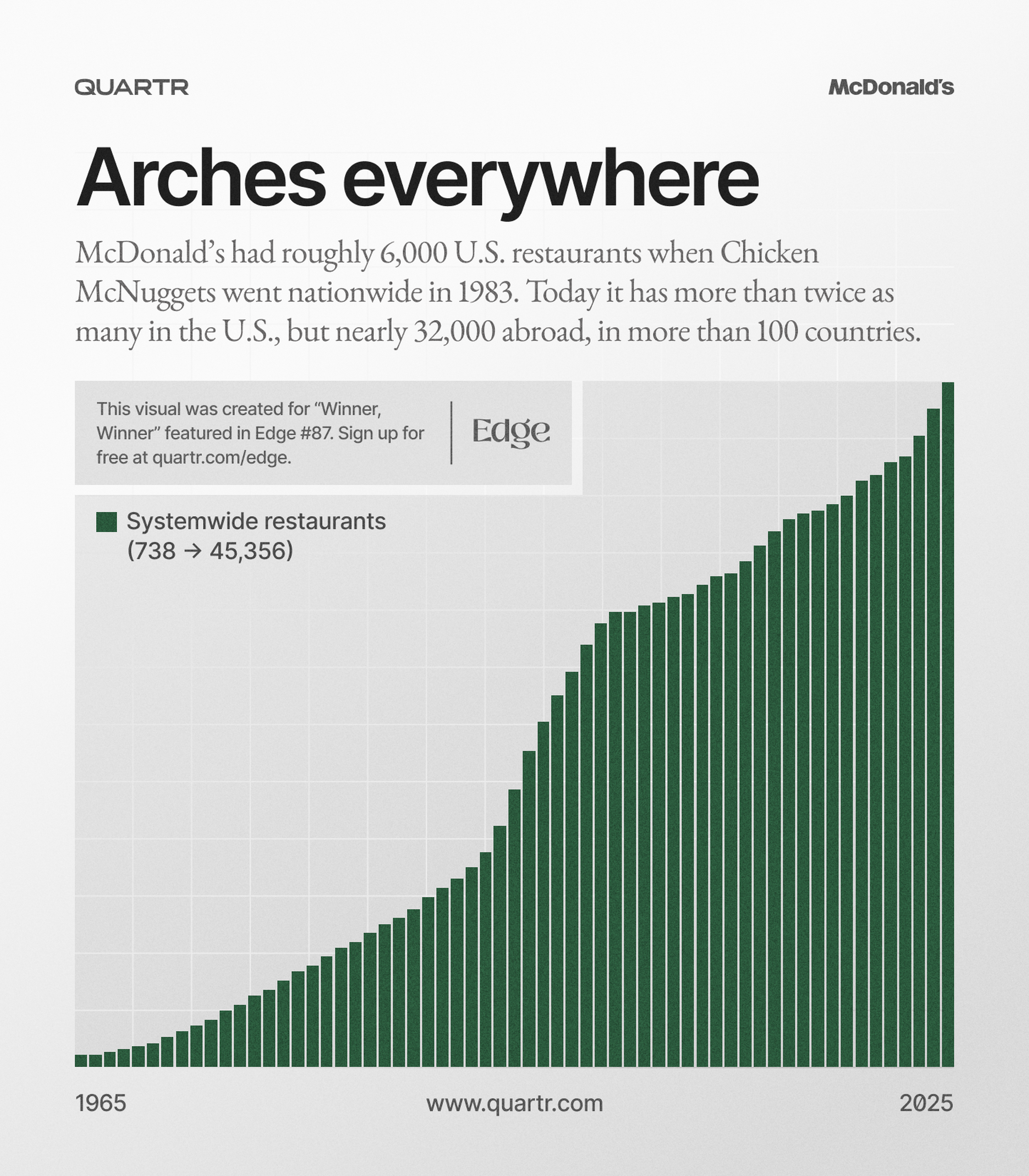
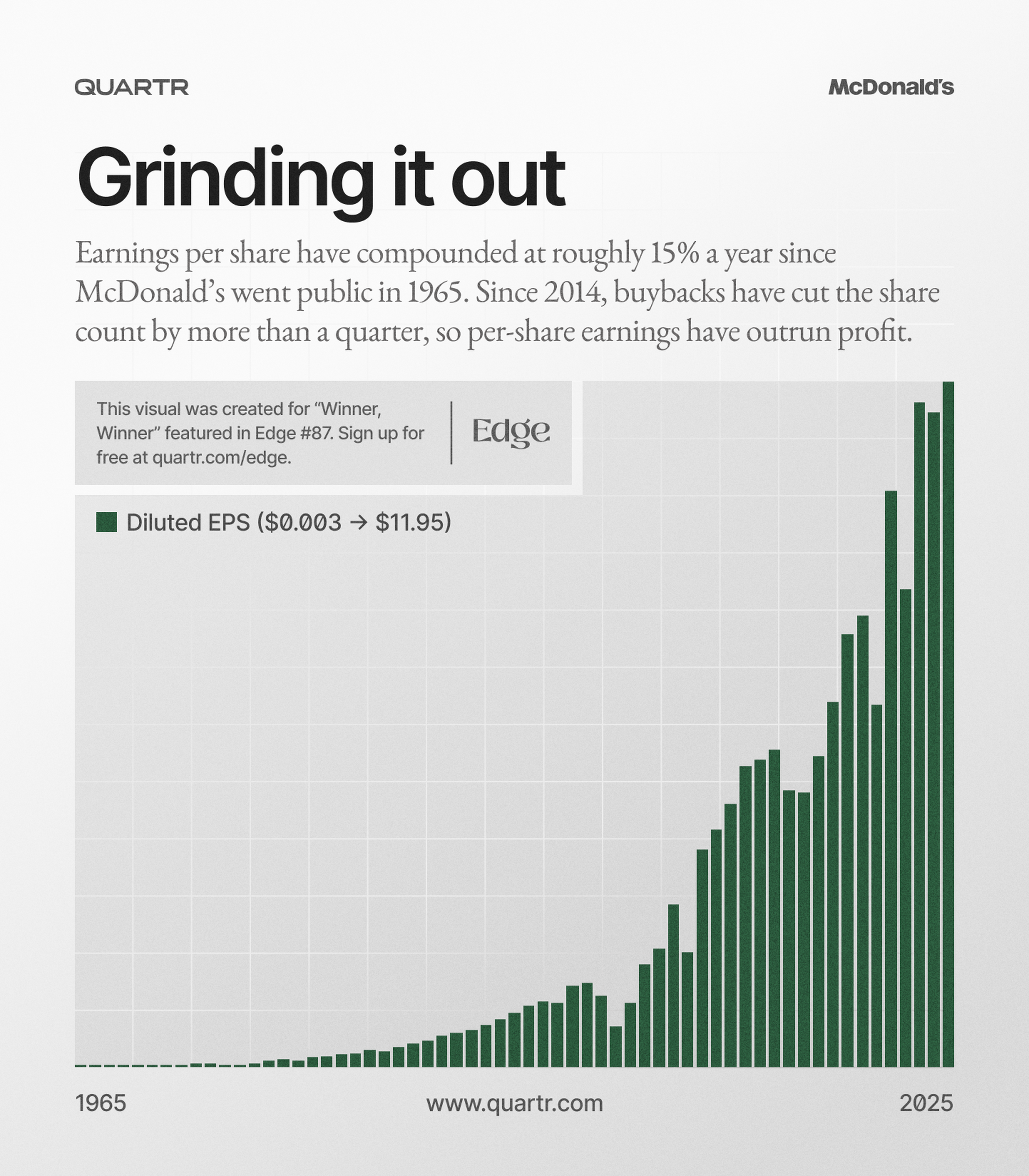
Winner, Winner: The Chicken McNugget Story
How a 1940s breeding contest, a Cornell food scientist, and a hedge by Ray Dalio helped McDonald's turn the Chicken McNugget into a fast-food icon.

Q3 net income was $766M and adjusted EPS was $2.07, versus $688M and $1.90 in Q3 2025; 2026 adjusted EPS guidance narrowed to $6.05–$6.15.
Nine-month net income was $1.998B and adjusted earnings were $1.864B; reported results included a $134M after-tax gain from the MVP sale.
Priorities include reliable earnings growth, infrastructure investment, system reliability, and affordability amid electrification and changing energy needs.
Q3 revenue was $4.913B versus $4.530B, and operating income was $1.170B versus $968M year over year.
Nine-month revenue was $14.078B versus $12.924B, and operating income was $2.900B versus $2.448B.
Nine-month adjusted EPS was $5.08 versus $4.82; adjusted earnings rose $146M year over year after specified exclusions.
Nine-month operating cash flow was $2.825B versus $3.320B; utility capital expenditures were $4.051B versus $3.460B.
2026 adjusted EPS guidance narrowed to $6.05–$6.15 from $6.00–$6.20; it excludes MVP sale gains, basis-difference accretion, strategic review costs, and HLBV effects.
Average investment earnings base is forecast to reach $71.393B in 2030, with a stated five-year CAGR of 8.7%.
Estimated capital requirements for 2027–2029 were reduced to $7.489B, $7.877B, and $8.546B, respectively; utility capital investment forecasts are $8.571B in 2027 and $8.588B in 2028.
CECONY forecasts New York City electric reliability needs of 125 MW from 2033, rising to 675 MW by 2036; proposed storage and clean-energy procurement are subject to approval.
CECONY's three-year steam rate proposal covers November 2026–October 2029, with requested base-rate changes of $13M, $42M, and $39M by year; approval is pending.

AI chat

Automations


Live audio & transcripts

Quartr's AI stands out because it only pulls clean, first-party data from public companies. In investing, that's everything.
Jamie Ross
Investment Manager, GAM Investments
Research that used to take hours now takes seconds with Quartr Pro. Tracking shifts in tone or extracting tables, it's as simple as typing a query.
Tom O'Hara
Investment Director
Before Quartr we spent hours manually compiling insights through the peer earnings cycle. Now, these tasks are done faster, with greater precision.
Gregg Lampf
VP of Investor Relations
Being able to ask specific questions across years of transcripts and reports and instantly get verified answers is a game-changer.
Pontus Dackmo
CEO & Investment Manager
Consolidated Edison, commonly referred to as Con Edison, is an American energy company primarily serving the New York metropolitan area. The company is one of the largest investor-owned energy companies in the United States and provides a wide array of energy-related products and services through its various subsidiaries. Con Edison’s main operations involve the production and distribution of electricity, gas, and steam. The company is headquartered in NYC, and its shares are traded on the NYSE.
The earliest predecessor to what would later go on to become Con Edison was the New York Gas Light Company, which was founded in 1823. Con Edison, as suggested by the name, is the result of the merger and consolidation of numerous companies, including the aforementioned Gas Light Company, The New York Steam Company, and Thomas Edison’s Edison Illuminating Company. The group continued to grow and acquire various utility companies in the New York metropolitan area over the years, and the modern form of the company (which got its name in 1998) is the result of the consolidation and merger of well over 150 different companies.
Con Edison primarily serves New York City and Westchester County and generates, transmits, and distributes electric power to millions of residential, commercial, and industrial customers. This segment of Con Edison’s business involves managing a complex grid system, which includes substations, transmission lines, and distribution networks. The company places a strong emphasis on maintaining system reliability and efficiency, ensuring uninterrupted power supply in a region known for high energy demand. Some other publicly traded US-based electricity companies are Duke Energy, Dominion Energy, and Exelon.
Besides electricity In the steam sector, Con Edison operates the largest district steam system in the United States, supplying steam for heating, hot water, and air conditioning to numerous buildings in Manhattan. This service is crucial for both residential and commercial establishments, including iconic structures and healthcare facilities. The company also supplies natural gas to customers within its service area.