

Edge16 Oct 2026
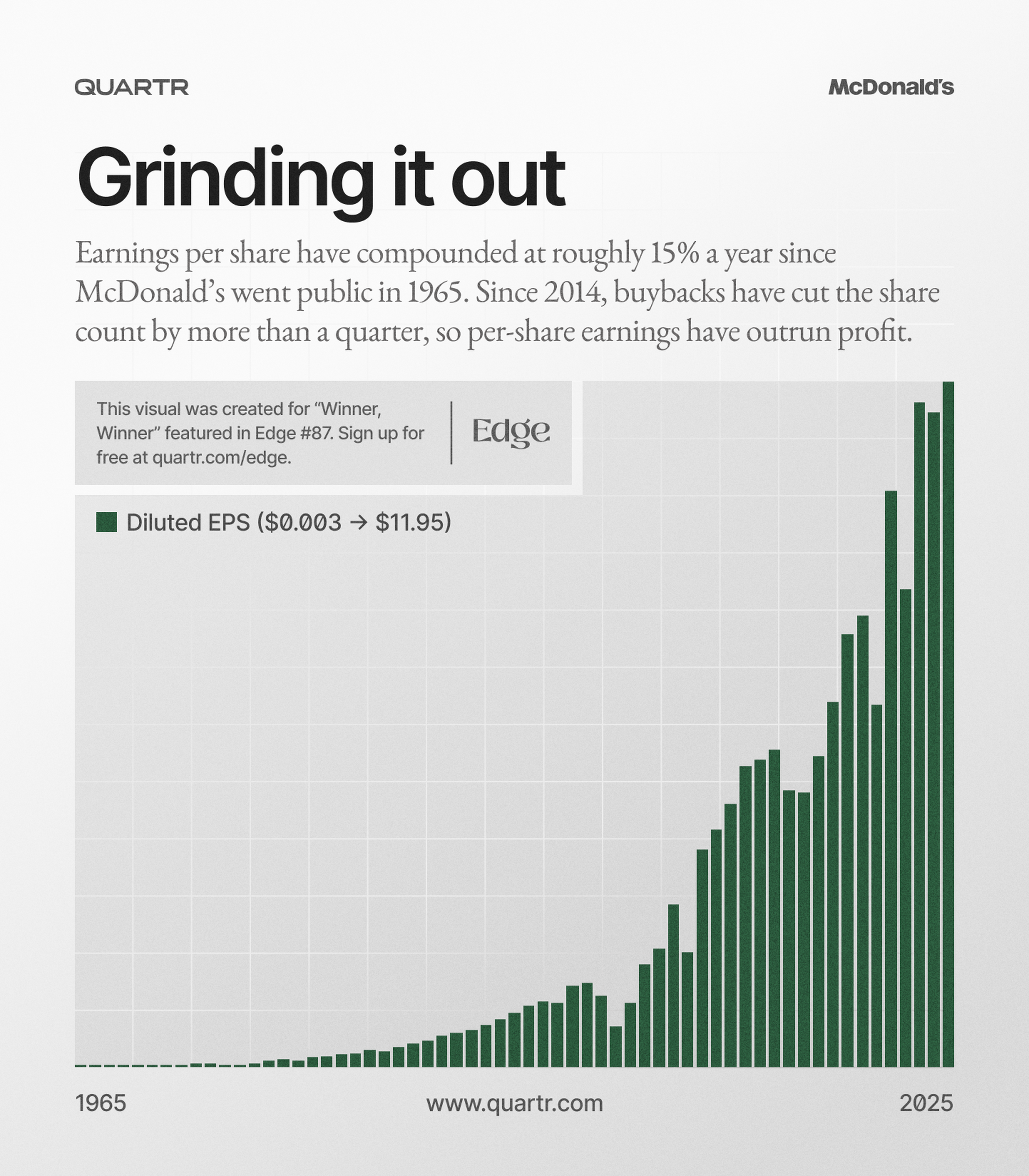
Winner, Winner: The Chicken McNugget Story
How a 1940s breeding contest, a Cornell food scientist, and a hedge by Ray Dalio helped McDonald's turn the Chicken McNugget into a fast-food icon.

Q3 reported and adjusted EPS was $1.99, up from $1.81 YoY, supported by investment recovery and favorable weather, partly offset by higher depreciation, interest, minority interest and taxes.
FY26 adjusted EPS guidance narrowed to $6.70–$6.80, with results expected near the top end; 5%–7% adjusted EPS growth through 2030 was reaffirmed.
A $103B 2026–2030 capital plan and generation expansion targeting 16 GW by 2031 support anticipated load growth.
Q3 revenue was $9.104B vs. $8.542B, operating income $2.747B vs. $2.334B, and net income available to common stockholders $1.551B vs. $1.407B.
9M reported EPS was $5.34 and adjusted EPS $5.35, vs. $4.81 for both measures in 2025.
9M operating cash flow was $7.889B; investing outflow was $10.824B, including $12.566B of capital expenditures.
Confidence in delivering adjusted EPS in the top half of the 5%–7% long-term growth range begins in 2028, as secured economic development projects ramp.
Load growth outlook is 3%–4%; the ~15.4 GW late-stage large-load pipeline is targeted for contract signing by H1 2027.
~7.8 GW of signed large-load agreements support 2027–2030 projections; 5.2 GW of data-center projects under construction are expected to take energy from H2 2027 into 2028.
2026 adjusted earnings assumptions include $17.75B of capital expenditures and a 10%–12% adjusted effective tax rate; 9M capex was $12.912B.

AI chat

Automations


Live audio & transcripts

Quartr's AI stands out because it only pulls clean, first-party data from public companies. In investing, that's everything.
Jamie Ross
Investment Manager, GAM Investments
Research that used to take hours now takes seconds with Quartr Pro. Tracking shifts in tone or extracting tables, it's as simple as typing a query.
Tom O'Hara
Investment Director
Before Quartr we spent hours manually compiling insights through the peer earnings cycle. Now, these tasks are done faster, with greater precision.
Gregg Lampf
VP of Investor Relations
Being able to ask specific questions across years of transcripts and reports and instantly get verified answers is a game-changer.
Pontus Dackmo
CEO & Investment Manager

Duke Energy is an American company headquartered in Charlotte, North Carolina. The company is a significant player in the American energy market and owns over 58,000 megawatts of base load and generation in the US. The company has traditionally generated most of its electricity through coal and nuclear power but also operates hydroelectric generation stations. Duke Energy primarily operates in the midwest and southern parts of the United States, and its shares are listed on the NYSE.
Duke Energy traces its roots back to the early 20th century when in1900, Dr. Walker Gill Wylie founded the Catawba Power Company to supply electricity to cotton mills in the Carolinas. This endeavor, with financial assistance from James Buchanan Duke, expanded rapidly, leading to the creation of the Southern Power Company in 1905. Over the decades, the company transformed and rebranded several times through mergers and expansions and solidified its place in the US energy market. The most notable merger occurred in 2012, when Duke Energy merged with Progress Energy, solidifying its position as one of the largest electric power companies in the United States.
Duke Energy is one of the largest electric power holding companies in the United States, serving millions of customers from the Midwest to the Southeast. The company is responsible for the generation, transmission, and distribution of electricity to residential, commercial, and industrial consumers. As previously mentioned, the company generates its electricity through a variety of different methods but is slowly but surely starting to shift out coal in favor of nuclear and renewable electricity sources.
Duke Energy has plenty of publicly traded peers, and a list of these would not be complete without mentioning NextEra, AEP, and Exelon.
Duke Energy has progressively expanded its involvement in renewable energy sources, reflecting a broader industry shift towards sustainability. A significant portion of its renewable capacity comes from hydroelectric power, with multiple hydro plants in operation. Furthermore, the company has invested in both wind and solar power in recent years.