

Edge16 Oct 2026
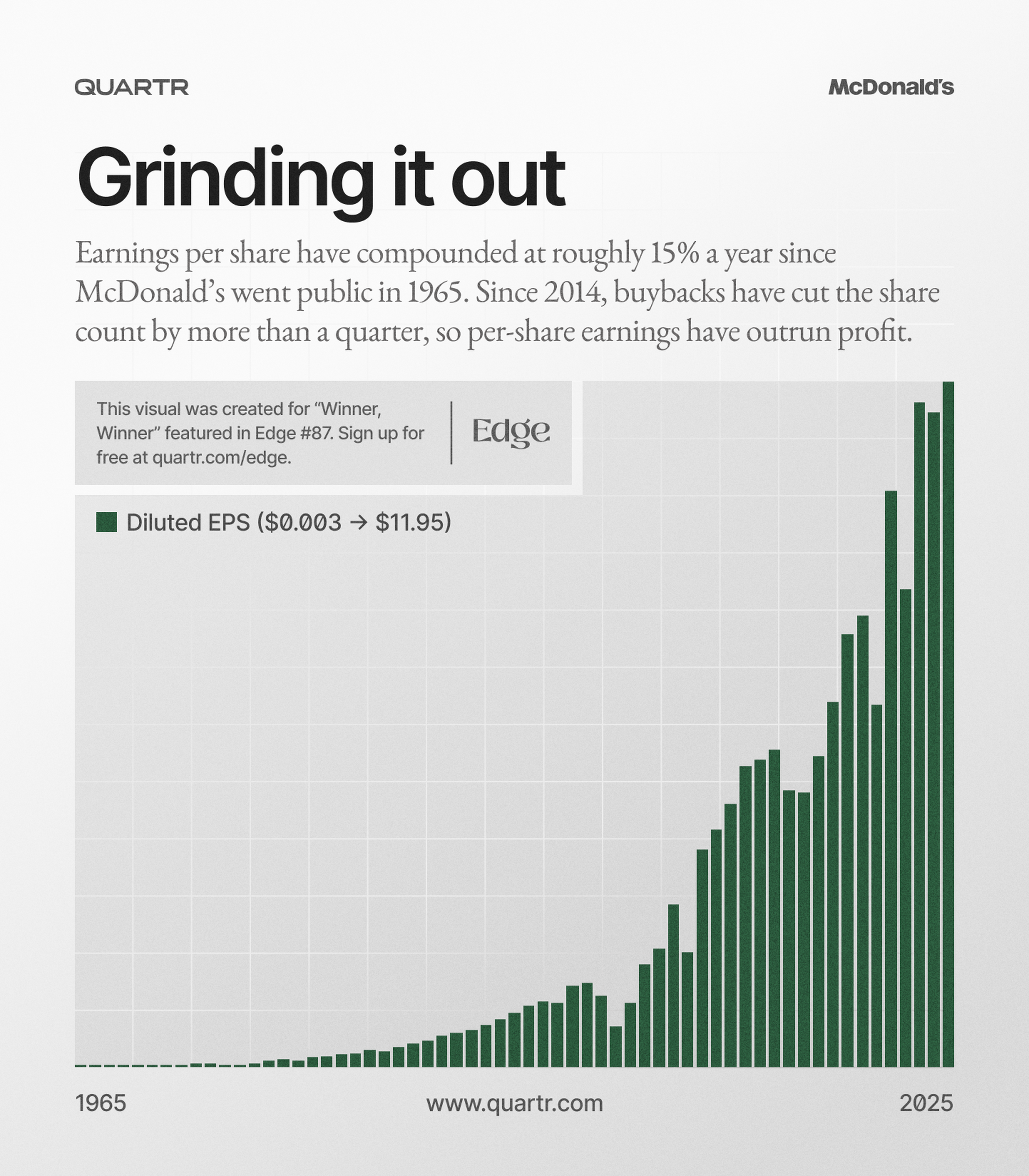
Winner, Winner: The Chicken McNugget Story
How a 1940s breeding contest, a Cornell food scientist, and a hedge by Ray Dalio helped McDonald's turn the Chicken McNugget into a fast-food icon.

Leadership cited 46,000 colleagues aligned to a strategy focused on client outcomes, stronger operations and culture; management sees the strongest years ahead and takes a decade-long view.
Sales grew YoY for 15 consecutive quarters through Q3; Q1 and Q2 were record sales quarters, with 10% of wins from new clients last year and roughly consistent this year.
Organic growth improved from -30 bps in 2022 to flat in 2023, 2% in 2024, 3% in 2025 and 4.5% in H1 2026.
Cross-sell remains a major opportunity: the median client uses one product, and only one client uses all eight cited businesses; work is underway to identify product, geographic and talent gaps.
Management described the multi-year transformation as largely complete, while emphasizing further reimagining of diverse businesses for an AI-driven future.
The platform model now covers 100% of operations; it is intended to reduce silos and duplication, clarify accountability and combine shared capabilities for scale and transparency.
Implementation occurred in five waves over several years, with maturity varying by wave; KYC/onboarding and lending were early examples, with AI now helping advance onboarding processes.
Management framed the goal as better investment returns and client outcomes, not cost-cutting; unified lending technology and ownership have improved visibility across business lines.
Q3 margin was 24%; management cited improved active-equity performance, emerging inflows and confidence in Dreyfus cash management.
Insight won a £1bn U.K. mandate; management cited work to improve expenses and revenue, restore client and AUM flows, and connect the business with wealth and asset servicing platforms.
The asset manager oversees $2tn; leadership described its recovery as slower because it had been more siloed and technologically distant, while remaining cautiously optimistic about progress.

AI chat
Automations


Live audio & transcripts

Quartr's AI stands out because it only pulls clean, first-party data from public companies. In investing, that's everything.
Jamie Ross
Investment Manager, GAM Investments
Research that used to take hours now takes seconds with Quartr Pro. Tracking shifts in tone or extracting tables, it's as simple as typing a query.
Tom O'Hara
Investment Director
Before Quartr we spent hours manually compiling insights through the peer earnings cycle. Now, these tasks are done faster, with greater precision.
Gregg Lampf
VP of Investor Relations
Being able to ask specific questions across years of transcripts and reports and instantly get verified answers is a game-changer.
Pontus Dackmo
CEO & Investment Manager

The Bank of New York Mellon Corporation, most commonly referred to BNY Mellon, is an American multinational banking and financial services holding company. The company is one of the world's largest financial services providers, and BNY Mellon delivers a range of services that enable institutions and individuals to manage their financial assets. Its offerings include investment servicing, investment management, and investment research and trading. The company is, unsurprisingly, headquartered in NYC, and its shares are listed on the NYSE.
BNY Mellon is the result of the 2007 merger between The Bank of New York and Mellon Financial Corporation. The Bank of New York, established in 1784 by Alexander Hamilton (Yes, that Alexander Hamilton), is one of America's oldest banks and was one of the first companies traded on the New York Stock Exchange. Mellon Financial was founded in 1869 by the Mellon family of Pittsburgh. The merger combined The Bank of New York's extensive securities servicing and treasury management with Mellon's asset and wealth management services. Today, it is one of the leading financial services companies in the world and competes against names such as JPMorgan Chase, State Street, Blackrock, and many others.
BNY Mellon has three key areas of operation: Securities Services, Market & Wealth Services, and Investment & Wealth Management.
Securities Services encompass a range of offerings for institutional investors and market participants. This includes custody services, as well as offering securities lending, enabling clients to loan out securities in exchange for potential revenue. In addition, their fund services cover fund accounting, administration, and transfer agency activities.
BNY Mellon's Markets and Wealth Services cater to a diverse clientele, including high-net-worth individuals, family offices, and institutions. In Market Services, the company offers foreign exchange, securities finance, and liquidity services, enabling market transactions and effective risk management.
In Wealth Services, BNY Mellon delivers comprehensive wealth management, including investment management, wealth planning, and private banking. They offer personalized strategies to help clients grow, manage, and preserve their wealth, tailored to individual goals and circumstances.
In Investment Management, they provide a broad spectrum of investment strategies and solutions. This includes managing assets across various classes like equities, fixed income, and alternatives. In Wealth Management, the focus is on delivering tailored financial strategies for high-net-worth individuals, families, and family offices. Services here include comprehensive financial planning, investment management, and private banking solutions.