

Edge16 Oct 2026
Winner, Winner: The Chicken McNugget Story
How a 1940s breeding contest, a Cornell food scientist, and a hedge by Ray Dalio helped McDonald's turn the Chicken McNugget into a fast-food icon.

Market pricing of just over two hikes by end-2027 was within a credible range, though rate risks remained tilted upward; the medium-term neutral rate mattered more than 2027 policy outcomes.
Medium-term rate forwards rose to 5% from 3% four years earlier, reflecting a higher-growth, investment and inflation environment, and a higher neutral-rate outlook.
Duration strategy was unchanged: stress-test both rate extremes, balancing earnings stability from duration against portfolio-loss risk.
The long-standing preference to avoid longer-dated investments reflected an infrastructure-investment thesis, though current market pricing made that stance harder to maintain.
HTM hedging could ease duration constraints, reduce the need for CET1 buffers against AOCI volatility and permit somewhat more low-credit-risk exposure in HTM.
The 2022–23 rate cycle featured unseasoned deposits and newly active rate-seeking, with the impact mainly appearing through deposit-balance normalization.
Deposit balances now track payment volumes and security-services balances; stress testing covers a break in the rate range and unprecedented policy-rate levels.
Agentic AI could gradually raise deposit velocity; checking convenience remains important, while higher deposit beta could reduce banks’ demand for duration-bearing assets and credit.
A rapid repricing to higher rates was the main rate concern, with potential confidence effects, liability chasing and nonlinear system outcomes; a generic slowdown was viewed as manageable for income over that policy period.
Stress-test transparency and averaging two scenarios were welcomed; the Fed estimated a ~20 bps system impact, while greater predictability could make more capital usable.
GSIB rule changes were praised for smoothing and smaller buckets; priorities were full coefficient recalibration and a clear policy rationale for any short-term wholesale funding change.
Proposed rules could make some low-risk intermediation uneconomic; broad client relationships would still be served, though marginal pullback from the activity could follow.
The through-cycle dividend remained the sole capital-distribution commitment; double-digit RWA growth and organic deployment opportunities supported retaining capital and moderating buybacks.
SLR cleanup was described as timely, helping support infrastructure financing and balance-sheet intermediation over the prior 18 months.

AI chat
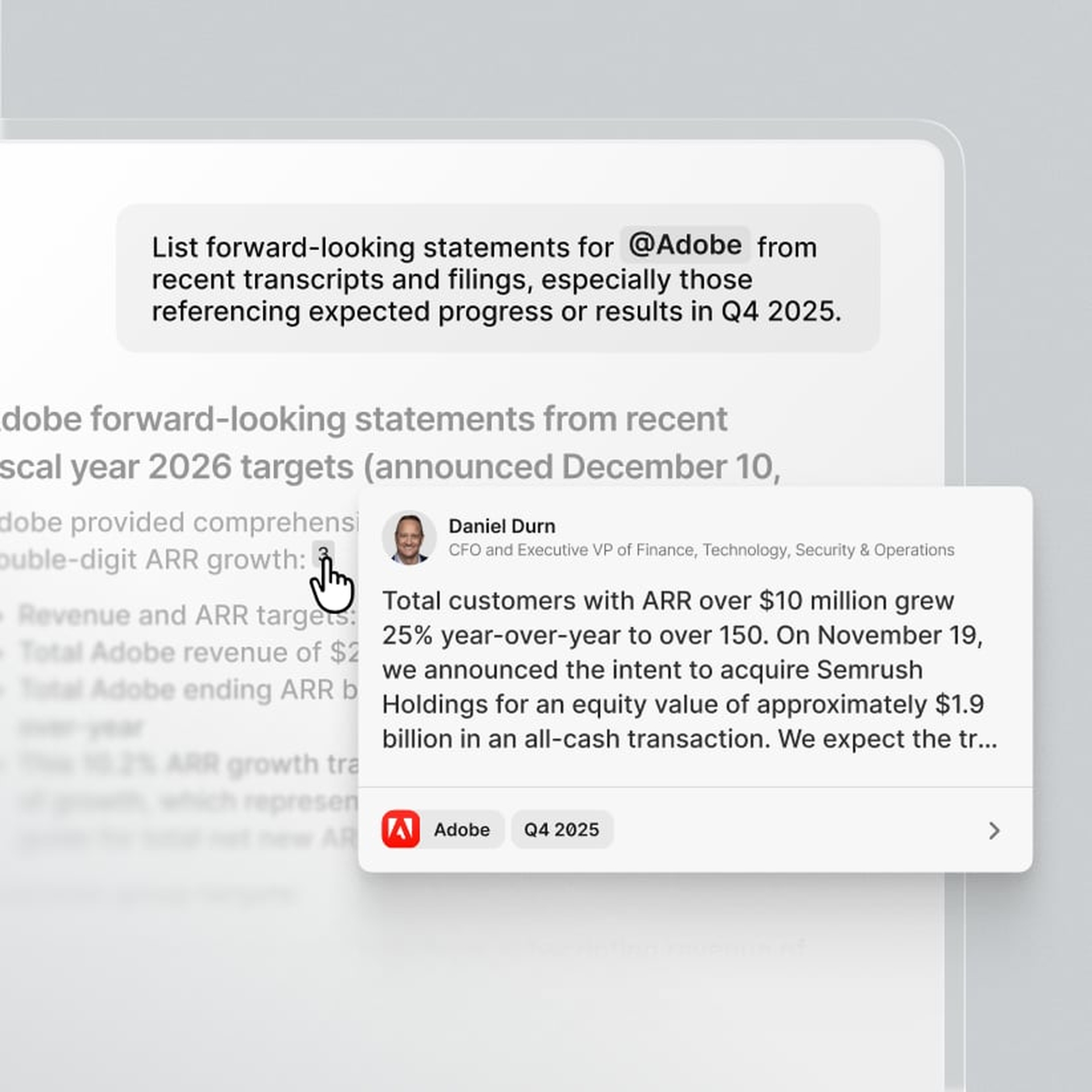
Automations


Live audio & transcripts

Quartr's AI stands out because it only pulls clean, first-party data from public companies. In investing, that's everything.
Jamie Ross
Investment Manager, GAM Investments
Research that used to take hours now takes seconds with Quartr Pro. Tracking shifts in tone or extracting tables, it's as simple as typing a query.
Tom O'Hara
Investment Director
Before Quartr we spent hours manually compiling insights through the peer earnings cycle. Now, these tasks are done faster, with greater precision.
Gregg Lampf
VP of Investor Relations
Being able to ask specific questions across years of transcripts and reports and instantly get verified answers is a game-changer.
Pontus Dackmo
CEO & Investment Manager

JP Morgan Chase is a multinational investment bank and financial services company headquartered in New York City. The company was formed in 2000 through the merger of J.P. Morgan & Co. and Chase Manhattan Corporation.
JPMorgan Chase generates a big part of its revenue through its investment banking services, which include advising on mergers and acquisitions, underwriting securities offerings, and managing assets for institutional and retail clients. The company's investment banking division is consistently ranked among the top performers in the industry, with JP Morgan Chase serving as a trusted advisor to some of the largest corporations in the world.
JP Morgan Chase also operates a consumer banking division, offering a range of retail services such as checking and savings accounts, credit cards, mortgages, and auto loans. The company has a significant presence in the United States, with over 4,700 branches and 16,000 ATMs across the country.
JP Morgan Chase's asset management division offers wealth management services to individuals and institutions. The company manages a wide range of assets, including equities, fixed income securities, and alternative investments. JP Morgan Chase's asset management division is one of the largest in the world, with over $3 trillion in assets under management.
JP Morgan Chase operates in a highly competitive financial services industry, with other public companies such as Bank of America, Wells Fargo, and Citigroup also offering similar services. JP Morgan Chase is known for its strong brand reputation and its focus on innovation, with the company investing heavily in technology to improve its services and stay ahead of the competition.
JP Morgan Chase has a long history and a significant impact on the financial industry. The company's namesake, John Pierpont Morgan, was one of the most influential financiers in history, playing a pivotal role in the development of the modern financial system.
JP Morgan Chase has also been involved in some of the most significant financial transactions in history, including the financing of the construction of the Titanic and the merger of Exxon and Mobil.
The company is known for its corporate social responsibility initiatives, including investments in affordable housing and small business development.
JP Morgan Chase is also a significant employer, with over 250,000 employees worldwide. The company has been recognized for its commitment to diversity and inclusion, and its efforts to create a more equitable workplace.
Despite facing criticism over issues such as its role in the 2008 financial crisis and its ties to fossil fuel companies, JP Morgan Chase remains a leader in the financial services industry and continues to shape the future of finance through its innovative approach to technology and sustainability.