)
)
)
)
)
Company research28 Aug 2024
Databricks: Ready for 2025 IPO
Databricks, leader in data analytics and artificial intelligence, is ready for a 2025 IPO, positioning itself as one of the year's largest tech offerings.
Search almost any obscure question, and chances are the best answer lives in a Reddit thread. Whether it's fixing a leaking dishwasher or figuring out how to navigate a divorce, millions of people turn to communities of strangers who have already debated the exact issue in surprising detail. Over two decades, those conversations have accumulated across hundreds of thousands of communities, forming a vast archive of human experience. That archive has powered Reddit's intent-driven advertising and positions it uniquely in the age of AI.
In 2005, the internet had forums and blogs, but it did not yet revolve around feeds, followers, or personal brands. Facebook was still confined to college campuses, Twitter had not launched, and online communities were fragmented across destinations like Digg, Slashdot, MySpace, and interest-specific forums.
That year, University of Virginia seniors and friends Steve Huffman and Alexis Ohanian applied to the first batch of Y Combinator with an idea for a mobile food-ordering service. The idea was rejected, but the founders were accepted into the program. Instead, they were encouraged to build something simpler in mechanism but broader in ambition: the front page of the internet.
Huffman and Ohanian believed the web needed a forum where participation was open for everyone, but visibility was earned. Rather than relying on editors, chronological feeds, or algorithms to surface content, they would let the users decide what rose to the top. Playing on the phrase “I read it,” they named the site Reddit and launched it on June 22, 2005. Alongside it came Snoo, the small alien mascot sketched by Ohanian that would become the platform's lasting symbol.
The concept was straightforward: users could submit links, discuss them in comment threads, and vote on which posts deserved attention. To get things moving and avoid the appearance of an empty room, the founders created multiple accounts themselves, posting and upvoting links until organic users began to arrive.
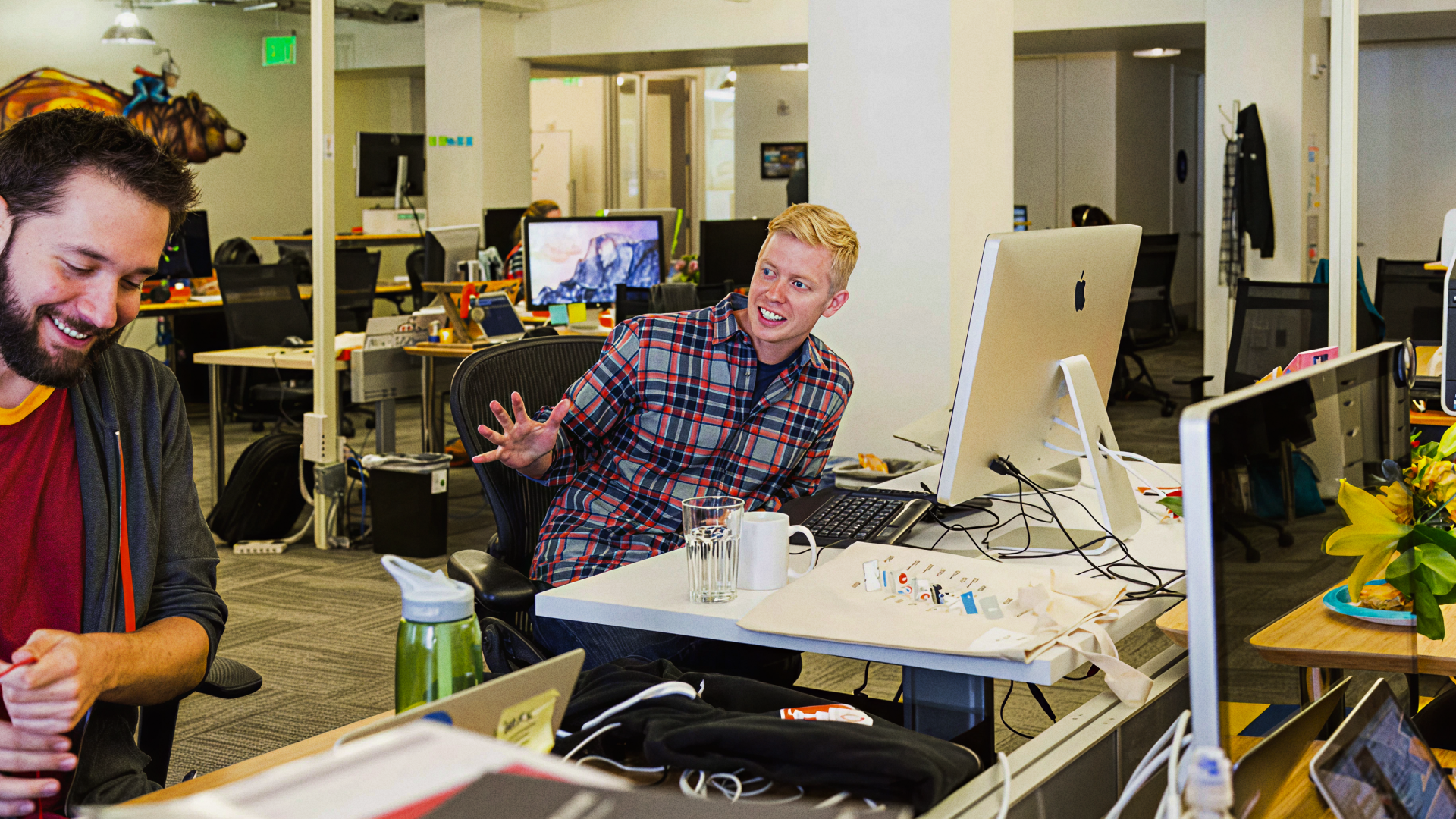
The fabricated activity quickly became unnecessary. As real users increased, growth began to sustain itself. By August of that first year, Reddit was already expanding on its own, driven by word of mouth and search. That would prove to be a pattern central to its story for decades to come.
By 2006, the site crossed 500,000 daily impressions. In October that year, Condé Nast – publisher of Wired, Vogue, and The New Yorker – acquired the company for a reported $10M and relocated the team to San Francisco. Huffman and Ohanian stayed on, running Reddit as a small team inside a large media organization while the platform continued to expand.
Leading up to 2008, Reddit was still structurally unified, with every topic competing on a single homepage. Technology links, political commentary, memes, and niche hobbies all rose and fell in the same feed. That model worked at a small scale, but as participation broadened, the limits of the structure became apparent.
In 2008, Reddit introduced subreddits: independent, user-created communities organized around specific topics. This was a pivotal step toward what Reddit would ultimately become: a federation of communities, each capable of developing its own identity, norms, and content hierarchy. Much of Reddit's growth, its challenges, and its business model trace back to this structure and its other core mechanics. Before we continue the story, it helps to understand how that architecture works.
Get curated quality company deep dives every other week.
Compared to the site Huffman and Ohanian launched in 2005, Reddit today operates at an entirely different scale. Yet, while many internet platforms drift from their original mechanics as they grow, Reddit has largely reinforced its founding principle: communities organizing and ranking conversations themselves.
Most people have encountered Reddit at some point. If not intentionally, then perhaps indirectly after Googling an obscure question and landing on a thread where users have already debated the exact issue extensively. Over time, Reddit has become one of the internet's primary repositories of human experience, where highly specific questions meet equally specific expertise. Across those niches live millions of everyday questions, product recommendations, breaking news, image sharing, and simple link aggregation.
Today, more than half a billion people visit Reddit each month across its website and app. Beneath that scale sits a database spanning more than two decades of accumulated conversation.
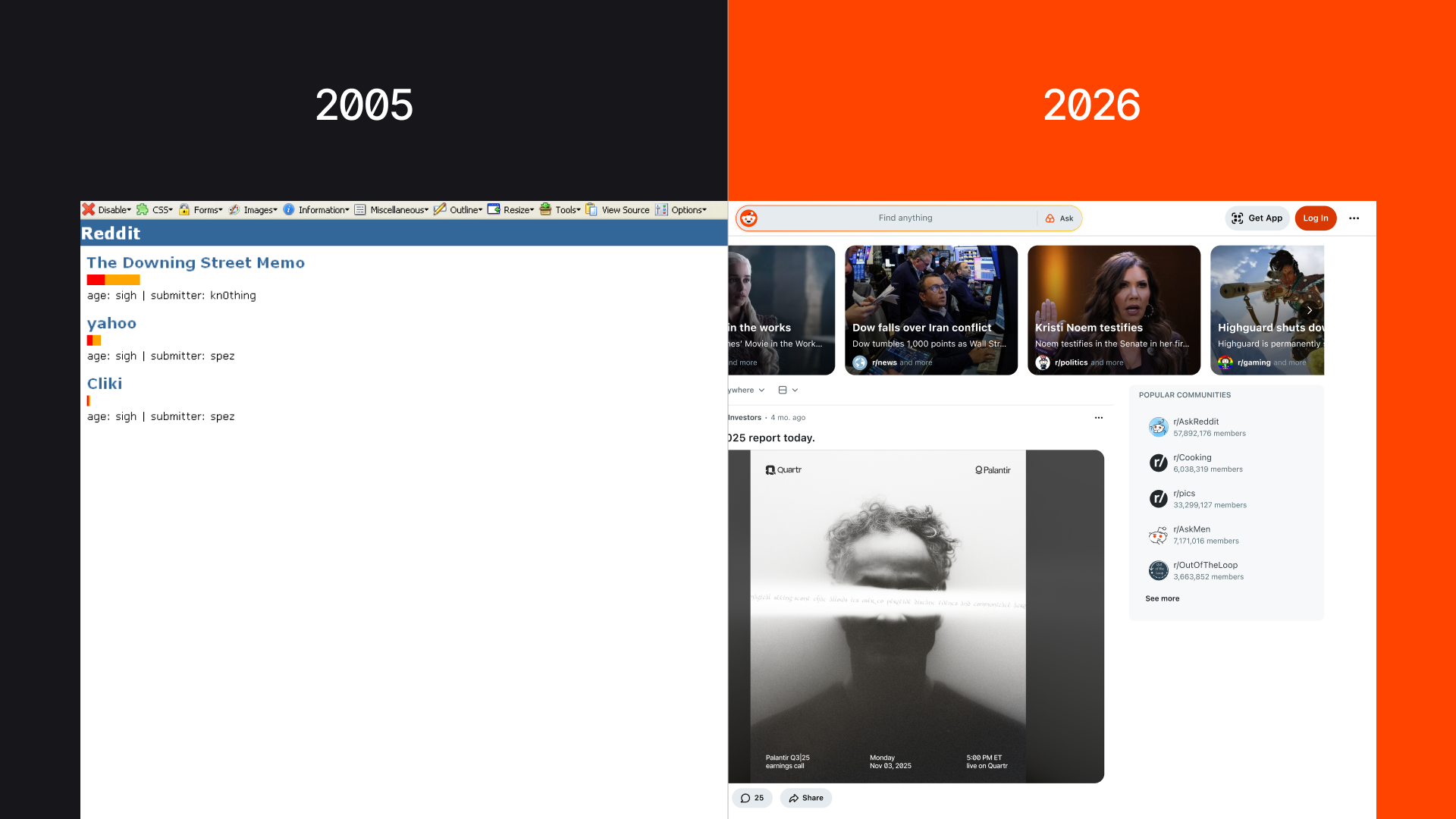
Anyone can browse Reddit without creating an account. The archive is open, searchable, and persistent. Creating an account unlocks participation, allowing users to post text, links, images, videos, or polls, and can comment, upvote, or downvote.
Instead of organizing around networks such as friends, followers, and personal profiles, Reddit organizes around interests and pseudonymous identities. As we touched on previously, the platform is now structured around subreddits: self-contained communities denoted by an r/ before their name, now totaling more than 100,000 active topics.
If you're, call it, 17 to 70, men, women, nerds, normies, whatever it is, there is a community for you on Reddit.— Steve Huffman
A user interested in large language models or prompt engineering might join r/ArtificialIntelligence, another drawn to retail trading might gravitate toward r/WallStreetBets – community discussions which we have reason to return to later. Each subreddit develops its own tone, rules, and norms, meaning users effectively experience different versions of Reddit depending on where they participate.
Some users arrive with a clear intent: to ask a question, research a purchase, or engage in a specific topic. Others browse more casually, moving between communities out of habit or curiosity. But even casual scrolling tends to revolve around defined interests rather than personal networks. That distinction shapes both the depth of discussion and the durability of the content, reinforcing Reddit's position as an interest-driven platform rather than a personality-driven one.
“Reddit is different than social media in that you're joining community, and so it's a more intentional experience. But over our history, we've been a slower grower than social media, because it's not -- right, where social media works, it's like I invite my friends, they invite their friends, you get this really, really powerful network effect. Reddit's more intentional.”
– Steve Huffman, CEO of Reddit, at the Goldman Sachs Technology Communacopia and Technology Conference 2024 (sourced through Quartr Pro).
Open participation and collective voting sit at the core of Reddit's architecture. Because anyone can submit a post or contribute to a discussion, visibility of a post or comment emerges from how the community responds rather than from pre-existing status or network size. Posts and comments rise or fall based on aggregated user assessment, forming a transparent, community-driven ranking system.
In effect, relevance is surfaced through human judgment at scale. Contributions gain prominence because a critical mass of users found them useful, credible, or funny. Protecting that signal is essential, and Reddit invests heavily in detecting bots and coordinated manipulation to preserve the integrity of the voting system.
Over time, that mechanism is key to the trust many users have in Reddit. If someone researching which drill to use for a concrete wall encounters a recommendation with 103 upvotes, those votes represent genuine community endorsement. Steve Huffman discussed that signal in comparison with feeds on social media at the 52nd J.P. Morgan Annual Global Technology, Media and Communications Conference 2024:
“Every post and comment on Reddit starts out at 0 points and has to earn accessibility. And so what this means is things don't become popular on Reddit unless a group of like-minded people make it popular. And so the content, if you kind of play all this through, what happens is on Reddit is the content is more authentic.”
Contributors on Reddit accumulate “karma,” a public score reflecting the net reception of their posts and comments. Karma functions as a visible reputation signal and a shorthand for sustained, community-validated participation. While anyone can create an account, many subreddits set minimum karma thresholds to filter out spam, bots, and low-effort contributions.
Reddit's structure relies on communities organizing and moderating themselves. The key to this is its volunteer moderators, unpaid members of the community who define rules, remove posts, and enforce standards. Creating a subreddit automatically confers moderator status, and growing communities appoint additional moderators from within their ranks. The position carries no financial compensation but only authority, responsibility, and influence over the community's culture.
Every subreddit relies on one or more individual moderators. Since these users and each community context differs, some subreddits maintain strict quality thresholds, while others embrace irrelevance. Moderators are usually long-standing community members motivated by ownership, reputation, and commitment to the topic.
Reddit's internal teams provide tooling, oversight, and continuous dialogue with its moderators. With more than 100,000 active communities, Reddit's governance model and day-to-day functioning rely fundamentally on these volunteer moderators. At that scale, centralized oversight alone would be impossible, as Steve Huffman noted at its Q3 2025 earnings call:
“Moderators aren't just enforcing rules. They're shaping culture, building communities and helping Reddit thrive.”
As Reddit grew inside Condé Nast, the parent company took a largely hands-off approach. That autonomy allowed Reddit's culture to evolve organically, but it also meant the company remained underbuilt relative to the scale of its user base. In 2009, when their initial contracts expired, both Huffman and Ohanian left the company they had founded.
In their absence, Reddit continued to grow in users and content breadth. By then, it had begun to resemble the platform we recognize today. Users created subreddits, defined norms, and moderated discussions. The distributed model allowed Reddit to expand without heavy centralized control. But as its reach widened, the gap between community autonomy and corporate oversight gradually became harder to manage.
Although some of that gap was an intentional consequence of Reddit's philosophy to avoid centralized governance, it was also the result of limited resources. Huffman has since recalled in interviews that, despite serving millions of users, Reddit was at times run by no more than two people during those years.
In 2011, Reddit was spun out as an independent subsidiary. The shift gave the company greater autonomy to invest in engineering, move faster, and introduce equity-based compensation, a critical feature for attracting and retaining talent in Silicon Valley.
The following year would bring two defining moments for the platform. In early 2012, Reddit joined a coordinated protest against two proposed U.S. bills, SOPA and PIPA, which critics argued would impose sweeping liability on user-generated platforms. Alongside Wikipedia, Mozilla, WordPress, and with Google altering its homepage, Reddit went dark for twelve hours, directing users to contact lawmakers. For many users, it was the moment Reddit stopped being a place they visited and became a cause they belonged to. Both bills were later shelved amid broad opposition.
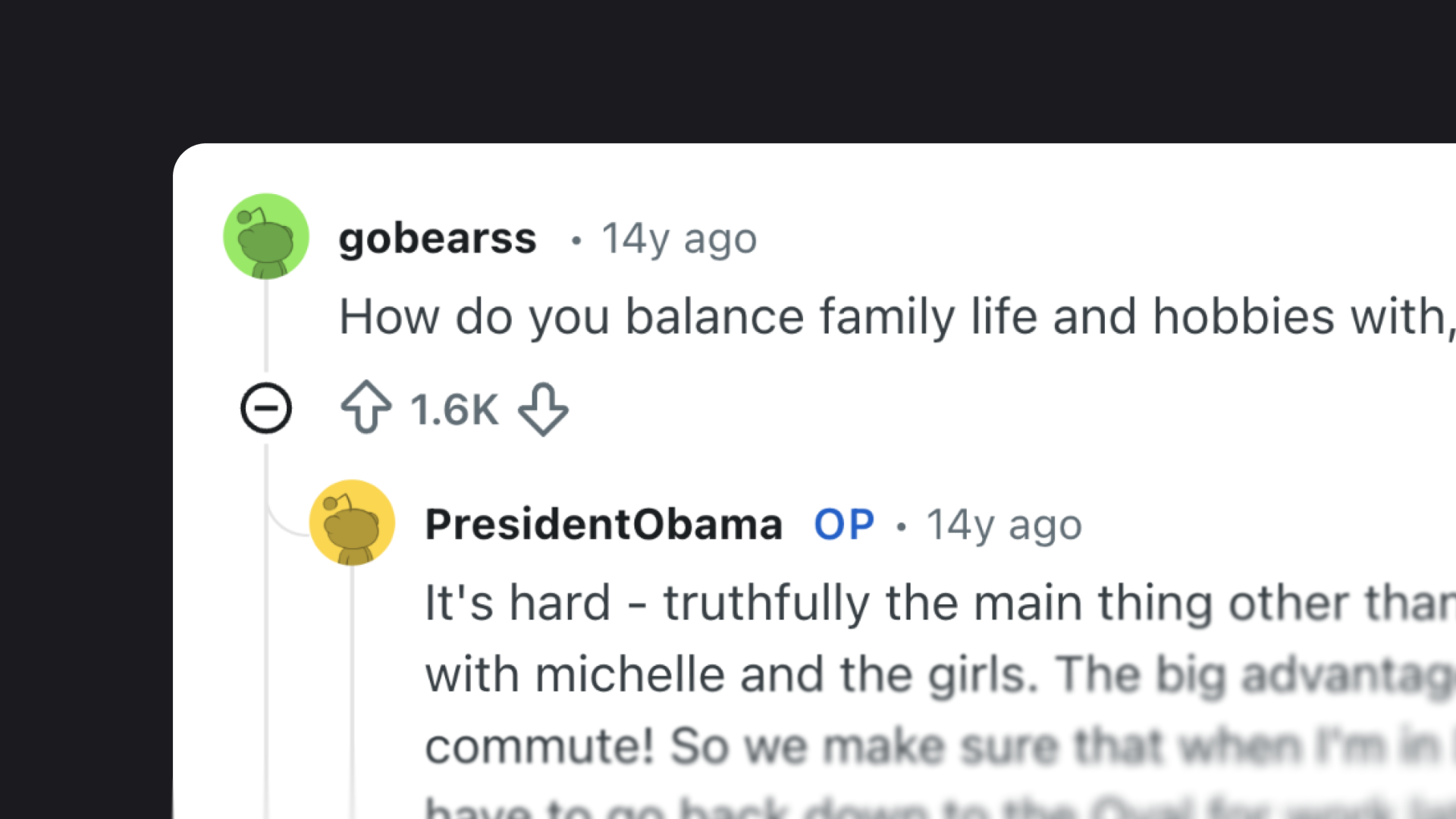
Later that year, the platform found itself collaborating with the very institutions it had protested. President Barack Obama hosted an Ask Me Anything (AMA) session, taking questions directly from users for thirty minutes. The thread drew nearly two million simultaneous viewers and intermittently strained Reddit's infrastructure. What began as a simple link-sharing website had become the de facto public forum of the internet.
Around this time, the company raised $50M in a funding round that valued it at $500M, with backing from Sam Altman, Peter Thiel, and Marc Andreessen, among others. From a business standpoint, however, Reddit remained modest relative to its growing influence. Advertising on the platform had been introduced in 2009 but was still limited primarily to sponsored links and basic display formats.
Approaching the mid-2010s, user engagement continued to expand, but the imbalance between scale and structure was becoming increasingly visible. Reddit's infrastructure lagged its growth, and governance mechanisms struggled to keep pace with the breadth of conversation unfolding across thousands of communities. The platform's culture had matured faster than the policies designed to manage it.
Reddit was founded upon minimal central intervention, treating broad latitude as both a principle and a practical necessity given its scale. But some of what that freedom had produced was widely viewed as toxic, and advertisers grew reluctant to appear alongside it. In 2015, the company banned several subreddits, prompting fierce resistance from parts of the user base who saw centralized moderation as a breach of Reddit's implicit contract.
Tensions escalated further when the dismissal of a key employee responsible for moderator relations triggered widespread protests. Hundreds of major subreddits temporarily went private, darkening large portions of the site. It was the first time Reddit's decentralized power structure asserted itself directly against company leadership.
After a second leadership shakeup in just a few years, Reddit's board searched for stability. Executive Chairman Alexis Ohanian, who had recently returned, and board member Sam Altman were central to that effort. The question eventually became whether one of the platform's original architects should come back to lead it. To steady the company, the board turned to co-founder Steve Huffman, and in July 2015, he returned as CEO.
Huffman came back to a company at an inflection point. Since its founding, Reddit had embraced a philosophy of broad free expression and minimal interference in community-moderated discussions. Central intervention was deeply sensitive, but preserving that was beginning to threaten the company's viability as a business. In a 2025 episode of The Prof G Pod with Scott Galloway, Huffman summarized his message upon returning:
Look, it's not 'if we change, we'll die.' It's 'if we don't change, we'll die'.
That marked the beginning of a shift: from a largely hands-off approach toward a more deliberate balance between community autonomy, governance, and business sustainability. The initial focus was operational. Reddit began modernizing its infrastructure, rebuilding trust with moderators, and aligning product development with its scale. From these efforts, Reddit's image gradually improved, bringing more users to the platform and, over time, attracting advertisers back. Another part of that evolving identity was the product itself. In 2018, Reddit launched its first major redesign since its early years, with Huffman describing the original interface as resembling a “dystopian Craigslist.”
By the late 2010s, Reddit had become one of the most visited sites in the United States. Its subreddits numbered in the tens of thousands, its archive had grown into billions of posts and comments, and its reach now spanned nearly every conceivable subject. Monetization was progressively beginning to reflect that scale. Although the company remained unprofitable, its advertising products grew more sophisticated and increasingly aligned with its interest-based communities. At the same time, Reddit continued to move away from its reputation as a loosely governed forum, investing more deliberately in policy, moderation tools, and institutional oversight.
That momentum carried into the pandemic years as lockdowns and social isolation drove more time online and a stronger pull toward digital communities. By 2020, Reddit was fundamentally different from the company Huffman had returned to five years earlier: governance had matured, the product had been overhauled, and users had grown into the hundreds of millions.
Reddit had come far in its transformation, and soon it would find itself on the front page of financial newspapers around the world.
In early 2021, Reddit's community mechanics transitioned from an internet subculture to the global financial spotlight. At the center was r/WallStreetBets, a subreddit built around high-risk retail trading, memes, and sharing investment theses. During the pandemic, participation in retail markets accelerated amid a low-rate and stimulus-check economy, zero-commission trading on platforms such as Robinhood, and millions confined to their homes. Within that environment, discussions around the struggling video game retailer GameStop suddenly gained traction.
The original and most prominent voice behind the thesis was a user known as Roaring Kitty, posting under the alias “DeepFuckingValue”. For months, he had shared detailed fundamental analysis, arguing that GameStop was undervalued while emphasizing that its extreme short interest created asymmetric upside. His posts were debated, memed, and amplified through Reddit's voting system. As engagement intensified, the thesis spread into a shared conviction.
As buying activity intensified, GameStop's share price surged, rising roughly fortyfold within months, prompting users to search for the next heavily shorted stock that might follow. Financial media coverage exploded while r/WallStreetBets grew by millions of members in weeks, and Reddit became one of the most visited sites globally during the peak of the frenzy.
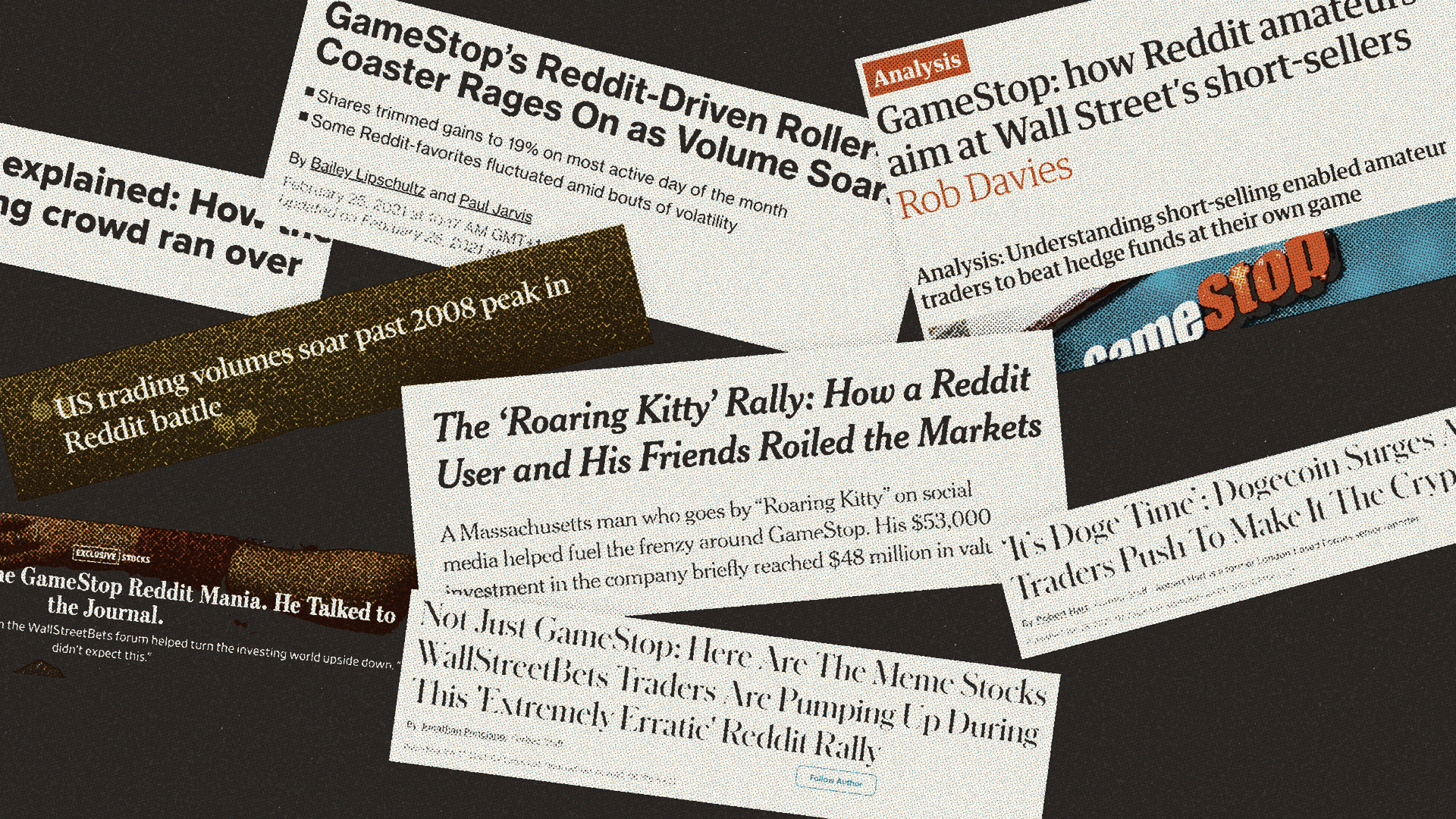
For Reddit, the episode was both scrutiny and validation. As Steve Huffman told The Wall Street Journal: “This whole event is showing the power of large communities of everyday people.” In congressional testimony, he defended the subreddit's role, emphasizing that visibility on Reddit reflects collective judgment: “WallStreetBets may look sophomoric or chaotic from the outside, but the fact that we are here today means they've managed to raise important issues about fairness and opportunity in our financial system. […] I'm proud they used Reddit to do so.”
GameStop's short squeeze and the “meme stock” wave of early 2021 was in many ways a breakthrough moment in Reddit's evolution. What had long been recognized by its users, that Reddit was a network of intent-driven communities capable of concentrating attention and conviction, became visible at a global scale. The platform's design allowed thousands of individuals to evaluate a thesis together, debate it openly, question or reinforce their beliefs, and ultimately act independently.
In the years that followed, the company invested heavily in its advertising infrastructure, improving targeting, measurement, and performance tools, while expanding its sales organization. Revenue continued to grow, driven primarily by advertising, but profitability remained distant as spending on product, infrastructure, and go-to-market stayed elevated.
At the same time, user engagement and traffic began to accelerate. After a relatively flat period through 2022, user numbers rebounded sharply into late 2023. The platform was as culturally relevant as ever, while expanding structurally, driven by both returning users and the growing stream of search-driven visitors.
Reddit went public on the NYSE in March 2024 at a valuation of approximately $6.4B. True to its values, the company structured the offering to include its own community. Through a Directed Share Program, qualifying users were invited to purchase shares at the IPO price alongside institutional investors. In its S1 Registration Statement, Reddit framed the decision: users had long expressed a sense of ownership over the communities they built, and the company wanted that sense of ownership to be reflected in real equity participation.
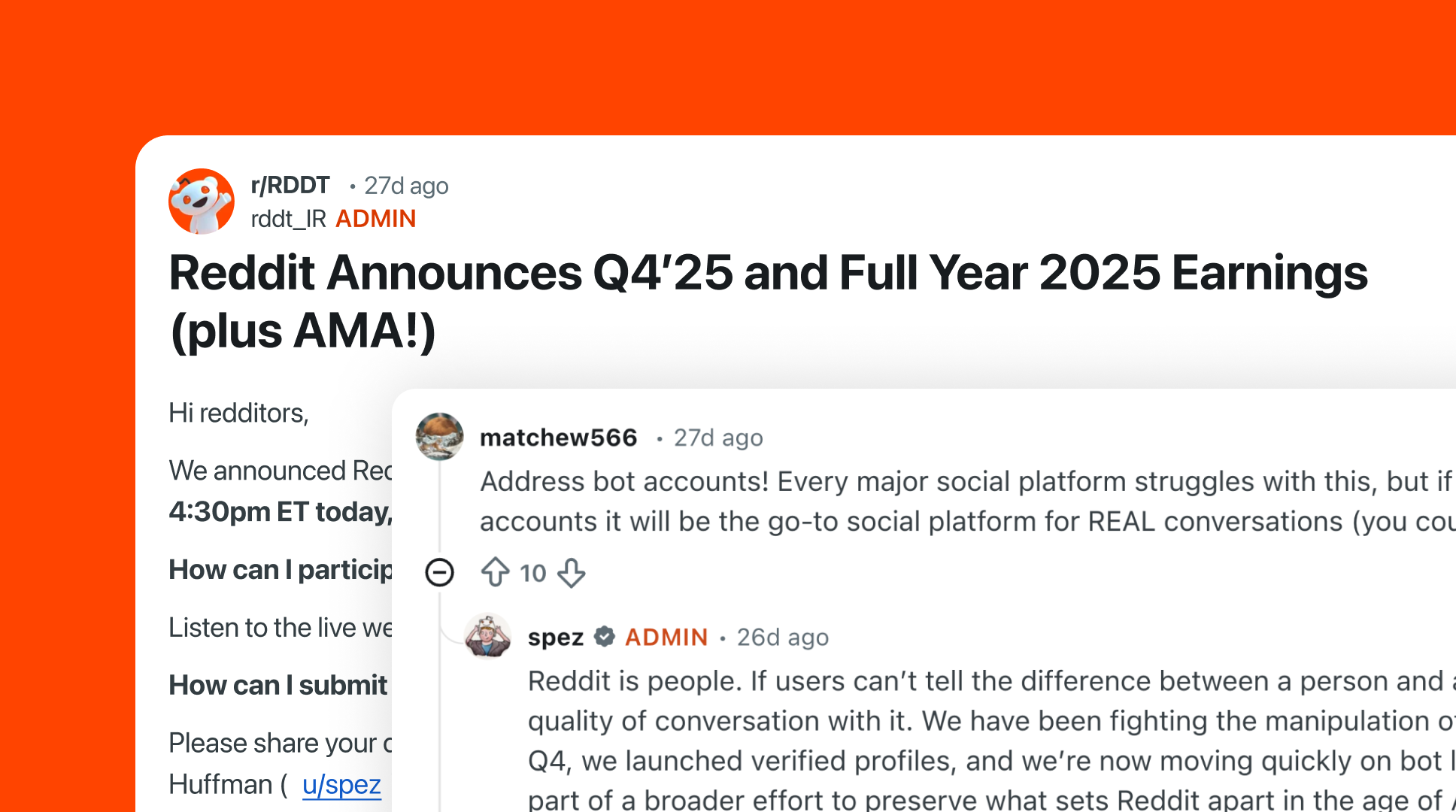
Reddit also launched r/RDDT as a dedicated investor relations subreddit and hosted an AMA with management during the listing process. That community engagement has continued post-IPO. After each earnings call, management returns to r/RDDT for AMAs, sourcing questions directly from users and responding from their own user profiles.
For much of the 2010s, Reddit's scale outpaced its monetization. The platform became culturally influential while remaining economically underdeveloped. That imbalance began to shift decisively around its 2024 IPO and has continued to strengthen since. At the time of its public debut, Reddit had just closed 2023 with annual revenue of $804M, up from $485M two years earlier. Since then, revenue has climbed further to $2.2B in 2025.
Improved monetization is only part of the story, as traffic and engagement have expanded equally impressively. As of January 2026, Reddit ranked as the sixth most-visited website globally. That status is reflected in its user growth in recent years and is visible in the company's core operating metrics. Daily active uniques (DAUq) increased from 73 million in Q4 2023, just prior to the IPO, to 121 million in Q4 2025. Over the same period, weekly active uniques (WAUq) expanded from 268 million to 472 million.
)
The underlying model is straightforward: Reddit provides the infrastructure, users generate the content, and the company monetizes the attention that content attracts. Revenue remains predominantly advertising-driven, accounting for approximately 94% of the total. Data licensing represents about 6% of the total, a small but increasingly important line of business in the age of AI that we will revisit later.
As mentioned, Reddit generates the vast majority of its revenue from advertising, reaching $2.1B, up 74% year-over-year. On most social platforms, intent must be inferred from scrolling behavior. But on Reddit, intent is often declared explicitly. When users join subreddits, whether it be r/PersonalFinance, r/SkincareAddiction, or r/HomeImprovement, they signal interests. Over time, that creates a structured map of what users actively care about.
The signal becomes even stronger at the page level. A user reading a thread titled “Best espresso machine under $500?” or “Which backpack holds up for multi-day hikes?” is most likely researching a product they're genuinely interested in buying. The ad isn't targeting a person who, out of coincidence, browsed coffee grinders three weeks ago. Instead, it's targeting the context of product evaluation in real time. That contextual alignment differentiates Reddit from platforms that rely primarily on historical behavioral profiles. Speaking at its Q4 2024 earnings call, COO Jennifer Wong highlighted how embedded commerce is within these discussions:
“Reddit is actually inherently commercial in so many ways. About 40% of the posts are actually classified as like purely commercial, meaning about products and services. But in a lot of ways, like joining an interest, starting skiing, I mean, that is commercial and that there's gear and things that you want as you start up an interest.”
Interests naturally evolve into purchase decisions, and those decisions unfold in public threads for everyone to see. Reddit's two-decade archive of candid discussions becomes particularly powerful given that a large share of traffic lands directly on these conversation pages via search. Someone arriving at a 200-comment discussion comparing home ice cream makers is already deep in evaluation mode. Management has described this surface as “one click more intentional than what you see on Google.”
The broader point is that these pages concentrate high-intent traffic in ways few platforms can. For advertisers, that feature increases conversion probability per impression, and for Reddit it supports higher effective monetization without relying on heavy ad loads. As Steve Huffman noted at the 33rd Annual Media, Internet & Telecom Conference in 2025:
“[We are] making sure when they land on Reddit for the answer to their question, that there's the most relevant ad possible. And so I think that's a really lucrative opportunity for us if we make that connection. And I think it will be really beneficial to the user as well, again, because they're in a transactional mindset.”
Reddit's advertising proposition also rests on credibility. Posts and comments earn visibility through community voting, reinforcing discussions that resonate within specific groups. The result is a reputation for honest product debates and lived experience. When advertising appears alongside those conversations, it inherits contextual legitimacy. Importantly for the user experience, this allows Reddit to monetize with restraint. As Jennifer Wong explained at the Morgan Stanley Technology, Media & Telecom Conference 2025:
“If you look at our ad load in the feed, it's about half of peers, like or closer one to 8, they are often one to 4. It's not a knob that we think about turning today. And the reason why is because our impression growth is driven by very healthy underlying user growth.”
Reddit's monetization is often measured through average revenue per unique user (ARPU), which reflects total revenue across advertising and other streams such as data licensing. But because advertising represents roughly 94% of the total, the metric is largely driven by the performance of its advertising business. In 2025, ARPU ranged between $3.63 and $5.98, up from $2.72 to $3.42 in 2023 prior to the IPO.
)
That expansion has been driven by improved monetization per impression as Reddit's ad stack matured with better targeting, stronger measurement, and rising advertiser confidence. At the same time, revenue mix has shifted toward performance advertising, where campaigns are optimized for measurable outcomes such as clicks, conversions, and installs rather than brand impressions alone. Performance budgets typically command higher pricing and generate more repeat spend.
The output of that engine, however, remains uneven across regions. In 2025, the U.S. accounted for more than 80% of the company's total revenue. Most recently, and in ARPU terms, U.S. monetization reached $10.79 in Q4 2025 versus $2.31 internationally. While international ARPU has improved in absolute terms since Q4 2023, the gap has widened as domestic monetization has scaled more quickly.
That difference is mainly explained by market maturity and platform penetration. In the United States, user awareness is higher, advertiser density is deeper, and performance budgets are more established. More bidders compete for each impression, which drives prices higher.
Internationally, user growth has been stronger in the past few years. From representing roughly half of DAUq at the time of the IPO, it now represents 57% of the total as of Q4 2025. At the Goldman Sachs Technology Communacopia and Technology Conference 2024, Steve Huffman commented that the user mix is likely to continue shifting in that direction:
“If you look at our peers in this space, they range from 80% to 95% outside the U.S. So just kind of like -- almost like a law of nature, the way these Internet platforms go. We would expect to grow up to that range. And so for us, the question is just over what time period.”
Despite now having more users abroad, international revenue remains well below U.S. levels, as these markets are earlier in their monetization development and operate under different conditions. Brand awareness is still developing, advertiser relationships are being built, and campaigns often begin with upper-funnel brand objectives before shifting toward the more lucrative performance advertising.
Structural differences further widen the spread. Many of Reddit's fastest-growing markets, such as Brazil, France, India, and Germany, all face lower digital ad pricing levels compared to the U.S. as a result of broader differences in advertiser spend per capita and competitive intensity.
Analyzing the composition of Reddit's user growth adds nuance to the divergence between U.S. and international ARPU. In Q4 2025, international DAUq grew 28% year-over-year, compared with 9% in the U.S. Much of that growth was driven by users who found the platform through search engines, browsed without signing in, and left without creating an account.
Internationally, this group of logged-out daily users grew 40% year-over-year and now makes up 60% of all international daily users. In the U.S., the figure is slightly lower at 56%. What makes this notable is that both regions were at the same level when the company went public. In other words, the regional gap has widened since then. Logged-out users generate impressions, and Reddit earns the same advertising revenue for these. But the issue is that these users engage less deeply and return less frequently than logged-in users, thereby limiting monetization potential.
The divergence is also visible in engagement ratios. The DAUq/WAUq ratio, a common proxy for platform stickiness, has remained stable in the U.S. at roughly 27-28% since the IPO, even as user numbers increased. Internationally, the ratio declined from 26.9% in Q4 2023 to 24.8% in Q4 2025. Engagement is clearly expanding globally, but habitual usage remains more established in the home market. Together, these two aforementioned trends are consistent with earlier-stage platform penetration. If these improve over time, monetization should improve.
Bridging the ARPU gap between its U.S. and international markets will be central to Reddit's revenue trajectory. The company is addressing this through initiatives aimed at both user depth and advertiser infrastructure.
On the user side, the focus is expanding accessibility through machine translation, now supporting more than 30 languages, increasing visibility in local search, and accelerating community formation in non-English markets. Reddit is also investing in understanding each market's nuances: identifying locally relevant topics, supporting native-language moderators, and running awareness campaigns to deepen platform penetration.
On the advertiser side, the company is building out its international commercial infrastructure. This includes expanding local sales teams and deepening agency relationships, while enhancing its measurement and automation capabilities to feed real-time conversion data back into its ad systems for improved targeting and campaign performance. Together, these efforts aim to increase user depth and advertiser demand simultaneously, as Steve Huffman summarized at the Q4 2024 earnings call:
“The potential is there because communities are universal. And our work is working. Now it's very high-touch work because we're growing communities, right? We can't force it, but it's coming along nicely. And then the revenue will follow the users.”
Reddit occupies an unusual position on the internet. It competes with social platforms for time and advertising budgets, while also functioning as a discovery layer accessed through search. Like social media, Reddit hosts user-generated interaction. Like search, it captures intent. Yet structurally, it resembles neither. As Steve Huffman put it at the 52nd J.P. Morgan Annual Global Technology, Media and Communications Conference 2024:
“I often frame Reddit in juxtaposition with social media. And so social media is powered by the Fs, as I call them: friends, followers, family, famous people. And Reddit's organized around community. And so the dynamics and incentives are really different. Social media also has algorithms that make things popular, whereas on Reddit, things are made popular through voting and through voting in the context of a community.”
Reddit is not organized around identity or personal broadcasting. Its content is structured around topics, and engagement is driven by intent, positioning it at the intersection of community and knowledge. Many of the questions it answers best are those without a single correct response, where insight emerges from the aggregation of many perspectives. That positioning, combined with more than two decades of publicly accessible, searchable, and persistent conversations, has created a continuously expanding archive of community-ranked human discussion, shaping the economics of its advertising engine.
As more of the internet becomes machine-generated, that has put Reddit in a unique position.
We have nearly two decades of authentic conversation, unique perspectives, earnest advice, honest reviews, and answers to questions about every topic imaginable.— Steve Huffman
In 2023, advertising amounted to 98% of Reddit's revenue and was in all aspects the core of the company's business model. However, from its S1, it acknowledged a structural opportunity that would soon become very relevant:
“Our content is particularly important for artificial intelligence (“AI”) – it is a foundational part of how many of the leading large language models (“LLMs”) have been trained. [...] Our massive corpus of conversational data and knowledge is what makes us unique…”
At the time, data licensing, alongside Reddit Premium and user-economy products, comprised the remaining 2% of revenue, totaling roughly $15M. But embedded in the filing's Risk Factors was an indication of what was to come:
“We are exploring business opportunities in licensing data for purposes including machine learning, business analysis, display, and training generative AI models.”
Reddit's data was not new. What changed was that high-quality human conversation had become a scarce and priced input in the AI value chain. For years, Reddit operated under what Steve Huffman described as an open-web equilibrium. Search engines crawled its pages, indexed discussions, and directed users back to Reddit. The exchange was mutually beneficial: visibility for traffic.
As large language models scaled, that dynamic shifted. Reddit's content was increasingly being used to train AI systems and power answer engines that did not return users to the platform. In response, the company moved from being “default open” to “default blocking” unlicensed crawlers. At its first earnings call as a public company, summarizing Q1 2024, Huffman made its new posture explicit. It now understood the value it held:
“Now will people be able to take Reddit's data, not send any users to us, take credit for themselves and enrich themselves going forward? The answer is no. I think our historical way of handling public data no longer works, right? In the past, I think calling Reddit benefited the whole ecosystem, including users on our platform as we said. But increasingly, we are seeing folks who hoard public data, and they use it to enrich themselves. So we're open-minded about having relationships with companies like this and being included in search and used for training.”
Huffman continued, reinforcing the company's stance and, in doing so, opening the door to data licensing as a formal business line:
“We're open for business. But we're not just going to give it away. And I don't think companies that have taken or continue to take our data can expect to continue to do so with no repercussion.”
Over more than two decades, users have generated billions of posts and tens of billions of comments. Continuously refreshed, organized by topic, ranked by voting, and moderated by communities, the archive represents a structured map of human experience.
In the AI era, that corpus has taken on new economic weight. What was long treated as an open archive is now framed as a proprietary asset. Reddit's combination of scale, freshness, and structured human evaluation is precisely what LLMs seek when grounding responses in lived experience. As Steve Huffman explained at the Q1 2024 earnings call:
“We believe Reddit is more important now than ever before [...] as we enter the AI era, where the value of our corpus continues to grow. The paradox I see is that as more content on the Internet is written by machines, there's an increasing premium on content that comes from real people. And we have nearly two decades of authentic conversation, unique perspectives, earnest advice, honest reviews and answers the questions about every topic imaginable.”
The platform's relevance is increasingly visible in downstream AI systems. A study by Profound, which analyzed over 4 billion AI citations and 300 million answer engine responses between August 2024 and October 2025, found Reddit to be the most cited domain across ChatGPT, Google AI Overviews, and Perplexity between August 2024 and October 2025. While citation shares fluctuate as models evolve, the pattern highlights just how central Reddit's data is within the AI ecosystem.
AI can't try a new hair dryer or listen to headphones and tell you what the experience is like, but users on Reddit can and do. And so that sort of information is super valuable.— Steve Huffman
Reddit has formalized this shift through content licensing agreements, granting partners API access over defined contractual periods, with pricing typically structured as fixed or usage-based fees. By 2025, what was recently an opportunity within a grouped $15M revenue line is now a key narrative shaping its focus.
Content licensing remains reported within “Other revenue,” but has grown that residual line to represent over 6% of total revenue, amounting to $140M in 2025. While still modest in percentage terms, the shift is strategically significant. Reddit's database is no longer treated as a byproduct of community engagement. It is positioned as a proprietary, monetizable input in the AI value chain.
Since opening up for business, Reddit has entered licensing agreements with leading AI developers, including Google and OpenAI, granting structured access to its data. Beyond foundational model training, the company has also expanded partnerships to marketing intelligence and financial data platforms. Consistent with Huffman's comments about blocking scrapers, the company has pursued legal action against firms alleged to have trained models on its corpus without a license. As stated, collaboration is welcome; uncompensated extraction is not.
The value of the dataset is not purely external. Internally, Reddit integrates its conversational archive into its own machine learning systems. Platform-trained models support moderation tools, content translation, feed ranking, and community recommendations. More recently, initiatives such as Reddit Answers aim to surface high-quality human responses directly within threads and search queries. As Huffman described at the 33rd Annual Media, Internet & Telecom Conference in 2025:
“... There's nothing quite like it on the Internet, because when we talk about AI summaries, AI can't tell you what it's like to use this backpack. AI doesn't have kids yet. And so there's like these really important interesting things about the human experience that only humans experience kind of by definition. And so that's what Reddit reveals. And so I think this product will be unique on the Internet in its ability to provide perspectives that are otherwise unattainable online.”
Reddit's history can be broken down into different eras. While the first decade was characterized by user growth, community adoption, and cultural relevance, the second decade – from Huffman's return – has been more about scaling into durable economics. That transition took time, but from the pandemic onward, the financial transformation became evident.
Revenue has increased from $485M in 2021 to $2.2B by 2025, implying a CAGR of 46%. Impressively, in the most recent two years of that period, annual growth rates have exceeded 60%. But the bigger shift over the last couple of years has been profitability, driven by an increasing scale, a more sophisticated advertising stack, and tighter operational execution.
In the years leading up to the IPO, operating losses ranged between $120M and $180M annually. In 2024, its operating loss increased to $561M, largely attributable to an $802M stock-based compensation (SBC) charge triggered by the company's public listing. The IPO activated long-standing RSUs, equity awards that could only vest upon a public listing, compressing years of accumulated compensation expense into one period. Adjusting for that distortion, 2024 marked a strong underlying year, with free cash flow reaching $216M – the first positive annual result in Reddit's history.
By 2025, operating income reached $442M, representing an operating margin of approximately 20%. That margin sits well below Reddit's ~91% gross margin, with the gap largely reflecting its personnel-heavy operating costs and SBC. The company's operations are supported by modest infrastructure costs and capital expenditures running below 1% of revenue. As an asset-light, platform-based business, Reddit's primary operating expenses are concentrated in R&D at roughly 35% of revenue in 2025, Sales and Marketing at around 23%, and General and Administrative at 13%.
SBC remained elevated at $343M in 2025, representing 16% of revenue, though materially lower than the IPO-driven figure in 2024. For 2026, management expects SBC to remain in the high teens as a percentage of revenue. Free cash flow expanded sharply from $216M in 2024 to $684M in 2025, highlighting the operating leverage embedded in the model. Across both advertising and data licensing, incremental revenue flows through with limited capital intensity.
)
On that momentum, the company recently authorized its first share repurchase program of up to $1B, adding buybacks as a third capital allocation lever alongside reinvestment and M&A. Historically, those acquisitions have been small tuck-in deals focused primarily on expanding Reddit's technology and product capabilities. Reflecting the company's improving financial position, CFO Andrew Vollero noted at the Q4 2025 earnings call:
“What you're seeing is the model is starting to inflect and you're seeing the model really shine. CapEx for the full year for this company is under $10 million. So you're really seeing the model start to throw off cash, and so I think that just gives us the ability to execute on all 3 dimensions: first priority, investing in the business; second priority, doing M&A where it makes sense; and then third, share repurchases, we'll be opportunistically in the market from time to time when it makes sense.”
Reddit has always been a story of contrast. While social media is organized around identity and broadcasting, Reddit has grown around communities and shared interests. That distinct positioning has powered its advertising model and now leaves it well placed as an intent-driven counterpoint to the generic and increasingly machine-generated content that dominates much of the web. If its history is any guide, Reddit's future will continue on its own path.
Explore our platforms
Leading companies and financial institutions worldwide rely on Quartr to make better decisions faster.
Desktop
API
)
)
)