)
)
)
)
)
Business philosophy21 May 2026
Target's New CEO: Michael Fiddelke
After more than 20 years at Target, Michael Fiddelke now carries the responsibility of reviving the retailer's growth.
Consumer electronics is not an industry known for producing rapid, sustained growth stories. SharkNinja is a rare exception. From vacuums and blenders to ice cream makers and hair care, its two brands have repeatedly entered crowded categories and taken share from incumbents, or turned overlooked niches into viral successes on a global scale. The direction differs, but the execution remains the same. Behind Shark and Ninja sits a company that has spent decades refining how it identifies consumer problems, builds solutions, and brings them to market. Let's start from the beginning.
The story of SharkNinja begins in the 1990s with a man called Mark Rosenzweig. After studying at the University of Pennsylvania and spending a few years working in Los Angeles, Montreal-born Rosenzweig returned home in 1994 to join the family business, Jolson Corp. Founded by his grandparents in 1954, the company had grown from a local sewing-machine distributor into an industrial supplier serving Canada's apparel manufacturing industry.
But Rosenzweig had far greater ambitions than staying on as a sales manager in the family operation. With support from his parents, he launched Euro-Pro in 1995, selling household appliances such as ironing systems, steam presses, sewing machines, and food processors. In its early years, the company sourced products overseas, particularly from China, and competed largely on affordability.
Although Rosenzweig's business grew and took market share from the well-known appliance brands on local store shelves, its approach began to shift by the mid-2000s. Rather than relying solely on generic imports, Euro-Pro started bringing more design and product development in-house, aiming to differentiate on functionality rather than price alone.
One of the first products to emerge from that shift was a steam mop. The launch of that purple mop proved successful and was soon followed by a broader lineup of wet floor cleaning products. Importantly, this gave the company direction, sharpening its focus on floor care and introducing a new brand name: Shark.
During these years, Rosenzweig and Euro-Pro began working closely with Wayne Conrad, a Canadian inventor with a portfolio of vacuum-related patents. The partnership would prove decisive. In 2009, the company released its breakthrough product: the Shark Navigator vacuum cleaner, built around a patented “no-loss-of-suction” technology.
The Shark Navigator addressed one of the most familiar flaws of standard vacuum cleaners at the time: suction declined as the dust bin filled and the filters clogged. With its patented airflow and filtration system, the Navigator promised consistent suction over time. At its core was a high-efficiency, compact motor capable of generating powerful, controlled airflow. This capability would later become foundational across Shark products, from vacuum cleaners to air purifiers and, eventually, hair dryers. For the first time in its history, Euro-Pro was competing on proprietary, patent-backed technology.
In terms of pricing, the Navigator sat above the everyday vacuum cleaner, but remained accessible relative to the functionality it offered. Dyson, the British pioneer (and future competitor to several Shark products), had already shown that consumers were willing to pay for high-performance, technology-led vacuums. The Navigator proved that a similar promise could be delivered at a lower price point.
For this and subsequent launches, and before social media and influencers became central to product launches, the company leaned heavily into television marketing and infomercials. The format offered a relatively cost-effective way to demonstrate performance at scale, particularly for products where visible proof mattered. The strategy worked, and in the years that followed, Shark expanded the Navigator into a growing lineup of vacuums tailored to different use cases: uprights, canisters, handhelds, and cordless models, all built around the same core promise.

As Shark was gaining momentum, a second growth path was beginning to take shape inside the company. In 2008, Mark Barrocas, a longtime friend of Rosenzweig, joined as President. Often described as a “second-generation co-founder,” Barrocas, along with CEO Rosenzweig, set out to replicate the Navigator's success in a new category. The result was the launch of a second brand: Ninja.
The first product released under the new brand was the Ninja Master Prep, a compact blender designed for frozen drinks, released in 2009. After the blender, it released the Ninja Mega Kitchen System in 2012, combining blending and food processing in a modular format. Ninja's expansion continued in the kitchen in 2015 with the launch of its first coffee maker, the Ninja Coffee Bar. The product fit squarely within the Ninja lineup but came under a company identity that had moved beyond Euro-Pro.
Just a few months earlier, the company had formally rebranded as SharkNinja. By that point, Shark's vacuums had become a fixture in North American households, while Ninja was increasingly making a name for itself in kitchen appliances. The rebrand allowed it to build on the awareness and consumer trust of both brands.
Around the same time, the company's internal focus increasingly centered on where to expand next, whether by deepening existing categories or entering new ones altogether. That emphasis on “identifying unmet consumer needs” would become more visible in the years that followed, as product launches accelerated. Over time, this approach would be formalized into what the company now describes as its “always-on consumer insights” framework, which we'll return to later.
As the portfolio expanded, greater attention was also placed on brand design and visual identity. Shark products leaned into a technical, performance-driven look, aiming to highlight the engineered components, while Ninja products adopted a cleaner aesthetic suited to permanent placement on kitchen countertops. Across both brands, packaging and design became more consistent, reinforcing a sense of quality and cohesion on retail shelves. Operationally, SharkNinja refined a model that combined in-house design and product development with an outsourced manufacturing footprint, supported by long-standing supplier relationships, primarily in China.
By the mid-2010s, both Shark and Ninja had built strong momentum in North America. With that, ambition increasingly shifted toward extending that success beyond its home market. While the company had operated internationally in the early 2010s, those efforts relied heavily on distributors across parts of Europe and Asia.
As Shark and Ninja products continued taking market share from established legacy brands, the company began taking a more structured approach, with the United Kingdom as the first major focus. Around 2014, SharkNinja established a direct presence in the UK, centered on a London-based engineering hub that would become a key part of its global R&D footprint. The British market offered scale, familiar retail dynamics, and proximity to continental Europe, providing the perfect base for further expansion.
Get curated quality company deep dives every other week.
That next phase of SharkNinja's growth unfolded under new ownership. In 2017, entrepreneur and investor CJ Xuning Wang acquired the business through a jointly structured buyout with CDH Investments, a China-focused private-equity firm.
Wang's ambition was to support SharkNinja's existing trajectory while providing the infrastructure to sustain and scale that success. Soon after, SharkNinja was combined with Wang's appliance company Joyoung, one of China's leading small-appliance makers, to form JS Global. The structure created a cross-border consumer appliance group that listed in Hong Kong in 2019, with Mark Barrocas serving as President. Around the same time, founder and longtime CEO Mark Rosenzweig stepped back from day-to-day operations.
The logic behind the acquisition was straightforward. SharkNinja was a fast-growing, brand-led business in North America and Europe, while its Chinese ownership and experience in appliance technology operations provided expertise in manufacturing scale, supplier relationships, and on-the-ground engineering capabilities to support that growth. These functions have been central to what was to come and remain in place to this day.
Under its new ownership, SharkNinja entered one of its most productive product development cycles. In 2018, Ninja launched the Foodi, a hybrid appliance that combined pressure cooking and air frying in a single device, marking the company's expansion into food preparation. The platform was later extended with countertop ovens, indoor grills, and other multi-function cooking systems, turning food into one of SharkNinja's most important growth engines.
Category expansion continued over the following years. In 2021, the company entered beauty, releasing the Shark HyperAIR hair dryer, while Ninja expanded into frozen desserts with the introduction of the Ninja CREAMi. Both products scaled quickly and established the brands in new adjacent categories that have since become key product lines in the SharkNinja portfolio.
Operational focus and product momentum drove strong revenue growth during this period, increasing from roughly $1.5B in 2018 to $3.7B by 2022. Perhaps the most illustrative measure of the company's innovation pace was that approximately 25% of revenue in 2022 came from products launched in 2021 and 2022. The company's geographic mix was also beginning to shift. Markets outside North America accounted for more than 20% of total revenue for the first time, with Europe contributing the majority of that growth.
Around this time, JS Global's APAC-focused portfolio and SharkNinja's fast-growing North American and European business were operating with very different strategic and capital needs. Both Shark and Ninja had become globally recognized consumer brands, driving the majority of group revenue and reinvesting heavily to expand in Western markets. Within a Hong Kong-listed group primarily oriented toward Asia, that profile was increasingly hard to justify.
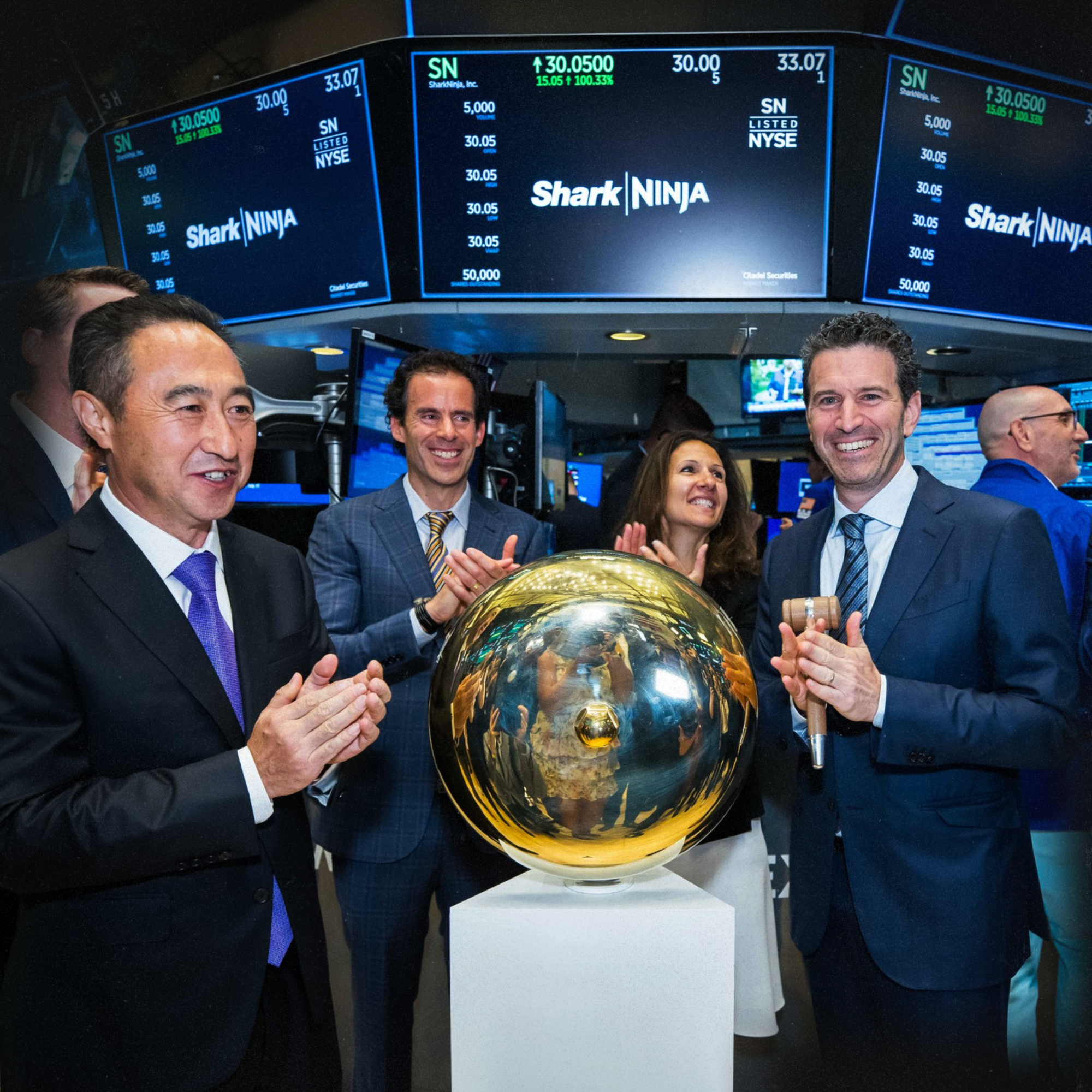
The August 2023 NYSE listing formalized that reality. SharkNinja separated as an independent public company, while maintaining commercial ties to JS Global through long-term distribution and sourcing agreements in Asia. CJ Xuning Wang remained a central figure in the company's structure, controlling roughly 48% of SharkNinja's outstanding shares and voting power by the time of the IPO, later reduced to approximately 40% by 2026.
SharkNinja went public at a $4.2B valuation, with Mark Barrocas continuing as CEO. During the years under the JS Global umbrella, the company had more than doubled its sales, expanded its category footprint, and extended its reach beyond North America. As a standalone entity, SharkNinja entered its next phase with two global brand portfolios and a product development organization that had repeatedly translated innovation into large-scale commercial successes.
Before we get into SharkNinja's blueprint for product commercial success, let's take a closer look at how the company positions itself in the market. By the time SharkNinja began scaling beyond its early categories, most of the spaces it targeted were already crowded. Consumers could buy blenders, hair dryers, air fryers, vacuums, ice cream makers, and countless other appliances at nearly any price point. In many cases, products handled the basic job, but rarely raised expectations around performance, design, or ease of use.
SharkNinja's strategy was to pair great product innovation with strong brand presentation, then price those products for broad reach. Instead of competing purely on low cost or sitting exclusively at the premium end, the company has consistently positioned itself in the mid-to-upper range. As SharkNinja put it in its 2024 annual report (sourced through Quartr Pro):
“We have succeeded in the marketplace by capitalizing on the sale of product offerings situated in the mid-price range, taking market share from competitors who sell products at price points above and below our own.”
At the lower end, SharkNinja competes with a wide field of established appliance brands and large-scale manufacturers. Many of these products are reliable and well-distributed, backed by decades of manufacturing experience. The challenge is rarely capability, but differentiation: improvements tend to be incremental, design ambition is constrained by broad portfolios or tight price bands, and marketing lacks the mandate and reach to translate product performance into broad consumer demand.
The most relevant reference point at the high, premium end is Dyson. Founded by James Dyson in 1991, the company was built around a commitment to engineering-led product development. Over time, its focus on core technologies in airflow, motors, and filtration redefined the upper end of categories such as vacuum cleaners, fans, and hair care. Today, Dyson is widely treated as the performance benchmark in these categories. One part of Dyson's legacy is demonstrating that many consumers were, in fact, willing to pay considerably higher prices when performance improvements are unquestionable – even in appliance categories long treated as utilitarian.
That realization helped widen the space between generic functionality and premium positioning across these categories. SharkNinja's opportunity emerged within that gap. Rather than pursuing the highest price points, the company focused on delivering performance and design that felt and performed like premium while remaining accessible. As the company noted in its 2023 F-1 registration filing:
“Those consumers who seek products with premium positioning often realize they can receive similar, or even better, performance at much better value with SharkNinja.”
You can see that positioning in how consumers talk about many of its products. On TikTok and YouTube, Shark devices are frequently compared head-to-head with Dyson – from the Airwrap versus FlexStyle to vacuum matchups like the V15 versus the PowerDetect Cordless – where the appeal lies in achieving similar outcomes at roughly half the price.
At SharkNinja, problem-solving is in our DNA.— Mark Barrocas
A defining feature of SharkNinja's identity is the internal system behind its product launches. The process begins with what the company calls “always-on consumer insights.” Using proprietary software, SharkNinja continuously analyzes product reviews and ratings across platforms to surface recurring pain points and unmet needs. CEO Mark Barrocas described this approach at the Goldman Sachs 30th Annual Global Retailing Conference 2023:
“I think we have a really unique consumer insights model, the ability to be able to mine consumer feedback, both in the home through social media, through reviews and kind of identify real consumer problems that exist, that might not have been apparent to others or even to the consumer sometimes. I mean these are known or unknown consumer problems.”
These insights inform incremental improvements to existing products, extensions within a category, or the development of entirely new category entries. From there, priorities flow into SharkNinja's product design and R&D organization. Approximately 10% of the workforce is dedicated to engineering and design across five innovation centers in the United States, the United Kingdom, and China. This structure keeps teams close to key consumer markets and shortens the feedback loop between insight, design, and iteration.
Engineering teams are organized by product category and core functional disciplines. With multiple workstreams running independently and at different stages, focus varies across teams. Some groups explore new categories two to three years out, others concentrate on launches within the next 12 months, while dedicated teams continuously optimize products already on shelves.
Beyond that singular focus, SharkNinja encourages engineers to rotate between product categories and geographies. This cross-functional approach supports what the company refers to as an “idea-generation machine,” enabling technologies and design approaches to move across the portfolio. Product development is further supported by a “tremendous amount of outside experts,” as explained by Mark Barrocas on a 2025 episode of Decoder with Nilay Patel:
“That's something that I don't want to underestimate because at a lot of engineering companies, engineers feel like, 'Hold on, you hired me to solve it, so I have to solve it.' We're sitting here saying, 'At the end of the day, we want the consumer to open up the box and enjoy the product.' The consumer doesn't care whether you made 100 percent of the product internally or whether you brought in five subject matter experts to help. We do a really incredible job of getting the best and brightest people to help us solve these problems.”
Once a concept reaches the prototype stage and a design direction is set, products enter what SharkNinja calls “dynamic testing.” Testing is both quantitative and qualitative, and intentionally rigorous, with products evaluated under extreme conditions to ensure consistent performance and long-term reliability once in the hands of actual consumers. Depending on the category, products move through labs, simulated home environments, professional settings such as restaurants or salons, and thousands of consumer households. By the time a product approaches manufacturing, it has already been tested extensively with end users. The company's 2023 F-1 described the scope of this process:
“Before the launch of our first hair dryer product in 2021, Shark HyperAIR, we conducted extensive market research and product testing with over 12,000 unique consumers across the globe and we also tested the product in 35 salons to gather feedback from professionals. Constant qualitative and quantitative testing with real consumers informs every stage of our design, engineering, manufacturing and marketing processes, even during late-stage development and product release.”
After final internal approval, SharkNinja brings its supplier and factory partners into the process. The company works with long-standing third-party manufacturers, primarily in China, alongside suppliers across several Southeast Asian countries. At this stage, differentiated designs and technologies are typically protected through the company's intellectual property portfolio. As a part of disruptive innovation, SharkNinja has extensive intellectual property spanning thousands of issued patents and pending applications globally, as well as trademarks, copyrights, trade secrets, and contractual protections.
During manufacturing, SharkNinja maintains on-the-ground teams to oversee daily production and quality control. Supplier agreements are designed for flexibility, with purchase orders typically finalized about 30 days before cargo-ready dates, enabling late-stage changes without restarting the process. This is a key feature of the company's culture, built around a "fail fast, learn, pivot, and move on" philosophy.
The timeline of the aforementioned process, from idea to final manufacturing stages and eventually market, understandably varies significantly across SharkNinja's launches. Simple line extensions can reach the market within a year, while more complex products, particularly those requiring new technologies, follow longer development paths. As products approach launch, marketing shifts from informing product decisions to shaping demand. While marketing is embedded throughout development via consumer insights and testing, its role intensifies as products move toward market introduction.
Product innovation is a critical pillar of our business but equally important is great storytelling and creating consumer demand.— Mark Barrocas
While product development sets the foundation, SharkNinja's marketing organization plays a central role in translating innovation into commercial momentum. More than 10% of the company's workforce is dedicated to marketing across geographies and product categories, operating across multiple channels. The company's marketing efforts still include long-form infomercials, but also short-form commercials, organic and paid social media, influencer and celebrity partnerships, and in-store marketing.
Marketing is embedded throughout the development process, with consumer insights and testing helping shape product features and positioning from early stages. But as products move onto store shelves, marketing becomes a decisive factor in determining the trajectory of a launch. Importantly, that work intensifies well before release. As Mark Barrocas explained on the company's Q1 2025 earnings call:
“We're seeding influencers with our products before launch. So they're already going out and they're already teasing the products. I mean Swirl was a great example. We brought about 15, 20 really strong CREAMi influencers behind the scenes. We let them use the product for 30 days. We let them develop content, and they were already seeding content two weeks before the product was launching into the market. So it was already starting to build excitement and awareness for the product before we even launched.”
In the case of the Ninja CREAMi Swirl, that approach translated into roughly 70 million social media impressions and a waitlist of 90,000 people, with initial sales flowing through the company's DTC channel. Beyond demand generation, this early engagement ties back to SharkNinja's broader feedback loop. By working closely with highly engaged users and incorporating their input, the company reduces launch risk and strengthens retailer confidence ahead of wider distribution. That same dynamic often turns early adopters into self-directed brand advocates, as Barrocas described at the Q4 2024 earnings call:
“I mean we had influencers that we sent the CREAMi Swirl to, they committed to us that they would do one TikTok, one Instagram post or one YouTube Shorts and they came back and they did 15 of them, 16 of them. I mean these influencers are recognizing that they're able to build their follower base using our products, [...] we're actually, in some cases, not investing monetarily but we're giving them a head start or we're giving them a sneak peek, we're giving them a behind-the-scenes view. And that is very, very valuable to them in terms of being able to develop content that engages their communities.”
As these examples illustrate, social media has become an increasingly important extension of SharkNinja's marketing approach. By engaging consumers across platforms such as TikTok, Instagram, YouTube, and others, the company has been able to scale awareness quickly and cross borders with relatively little incremental spend. One effect of this organic spread is a lower cost of customer acquisition, as Mark Barrocas explained at the Goldman Sachs 31st Annual Global Retailing Conference 2024:
“So this is an interesting fact. I mean, over the course of the last few months, 99.5% of the content that is on TikTok or Instagram for the Ninja CREAMi has nothing to do with SharkNinja. Nothing to do with SharkNinja. These are consumers that just went, bought the product, made the recipes and want to tell all their friends around the world, the great recipes that they've made and what they've done with the product.
So there's an incredible like flywheel that's able to be created that as we get lots of units out into the market, consumers then hack our products, they kind of turn them into what they want. And then they go and they use things like social media, and it's not just Instagram and TikTok, it's Pinterest, it's Reddit, it's YouTube.”
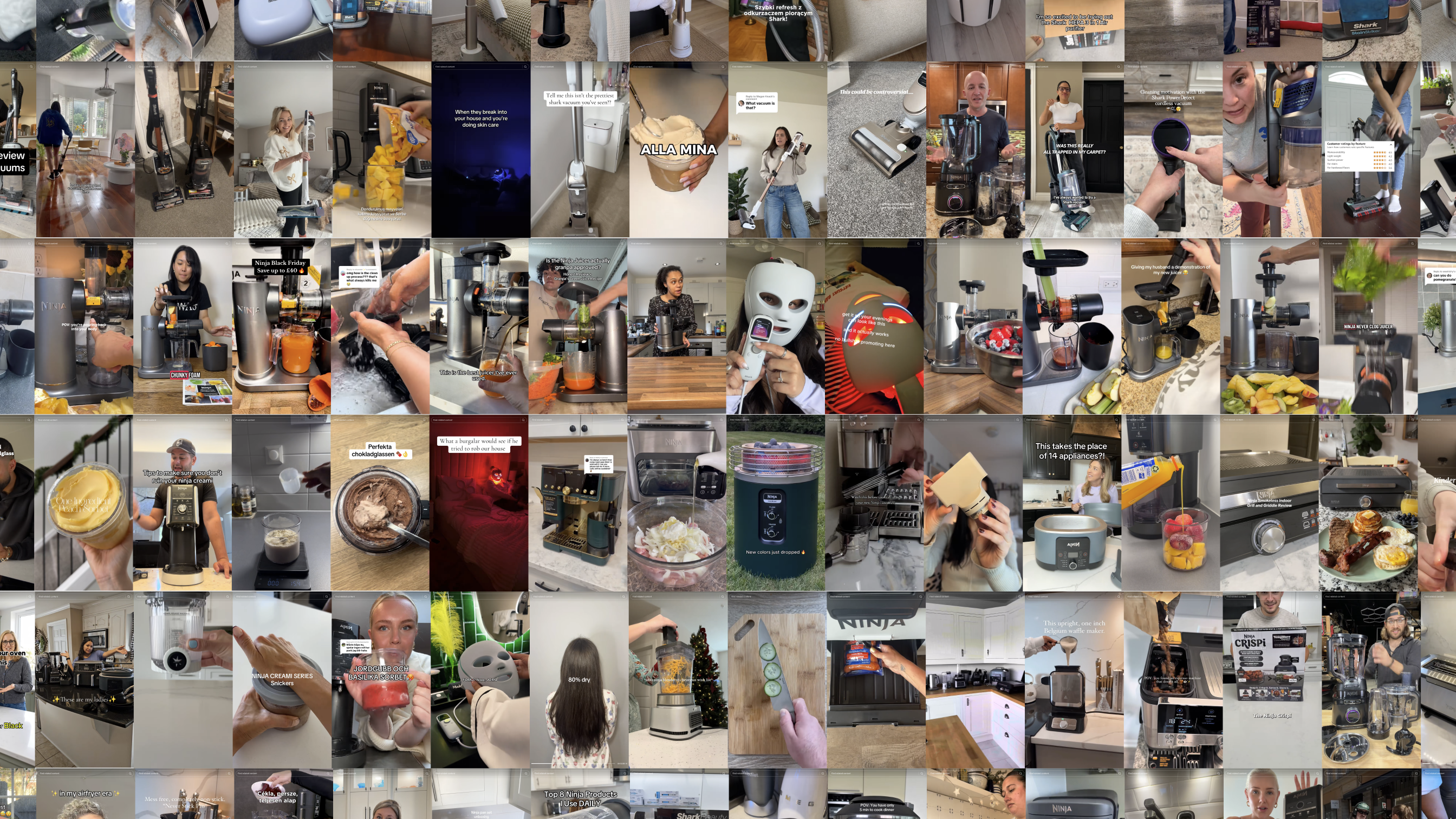
With two brands spanning dozens of categories and hundreds of products, SharkNinja does not rely on a single marketing playbook. Influencer-led pre-launch seeding is most effective in highly visual, social-native categories such as kitchen appliances and beauty, where use cases translate easily into short-form content. In contrast, categories like floor care and home environment, where purchasing decisions are driven by durability, performance, and long-term value, lean more heavily on retail execution, in-store demonstration, and clear communication of functional benefits.
Creating an innovative product and making it a commercial success stops at that singular milestone for many companies. But at SharkNinja, commercial success is the endpoint of a systematic process, refined over years, and remains central to the daily operations. The result is a self-reinforcing cycle of customer acquisition and cross-selling.
“This combination of best-in-class product innovation and world-class brand storytelling is not easily replicable. It's not just about launching a great product. It's about creating an ecosystem of demand that compels consumers to seek out our products at their preferred destinations.”
– Mark Barrocas, at SharkNinja's Q4 2024 earnings call (sourced through Quartr Pro).
Even after a Shark or Ninja product reaches the market, the company's product development does not slow down. SharkNinja's “fail fast, learn, pivot, and move on” philosophy extends well beyond launch, with hardware development treated more like software: iterative, continuous, and without a fixed endpoint. Teams test improvements, evaluate consumer feedback, and refine products to maintain performance and ratings over time. That operating emphasis is embedded across the organization and enforced at the executive level. Mark Barrocas expanded on this at the Morgan Stanley Global Consumer & Retail Conference 2025:
“I think SharkNinja goes through exhaustive detail that many other companies would just find exhausting, okay? I mean we have an initiative that takes place every week that we spend 5 hours on, which is a meeting called Obsessed With Winning. I mean we go through every single subcategory in every market, and all of our executives kind of sit through that meeting. I think you might look at other companies, you might say, like, 'Do you do that once?' No, we do that every single week. Like, every week, we do that. And I think that kind of maniacal focus on the details is what's needed.”
After launch, consumer feedback is a permanent input stream. Insights are collected from call centers, product reviews, returns data, and social media discussions, then evaluated centrally and routed back into engineering, design, and commercial teams. Eventual refinements span everything from component sourcing and design optimization to packaging, accessories, and firmware.
This discipline helps explain the longevity of many SharkNinja franchises. Ongoing iteration extends product life cycles and helps protect shelf positions that might otherwise erode as competitors introduce newer models. A large share of the company's early products remain in production today, including legacy products such as the Shark Navigator Lift-Away, introduced in 2010, and the Ninja Mega Kitchen System, introduced in 2012, both of which continue to see strong demand.
Iteration can also lead to category-defining follow-on products, as was the case with the Ninja Crispi air fryer. After years of operating in the air-frying category, SharkNinja had accumulated detailed insight into persistent sources of consumer friction, including material safety concerns, space constraints in modern kitchens, and the limitations of fixed, single-purpose air fryer designs. Those learnings informed a shift in product format in 2024, rather than an incremental update. As Barrocas explained at the company's Q2 2025 earnings call:
“Our leading position in this market presents a new challenge to solve, figuring out how to grow even bigger. This is where SharkNinja shines. The portable glass system Crispi revolutionizes air fryer cooking. With this innovation, we're capturing new consumers into the market and even seeing existing consumers retiring their legacy air fryers to upgrade. Excitement for this product is a global phenomenon.”
At SharkNinja, the idea that “each day we are gaining loyal consumers or losing frustrated ones” shapes a “manically consumer focused” approach to post-launch evaluation. In a highly competitive appliance market, that mindset shapes how the portfolio evolves. Products that fail to meet consumer expectations are improved quickly or removed altogether. New products continue to launch, but for those that succeed, development remains ongoing.
At SharkNinja, we're obsessed with winning.— Mark Barrocas
From the innovation process described earlier, SharkNinja has built a broad portfolio. As of early 2026, the company is present in 38 subcategories organized under four major product categories and two distinct brand architectures. That product portfolio generated $6.1B in revenue on a trailing twelve-month basis as of Q3 2025.
The total is distributed across product categories with significant contributions from each. Under the Shark brand, Cleaning Appliances and Beauty and Home Environment represent 36% and 12% respectively, while Ninja's Cooking and Beverage Appliances and Food Preparation Appliances account for 29% and 24%, respectively.
SharkNinja's breadth across categories also carries important strategic value. Its positioning in the mid- to upper tier of the market allows it to compete across multiple price points while maintaining clear upgrade paths within each category. Rather than compromising on quality, the company targets different consumer segments by offering products at various price levels within the same category.
)
At first glance, the portfolio can appear too wide-ranging, spanning everything from robotic vacuums and outdoor grills to hair styling tools and frozen drink makers. But as you know by now, these expansions are highly intentional. Each product is designed to address specific consumer problems in categories where SharkNinja believes it can apply differentiated technology and deliver clear value.
The value SharkNinja can bring and the opportunity it sees vary by category. In some cases, the company enters markets where consumer demand exists in theory, but expectations are low due to poor historical solutions. That was the case with its entry into the home ice cream maker market in 2021. At the time, the U.S. category generated roughly $53M in annual sales, constrained by products that failed to deliver consistent results and, therefore, limited consumer expectations. Following the launch of the Ninja CREAMi, the product alone generated $78M in sales in its first full year in 2022, and nearly doubled that figure in 2023.
In other cases, SharkNinja enters highly competitive markets where consumer demand is already well established, but differentiation is limited. Its entry into beauty in late 2021, with the Shark HyperAIR hair dryer, is a great example. Roughly four years later, SharkNinja has expanded that initial entry into a standalone beauty and home environment portfolio, effectively earning it a distinct product category within the company and growing it to approximately $700M in trailing twelve-month sales by Q3 2025.
While the rationale for entering each category may differ, the pattern that follows is consistent: SharkNinja establishes a differentiated entry point, then expands outward through successive product releases and adjacent use cases. Initial launches are treated as platforms rather than endpoints, allowing the company to serve a wider set of consumer needs over time.
As the organization has scaled, SharkNinja has built a broader base of technical competencies that can be applied across categories. Capabilities developed around motors, airflow management, thermal control, and power electronics have been used across multiple product lines. When Shark entered hair care, it drew on its experience in air-movement and motor design from vacuums, adapting those capabilities to the requirements of personal care. That broad level of competency will continue opening opportunities in the future, as Mark Barrocas noted at the Morgan Stanley Global Consumer & Retail Conference 2025:
“... there's lots of other places for us to explore from a beauty tech perspective. I mean we have LED technology competency. We have medical device development competency now. We have Peltier technology, having heating and cooling technology. There are so many other places to go. Could we go into the scalp? Could we go into nails? Could we go into other places within beauty?”
This capability base supports its continuous expansion. Over each of the past three years, SharkNinja has launched approximately 25 new products annually, including entries into at least two new categories. The company has confirmed its intention to maintain that pace in 2026, supported by a product pipeline that extends several years into the future. Despite that ambition, and the steady pace of new product launches, SharkNinja applies a high bar when evaluating new opportunities. SharkNinja CEO Mark Barrocas elaborated on this at the 2025 episode of Decoder with Nilay Patel:
“We set a very high bar on that within the company. There have been categories that we worked on for 10 years and never brought a product to market because, ultimately, we came to the conclusion that the consumer and world don't need us. So, being anchored on this beacon and asking what gives us the right to be in the category has led us very methodically to the next opportunity and the next opportunity and the next opportunity.”
That discipline translates into strong consumer demand across both the Shark and Ninja portfolios. As the brands become established across categories, retailers and e-commerce platforms allocate premium shelf space and first-page placement, while organic demand increasingly supports scale without proportional increases in marketing spend.
The global consumer appliance industry is not typically associated with sustained, outsized performance. But from 2020, SharkNinja has increased revenue from $2.8B to $6.1B in Q3 2025 on a trailing twelve-month basis, representing a CAGR of roughly 17%. While the Shark Cleaning product category, which captured significant U.S. market share more than a decade ago, has grown more slowly, the company's other three product categories continue to expand at a strong pace.
)
While SharkNinja does not disclose product-level revenue, it has provided insight into the mix between newer and established products. As outlined earlier, in 2022, approximately 25% of revenue came from products launched that year or the year before. Given the company's sustained pace of roughly 25 product launches annually – and the growth of the overall revenue base since then – that share has likely moderated as newer launches represent a smaller portion of an increasingly large portfolio.
Taken together, this mix highlights an important dynamic. While successful launches and moments of virality matter, SharkNinja's growth is not reliant on constant new products. Across a portfolio spanning 38 categories and hundreds of products, many of which were introduced more than a decade ago, the company has built a durable base that supports continued expansion across categories and markets.
At the same time, newer categories have demonstrated how quickly SharkNinja can succeed in scale. The Beauty and Home Environment product category illustrates that most clearly, where both directions within the segment were uncharted territory as recently as 2021. Yet the category has grown from approximately $117M in revenue in 2022 to around $700M in trailing twelve-month revenue by Q3 2025, representing roughly 12% of the company's total.
Since 2020, SharkNinja's EBIT has increased from $465M to $782M on a trailing twelve-month basis as of Q3 2025, representing a CAGR of roughly 11%. The divergence relative to revenue growth reflects the company's focus on reinvestment to extend growth and continue capturing market share.
)
One of the clearest expressions of that approach is its R&D spending. Over the past five years, SharkNinja has consistently invested approximately 6% of its revenue in R&D. As revenue has more than doubled during that period, R&D spending has risen substantially in absolute terms. The persistence of that ratio shows how innovation, iteration, and a “manically consumer-focused” approach remain priorities, despite the portfolio's expansion across categories and use cases.
A similar pattern is evident in marketing. Advertising spend as a percentage of sales has increased from 9.2% to 10.6% between 2020 and 2024, highlighting the central role that demand creation plays in SharkNinja's strategy. Mark Barrocas expanded on that commitment as a differentiator at the Goldman Sachs 32nd Annual Global Retailing Conference 2025:
“I mean, we spend over 11% of sales on advertising. And so if you think about companies that have margins in the low 30s, it would be very hard for them to spend that kind of money. So I think there's a competitive moat just in terms of our gross margin level and the amount of money that we're able to invest in advertising and creating consumer demand.”
Since 2022, SharkNinja has improved its gross margin from 38.9% to 48.8%, driven by a set of structural changes that management believes remain durable going forward. One part of that durability comes from the long lifetime of many of its products, allowing for cost optimization over time. In its manufacturing operations, SharkNinja works closely with suppliers to systematically remove cost from production each year. At the same time, consistently higher volumes across the portfolio have improved fixed-cost absorption. These efforts enable established products to remain competitive even against lower-priced alternatives, supporting margin expansion without sacrificing value.
Another part of the margin story relates to changes in the sales channel mix. Retailers have always played a central role in SharkNinja's history. Amazon remains its primary e-commerce channel, while brick-and-mortar chains such as Walmart and Costco form the backbone of its in-store retail presence. Each of these three accounts for more than 10% of sales, and together they represented 46% of the total in 2024.
However, SharkNinja's DTC channel, where it generates a higher gross margin, has grown in importance in recent years. Management continues to view DTC as “a really viable growth channel that will grow even faster than our retail business over the course of the next couple of years.” Mark Barrocas expanded on the opportunity at the company's Q4 2024 earnings call:
“Launching our products on direct-to-consumer allows us to kind of control the distribution early on. It allows us to get immediate feedback from consumers as they start using the product. So I think you should expect to see the first 30 to 45 days of many of these big viral product launches to be done through direct-to-consumer and then to expand out into our retail partners. Now that said, I think what we're also recognizing is that there's a real opportunity for us to have a broader merchandising assortment in direct-to-consumer.”
Finally, the company has revisited its approach to pricing in recent years. Rather than setting prices by reference alone, it has reassessed where its products sit relative to what consumers are willing to pay. Mark Barrocas discussed the inspiration behind that shift at the Goldman Sachs 32nd Annual Global Retailing Conference 2025:
“I was listening to an acquired podcast on LVMH, and I was inspired by Arnault's view on companies don't know what they're able to actually sell their products for. And I remember listening to that on the weekend, and I pulled my team together on Monday, and I said, look, I mean, we're making some really disruptive viral products. I mean, are we truly getting paid the right amount for those products. I mean we don't want to move away from an extraordinary value to the consumer, but we also feel like maybe there's some price that we've left on the table, and we took prices up on a few products at that point.”
CFO Adam Quigley later provided a concrete example at the Morgan Stanley Global Consumer & Retail Conference 2025:
“SLUSHi is a great example of that, that launched a year ago at $280. Within 48 hours, it was at about $300, and we took another price increase in Q1. That was unrelated to tariffs. That was just a matter of what's the innovation worth to that consumer.”
SharkNinja organizes its growth around three interconnected pillars: expanding into new and adjacent categories, gaining share within existing categories, and extending its brands internationally. Together, these have allowed the company to scale across products, channels, and geographies without relying on a single growth engine. CEO Mark Barrocas described the importance of this strategic framework at the company's Q3 2025 earnings call:
“I believe the power of our 3-pillar growth strategy cannot be overstated. This balanced approach across new categories, existing category share gains and international expansion has enabled us to deliver 10 consecutive quarters of double-digit growth. Our diversification across products, distribution channels and geographies should only fortify our position as we move forward. While many view SharkNinja as a product and marketing company, we're fundamentally a company intently focused on execution and delivering results consistently across all areas of our business.”
As the first two pillars have been covered in detail earlier, what remains is its international expansion. Ever since the launch of the Shark Navigator in 2009, the company has built a dominant position in North America, turning both Shark and Ninja into established consumer brands across multiple categories. While expansion beyond North America began later, that growth has accelerated since. Before its IPO in 2022, North America accounted for 79% of total revenue. By 2024, that share had declined to 69%, driven by impressive international revenue growth of more than 40% per year.
That expansion, however, comes with materially higher upfront investment. As the company establishes itself in new regions, it often spends up to 25% of sales on advertising to build awareness and demand, well above the 6-7% range it targets in more mature markets. Management expects international expansion to remain a key growth driver across additional geographies. Barrocas summarized that view at the company's Q3 2025 earnings call:
“And I think we've kind of proven out that the model of disruptive consumer-focused product innovation and viral marketing that creates consumer demand is a global translatable strategy, and we're seeing that in countries around the world. [...] we're very focused on the path to getting to 50% of our business outside of the U.S., and that's kind of the short to midterm immediate target for us.”
“Fast-moving, uniquely innovative and steadfastly committed to marketing and demand generation.” As Mark Barrocas has described it, that combination is rare for any business, and particularly uncommon in consumer electronics. Embedded across its operating model, those priorities help explain why SharkNinja's legacy products remain relevant even as a new generation of products go viral.
Explore our platforms
Leading companies and financial institutions worldwide rely on Quartr to make better decisions faster.
Desktop
API
)
)
)