

Edge16 Oct 2026
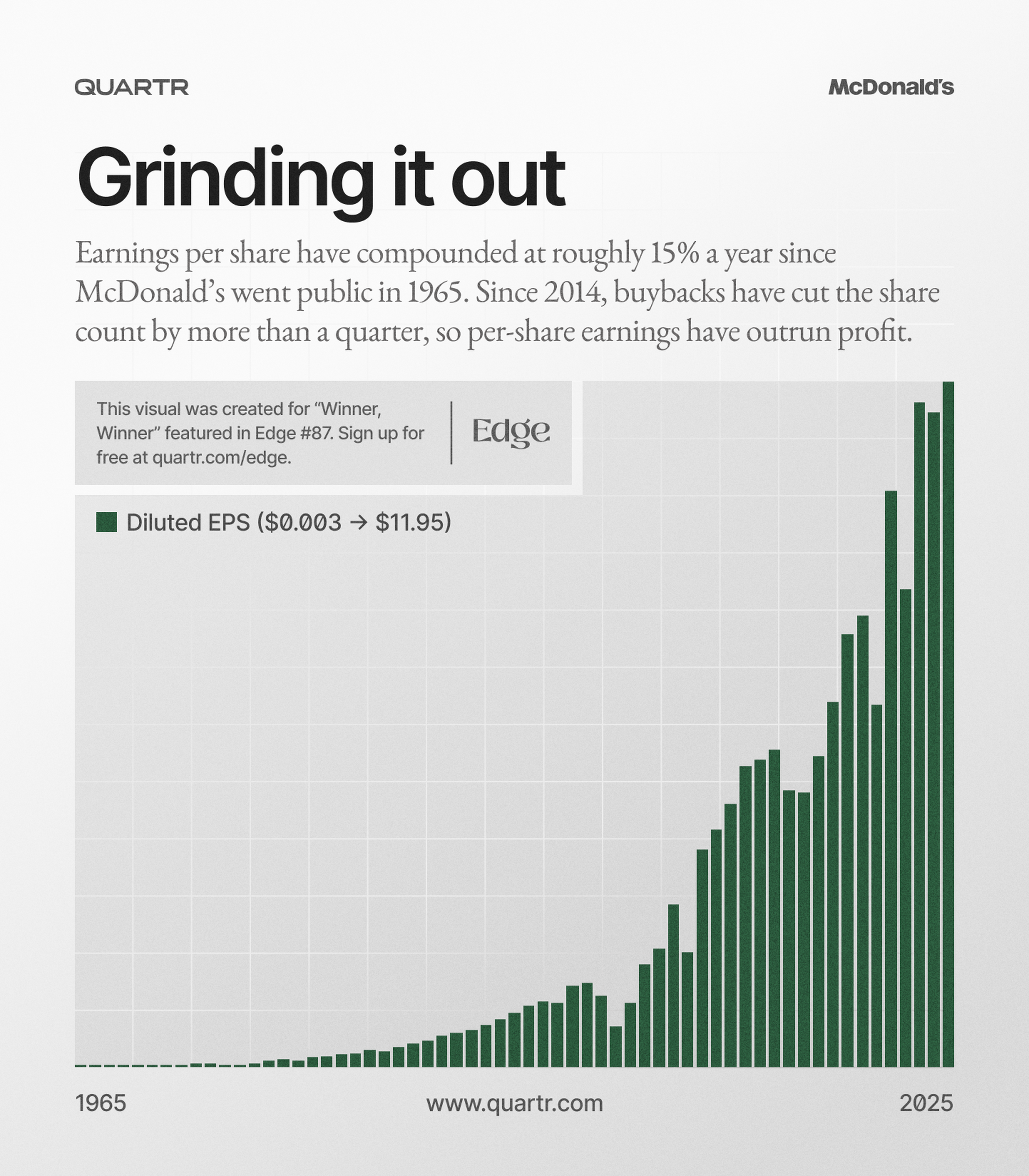
Winner, Winner: The Chicken McNugget Story
How a 1940s breeding contest, a Cornell food scientist, and a hedge by Ray Dalio helped McDonald's turn the Chicken McNugget into a fast-food icon.

Adjusted diluted EPS was $1.16, up 12% YoY, and adjusted ROTCE was 14.6%; reported diluted EPS was $0.56 after $0.60 per share of strategic-action impacts.
Client deposit growth, record wealth income, asset quality and expense discipline supported underlying results; loan runoff and delayed investment banking revenue weighed on performance.
Strategy prioritizes relationship-based banking and reallocating capital, talent and expenses toward core businesses to improve growth, profitability and shareholder returns.
Adjusted net income available to common shareholders was $1.423B; reported net income available to common shareholders was $684M, or $0.56 diluted EPS.
Adjusted revenue-TE was $5.304B, stable YoY and down 0.1% QoQ; reported revenue-TE was $3.791B, including $1.447B of AFS losses and $66M of RAC sale losses.
NII-TE was $3.707B, up 1.1% QoQ and 0.7% YoY; NIM-TE was 3.00%, up 2 bps QoQ and flat YoY.
Adjusted noninterest income rose 2.5% YoY; wealth management income reached a record $407M. Adjusted expenses were $3.065B, up 0.3% QoQ and 1.7% YoY.
Adjusted PPNR was $2.239B versus $686M reported; provision for credit losses was a $253M benefit, including RAC-related reserve recapture.
Q4 revenue-TE outlook is ~$5.35B; NII-TE outlook is $3.65B-$3.70B, including a $125M reduction from the RAC sale and a $40M benefit from AFS repositioning.
Q4 reported noninterest expense is expected to rise 2.5% QoQ; net charge-off ratio is forecast at ~0.45%, effective tax rate at ~13.5% and FTE tax rate at ~15.5%.
Q4 share repurchases assumed at ~$1B; guidance excludes potential additional strategic actions, including LightStream’s sale.
2026 average loan growth target remains 3%-4%, excluding RAC and LightStream sales; full-year commercial loan growth is expected in the mid-single digits.
ROTCE targets remain 15% for 2027 and 16%-18% long term; a detailed 2027 outlook and strategic review update are planned for January 2027.

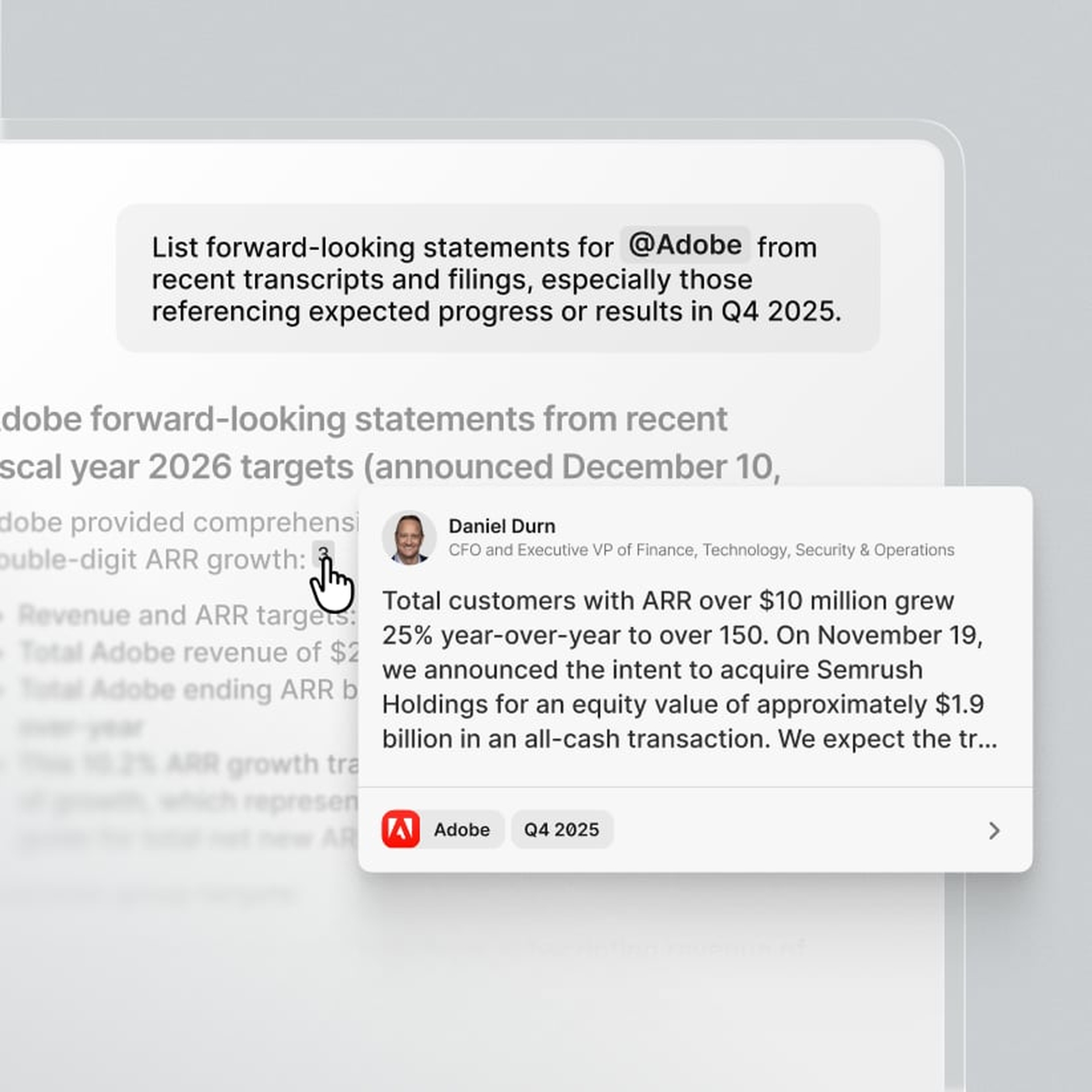
AI chat
Automations


Live audio & transcripts

Quartr's AI stands out because it only pulls clean, first-party data from public companies. In investing, that's everything.
Jamie Ross
Investment Manager, GAM Investments
Research that used to take hours now takes seconds with Quartr Pro. Tracking shifts in tone or extracting tables, it's as simple as typing a query.
Tom O'Hara
Investment Director
Before Quartr we spent hours manually compiling insights through the peer earnings cycle. Now, these tasks are done faster, with greater precision.
Gregg Lampf
VP of Investor Relations
Being able to ask specific questions across years of transcripts and reports and instantly get verified answers is a game-changer.
Pontus Dackmo
CEO & Investment Manager

Truist Financial Corporation is a major US bank holding company formed through the merger of BB&T and SunTrust in 2019. The company offers a range of financial services, including banking, lending, and wealth management.
One of the primary ways that Truist Financial generates revenue is through interest income. The company offers a range of banking products, including savings accounts, checking accounts, and loans, which generate interest income. Truist Financial also generates interest income through its investment portfolio, which includes a range of assets such as bonds, securities, and other financial instruments.
In addition to interest income, Truist Financial also generates revenue through fees and commissions. The company charges fees for a variety of banking services, including ATM usage, wire transfers, and overdraft protection. Truist Financial also earns commissions on investment products, such as mutual funds and insurance policies.
Truist Financial also generates revenue through investment banking services. They offer a wide range of services, including underwriting, mergers and acquisitions, and capital markets. Truist Financial works with a variety of clients, including corporations, governments, and institutional investors, to help them raise capital, execute strategic transactions, and manage risk. It is a market segment driven by fierce competition and they go up against giants such as Bank of America, JP Morgan, Goldman Sachs, Citigroup, and Barclays.